-->

Sunday, May 25, 2014

The Surprising Career of Andy Marte

My friend Bryce has written a couple of columns for me here and recently sought my thoughts on Cubs third-baseman Mike Olt. The 25 year-old is getting his first prolonged experience in the majors after the Cubs got him from the Rangers last trading deadline and is hitting .175/.254/.430 entering Saturday's action. The power is real (it's damn real) with nine homers out of 20 hits. But the strikeouts are plentiful and even "moneyball nerds" like myself can't put a good spin on those numbers.

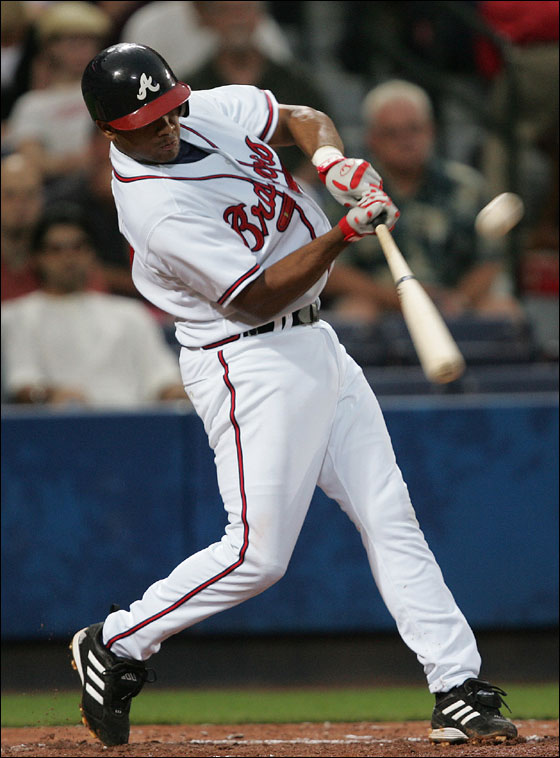
Looking at Olt's minor league numbers, I was briefly reminded of a former Braves third baseman who was a sure thing, but at the age of 30, is as quad-A as they come. Signed out of the Dominican Republic in September of 2000, Andy Marte was a big international free agent who the Braves were expecting huge things out of. It didn't take long for the Braves to think he would deliver on those expectations as, at 18, he slashed .281/.339/.492 at Macon in the South Atlantic League. You don't put up those kind of numbers against 20 year-old pitchers if you aren't special.

Credit: Boston.com
The season got him a top 40 spot in Baseball America's Top Prospect list entering 2003, where he posted an .840 OPS while battling the notorious wind in Myrtle Beach, along with the pitcher's parks that frequently aid the guy on the mound in the Carolina League. He was the 11th best prospect i baseball entering 2004, when injuries limited him to just 107 games in Greenville, but he still bashed 23 homers and slashed .269/.364/.525. The power was there, the plate discipline was there, and he was graded as a pretty good third baseman to boot. While he was not projected to hit .300, he was supposed to be good enough with the stick to bat in the .260's and with his plate discipline and power, that was All-Star worthy consideration at third.

Two problems. One, his swing was long and his bat speed suffered as a result. Two, the Braves already had Chipper Jones at third base. The Braves had tried left field with Chipper from 2002-to-2004 and the idea was scrapped, which was good news for Chipper. There was talk about moving Chipper to first, but Chipper either wasn't anxious to do so or the Braves simply gave up on the idea of moving old man Larry anywhere else.

In 2005, Marte got his first taste of AAA and hit .275/.372/.506 with 20 homers for Richmond. An injury to Chipper got Marte to the majors in June for his first cup of coffee, but he struggled and hit just .200 with a .600 OPS. He briefly got back for a little more than a week in July and was recalled in September with expanded rosters where he often finished off games at third to keep Chipper healthy. However, in 66 PA, he slashed just .140/.227/.211 with 13 K's, looking every bit of overmatched.

But that was okay. After all, he was only 21. He had his entire future ahead of him and looked like a sure thing. That career took a detour to Boston after the Braves traded Marte for Edgar Renteria, who had signed a big contract with the Red Sox and crashed during his only year with Boston. Renteria would replace the departing Rafael Furcal. The Red Sox were so kind to add money to the deal and the Braves were happy to turn a blocked prospect into a major league shortstop, especially one who was above average. In addition, after the 2005 season, Chipper had signed an extension. Marte's time in Boston lasted less than two months. Before spring training, the Sox sent Marte to the Indians in a deal where seven players changed cities, including most notably for the Red Sox, Coco Crisp.

For five years, Marte failed to stick in Cleveland and his production in the minors slipped. He OPS'd .773 in 96 games with Buffalo in 2006 and then .766 in 96 more games with the Bisons in 2007. At the majors, that OPS would look like a career year for Marte. In 302 games in the majors, all but 24 with the Indians, Marte slashed .218/.277/.358. It's not that he was striking out a lot. His career 19.2 K% is less than 2 points higher than the MLB average for the six years he was in the majors. He simply wasn't producing. Too many flyballs turned into outs and his plate discipline all but disappeared. His upper cut swing was producing far too many harmless outs and too few line drives or groundballs that found the outfield grass. He posted a 67 wRC+ over his career to go with a woeful .280 wOBA. Defensively, he was pretty average, though perhaps his UZR's would have looked better if he could have stayed in the lineup.

His highlight of 2010? He pitched a scoreless inning with a strikeout of Nick Swisher.

Arbitration-eligible for the first time after 2010, the Indians non-tendered Marte and his journey from system to system began. First stop was a year with Indianapolis in the Pirates system, where he hit just .202 with a putrid .606 OPS. After a year out of baseball, Marte caught on with the York Revolution of the Atlantic League to open 2013 and produced rather well with York, hitting .301 with an .893 OPS and 19 HR. The Angels figured he was worth a look and signed him for the remainder of 2013 and in 26 games for Salt Lake, Marte slashed .362/.398/.574, but didn't get a callup to the bigs.

This season, Marte is playing for Reno in the Arizona Diamondbacks organization. As of Saturday, the former top prospect is hitting .306/.358/.493. Reno has a team is hitting .291 so you take these numbers with a grain of salt.

Marte is the classic "can't miss, sure thing, once every ten years prospect" who falls so spectacularly on his face. Still only 30, there remains a chance Marte can get back to the majors, but the likelihood of Marte ever being a productive major league player is very small. You almost have to root for him because by all accounts, he seems like a strong worker and a good guy. But nice traits will never trump a long uppercut swing that can't keep up with the heat.

Random Prospect Sunday: Andry Ubiera

Last week, I brought back Random Prospect Sunday with Phil Gosselin. This week, we go to the mound with a young righthander from the Dominican Republic who could become the Braves' next big international star. Or not. That's the nature of prospects after all.

Andry Ubiera was born on May 22, 1993 out of San Pedro de Macoris. In Flushing that day, Dwight Gooden out-pitched John Smoltz as the Mets took down the Braves 6-1 with David Justice providing the only notable offense with his tenth homer of the season. Gooden homered off Smoltz and drove in three. Ugh.

Ubiera would sign ahead of the 2011 season, joining the Dominican Summer League squad that finish 34-35. He finished fifth on the team in innings with 50.2 while striking out a team-high 52. While teammate Mauricio Cabrera is the more well-known prospect, Ubiera was quickly a prospect to keep an eye on.

Credit: MILB.com
With experience under his belt, Ubiera made his state-side debut the following year, joining the GCL Braves for the 2012 campaign. He led the team in innings with 49, though his WHIP spiked to 1.45 largely because of a 9.9 H/9. The righthander also finished second on the team in strikeouts with 48.

In 2013, Ubiera briefly made his full-season debut, going 3.1 ING with 4 walks and 2 K's in a spot start for Rome, but spent the majority of the season with Danville. Again, he was far too hittable, though he struck out 51 in 53 innings. He would start this season with Rome, but after four rough starts that saw him give up 21 runs in 19 innings, Ubiera headed to Danville at the beginning of May to await their season.

Credit: MILB.com
From a scout's point-of-view, there is a lot to like about Ubiera. His velocity sticks in the 92-93 mph range with the ability to reach 95. He's developed a good looking curveball and that could make Ubiera a potential reliever out of the pen. If he can work a plus change-up into his repertoire, there is a chance he could play as a starter in the major leagues. But he's struggling with his control and consistency and too often seems to fall apart.

He turned 21 last Thursday so he has a lot of time to take his potential and turn it into results, but the minor league graveyard is full of high potential, low results guys. Still, if it begins to click, Ubiera has the profile to become a big prospect.

Saturday, May 24, 2014

1995 Reflections: Eugene Emeralds

Last Saturday, I started to look at the "Other" Braves teams of 1995, the season that brought a World Championship to Atlanta. I am moving up the ladder after opening with the Danville Braves and will head to the other coast to look at the Eugene Emeralds.

Wait, we had a team in Oregon? It didn't last long. The Braves experimented with the idea of a short-season A-ball team, largely built of college draftees. In 1995, the experiment began in Eugene and lasted four years before the Braves moved their short-season squad to Jamestown, New York, but after three years, they simply dropped the extra squad, pushing up Danville as the highest short-season team before the jump to full season ball in the South Atlantic League. The Eugene squad actually replaced the Idaho Falls Braves team that existed from 1986 to 1994. The Eugene Emeralds continue to play, most recently as an affiliate of the Padres.

Good advice. Cards used in this column credit to
http://www.tradingcarddb.com/
But back to 1995. Paul Runge took over the reigns for the first season in the Northwest League. Runge had managed Idaho Falls in 1993, Danville in 1994, and would head to Macon in 1996. He has managed 1459 games in the minors, all with the Braves, and currently serves as a minor league coordinator in the Astros organization.

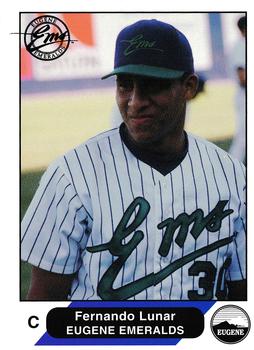
The Emeralds were led behind the plate by Mike Mahoney and Fernando Lunar. Mahoney was the better hitter, but the difference between the two was not great and both had sub .700 OPS. Mahoney would eventually get cut after the 1999 season, when he hit just .228 with Richmond. He caught on with the Cubs and made his major league debut with the Cubbies in 2000. He would stick around for the Cubs, making it back to the bigs for a 16 game run in 2002 and also played for the Cardinals in 2005, where he hit his only major league homer against Mark Prior. Lunar made it to the majors with the Braves in 2000, but was traded at the deadline to the Orioles as part of the package that brought B.J. Surhoff to the Braves. He played in 75 games with the Orioles, mostly in 2001, but appeared in his final game with the O's on April 11th, 2002. He would bang around the minors for awhile, even playing in six games for Mississippi in 2007 to close off his career. He did have a brief moment in the sun during his time with the Braves. On June 24th, 2000, Lunar was called for a "catcher's balk" while receiving a pitch from Greg Maddux where he set up behind the plate with a foot outside the catcher's box. In 363 games with the Braves, Maddux was called for just four balks.

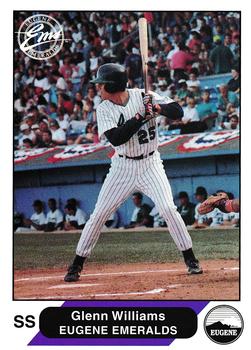
Wilt Person and Randy Hodges were the primary performers at first and second, but neither would be in the system by 1997. At third base, Brian Rust was a recent draftee from Lewis and Clark College out of Portland so he had to enjoy playing near to home. He would struggle, though he did hit 10 homers for Eugene the following season. Rust would catch on with the O's organization in 1999 and played three years for them, reaching AAA, but he never got a callup, finishing his career with a .785 OPS after 2001. At shortstop, Rob Sasser was a tenth rounder in 1993 by the Braves out of Oakland, CA. He was a slow riser, but after a brief run in Danville that I spoke of last week, Sasser headed to Eugene and was a solid everyday player for the Emeralds, slashing .269/.344/.444 with 9 HR and 14 steals. He struggled defensively as most minor league shortstops do. After a 1996 year with Macon that saw him hit .262 with 38 steals, the Angels selected him in the minor league Rule 5 draft. He wasn't there long before being used in a deal that sent Ken Hill to the Angels and Braves nemesis Jim Leyritz to the Rangers. In 1998, Sasser appeared in a 10-2 rout by the White Sox over the Rangers, hitting a popup in foul territory to former major leaguer Chad Kreuter. Sasser would play baseball until 2006, but never got back to the majors. Glenn Williams, the Australian prospect, slashed just .224/.291/.373 while playing mostly DH, though he did play a little short. Williams was ranked #76 by Baseball America before the season, but would continue a unspectacular career where he OPS'd .700 in 1260 minor league games before hanging it up after 2007.  He did have a nice cup of coffee in 2005 with the Twins, though, hitting .425 in 40 AB.

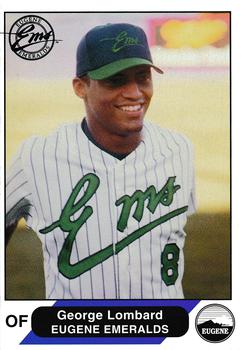
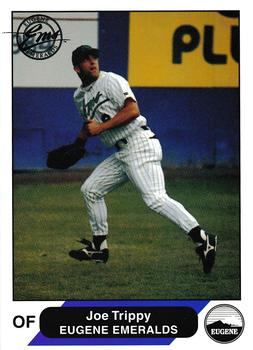
From left-to-right, the outfield was made up of George Lombard, Joe Trippy, and a platoon of Reymundo DeLeon and Roosevelt Brown. In the case of Lombard, the Braves had a five-tool prospect. A second rounder out of Lovett School in Atlanta, Lombard hit .252/.323/.351 with Eugene with 35 steals. When you add his 16 steals from Macon, Lombard finished the year with a personal best 51 steals. Lombard would climb the ladder, reaching the Baseball America Top 100 before 1997 with a high of the #26th best prospect in the game prior to 1999. However, he stagnated in AAA and injuries limited him to 32 games from the beginning of 2001 to mid-June of 2002. At that point, the Braves traded him to the Tigers. He would bounce around from there, playing for the Devil Rays, Red Sox, Nationals, Dodgers, Marlins, and Indians. He was a bust and played in just 144 games in the majors, half of which came for the Tigers after his trade in 2002. That version of the Tigers lost 106 games. Since returing after 2009, Lombard managed for two seasons in the Gulf Coast League for the Red Sox before being promoted to an outfield and baserunner coordinator in the Red Sox farm system.

Trippy was a northwest native and undrafted free agent with range and speed. He hit .309 and stole 29 bases for Eugene. He added 48 steals in 1996 and 34 in 1997 for Durham, but couldn't hit at AA and eventually tried his hand in independent ball before ending his playing career after 2001. His season with Eugene was the only year of DeLeon's playing career. He struck out 48 times in 127 at-bats and slashed .189/.268/.260. Roosevelt Brown, a native of Mississippi, was a 20th rounder back in 1993. He slashed a brilliant .309/.366/.558 with Eugene and was hitting .278 with 19 HR with the Macon Braves in 1996 before the Braves sent him to Marlins for Terry Pendleton. After 1997, the Cubs selected him in the minor league Rule 5. He hit well with them and made it to the majors in 1999 and would go on to appear in 228 games over four years with the Cubs, hitting .251/.311/.407. The Cubs cut him after 2002 and he went to Japan, hitting .291 with 43 HR in two years with Orix. He tried to make the Braves squad in 2005, but was a spring training cut as Ryan Langerhans beat him out for the last OF spot. After a season in the White Sox system, he retired and has been a hitting coach in the Braves system.

The top starters for the Emeralds included a famous name. John Rocker, a 1993 18th rounder, started 12 games for Eugene, though he didn't pitch very well (5.16 ERA, 1.37 WHIP).  Of course, he would go on to become a great reliever whose mouth got him into trouble, along with some injury issues. Charlie Cruz, a 13th rounder out of Florida State, was Eugene's best starter, striking out 90 in 81.1 ING to go with a 2.55 ERA and 1.28 WHIP. Cruz finished second in K's. Billy Blythe was historically awful in 1995. In 14 games, including 10 starts, Blythe gave up 55 runs, 41 earned, in 37.2 ING (9.80 ERA). He walked a league-leading 49 and struck out 24. He was equally wild the following season, walking 107 in 122.2 ING for Macon with 19 wild pitches. After injuries and ineffective play, Blythe was finally cut in 1999 after never making it beyond Macon.

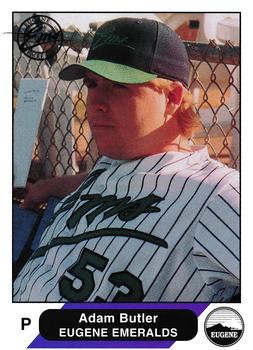
Future Brave Adam Butler was signed out of independent ball and led Eugene with 8 saves, which was three fewer than the league-lead, shared by Russ Ortiz (yep). He struck out a Kimbrel-like 50 in 25.1 ING. In 1996, the lefthander saved 30 at three different levels while nailing down 22 saves with Greenville in 1997. Butler broke camp in 1998 with the Braves, though after four games, he was demoted with a 33.75 ERA. In his final April game, he gave up a homer to future Brave, Rico Brogna. He would get a pair of callups and lowered his ERA to 10.80, but never got back to the bigs after 1998. He spent just more year in the Braves system and went back to independent ball. After 2001, he hung up the spikes. Another lefty, Antone Brooks, was stellar with the Emeralds, allowing just one earned run in 17 innings with 26 K's. He went to Macon the following season and again was very good with 101 K's in 80.1 ING to go with 10 saves. Unfortunately, injuries derailed a once promising career and after 2001, his time was done.

The Emeralds would finish 37-39, 11.5 games out of first.

Friday, May 23, 2014

One Weird Night Involving a Big Cat and Backup Catcher-Pitcher

The Braves open a series with the Rockies tonight and it made me recall one of my favorite Braves/Rockies matchups from the summer of 2000. Playing the middle of a three game series, the Braves were in a close divisional race with the Mets, a race they would win by one game. Colorado, under the stewardship of Buddy Bell, was trying to get back to .500 in a season they would finish with just two more victories than losses.

The pitching matchup saw John Burkett face Masato Yoshii. Burkett would be an All-Star the following season, but in 2000, he was pretty below-average, finishing with a 4.89 ERA and 1.59 WHIP. Yoshii sucked in his only year with Colorado and after two years in Montreal, his career state-side was over. He would back overseas and wasn't that good in Japan, either.

Atlanta's offense in 2000 was spearheaded by the rookie Rafael Furcal and by August, the Braves had also added B.J. Surhoff. In addition, former Rockie and cancer-survivor Andres Galarraga was producing quite well in his return to the bigs and has notably homered off his former team on opening day. The Rockies were led by Todd Helton, who was having an explosive season, with support from Jeffrey Hammonds and Jeff Cirillo. Even Juan Pierre was having a very productive season.

The Rockies built a 6-1 lead on the Braves by the end of the fourth, but the Braves battled back in the fifth. Enjoying his first big offensive year batting between Furcal and Chipper Jones, center fielder Andruw Jones homered with one out in the fifth. After a Chipper single, Surhoff doubled him in and scored on a Galarraga single. A lead is never safe in Coors Field.

In the seventh, the Braves completed the rally. Chipper homered off Mike DeJean and with two outs, Javy Lopez singled in Surhoff. It was probably a breaking ball knowing Lopez's uncanny ability to go down and get them.

Atlanta squandered a leadoff single by Chipper in the ninth. Foolishly, Surhoff bunted him to second and after Galarraga was walked, the rapidly declining Brian Jordan grounded into a twin-killing. Kerry Ligtenberg stranded the bases loaded in the ninth.

In the eleventh, things got nutty. With two outs, John Wasdin entered to face Galarraga. On a fullcount pitch, Wasdin hit Galarraga. It was probably not intentional, but according to reports, Wasdin gestured to Galarraga. While Galarraga has a well-known cheerful demeanor, nobody likes to get hit by a pitch and to get gestured at, even the mellow guys lose their composure. The Big Cat did just that, charging the mound and beginning a benches-clearing, extra innings brawl. Both players, along with Bell, were ejected and Bell was a little pissed off about it after the game. "If Galarraga's going to instigate, he's the one who should be thrown out of the game... What's Wasdin supposed to do? Run out into left field? It's unbelievable. Unbelievable."

Paul Bako replaced Galarraga at first as the last remaining position player the Braves had. In 789 games during a 12 year career, Bako played all of 1.2 innings at first base. All of that occurred because of an unlikely brawl. Scott Kamieniecki pitched a quiet 11th and tossed two perfect frames during the game.

Things got straight-up ridiculous in the 12th. Out of relievers after using eight guys after Yoshii was removed after five, the Rockies called upon Brent Mayne. A catcher by trade who played in over 1250 games in 15 years in the majors, Mayne was a reliable backup catcher. What he wasn't was a pitcher. We have seen many cases of position players pitching, typically in blowouts. Often, they pitched in high school or college and at least have some experience. How much experience did Mayne have? "I'd never been on the mound before in my life."

Advantage to the Braves, right? Tom Glavine hit for Kamieniecki, but he grounded back to Mayne, who quipped later, "He's a better hitter than I am a pitcher." Future Rockies manager Walt Weiss flew out to center. However, Furcal singled and suddenly, it looked like the Braves would get at least a run across, especially with the help of a wild pitch. Andruw worked a five pitch walk. However, as if he should be a current Brave, Chipper went up hacking and grounded out to third to end the 12th and strand a pair. Imagine that. A likely first-ballot Hall of Famer retired by a catcher making his first and only appearance as a pitcher.

John Rocker came in for the 12th, but Rocker was not sharp (and wasn't for the entirety of 2000...possibly because of backlash due to his idiotic comments to Sports Illustrated). He came up back-to-back singles, but after Hammonds lined out, Bobby Cox went with Stan Belinda. In Atlanta, Belinda's only claim to fame was that he served up the RBI single to Francisco Cabrera in Game Seven of the 1992 NLCS. In 2000, Belinda opened the season with the Rockies and had recently joined the Braves for a ten game run that was beyond ugly (1.91 WHIP). He would not pitch professionally again after 2000. In fact, he would only make three more appearances after this one.

Belinda struck out Terry Shumpert looking on three straight. With Cirillo up and Mayne on deck, the Braves chose to go after Mayne and walked Cirillo instead. The Rockies countered with Adam Melhuse, a third catcher who hit .234 in 735 AB at the major league level. On the first pitch, Melhuse singled to left, ending the game and making Mayne the first position player to win a ballgame since 1968. The last NL pitcher to do so? 1956. What made the moment even more odd was that Melhuse was 0-for-6 in his career with 3 K's.

The Rockies tied an NL record by using ten pitchers in the game while the Braves used all but three members of their 25-man roster in the game.

As the Braves open a three game weekend series with the Rockies tonight, here's hoping we don't get another odd one like we did on that August night in 2000. Actually, you know what, here's hoping we do. I don't remember the first or third games of that series, but that middle game is unforgettable for me.

(This original write-up from Sports Illustrated was incredibly helpful for this column.)

Do We Still Hate Ryan Doumit?

As Braves fans tend to do, the overreaction to Ryan Doumit's slow start were almost immediate. Doumit, who had OPS'd over .800 three times in his career (most recently in 2011, his last season in the NL), struggled to open the season with the Braves. After a strikeout in his only at-bat on May 9th against the Cubs, Doumit was slashing a miserable .171/.194/.366. I read from a few twitter folks about how Frank Wren screwed up by trading young southpaw Sean Gilmartin for Doumit.

It was a surprising move, though low-key, when the Braves picked up Doumit from the Twins last December. The Braves were set at every position Doumit played, or so everyone figured, and Doumit wasn't exactly gifted at any position defensively. He was a bad catcher (-16 DRS over 4000+ innings), a bad first baseman (short sample size, but it's awful), and a fairly weak corner outfielder. Why pay $3.5M for a guy who has typically been a starter and posted a .710 OPS last season?

Doumit, a former 2nd rounder in the 1999 draft, is a switch-hitter and in the National League, having that off the bench is important. While throughout his career, Doumit has hit for much more power against righties, he holds his own rather well against left-hand hitting pitchers, at least comparable to his production vs. righties. And that flexibility? Yeah, he's never going to make anyone think he is a stud at any of his four positions, but flexibility is valuable, especially on a NL bench. The ability, and experience, to catch from someone who isn't your primary backup catcher? That's unusual and a benefit for the Braves.

But his struggles made people overreact. "We could have Sean Gilmartin!"

Really?  We're upset about losing Sean Gilmartin? I get that he was a 1st rounder, but he wasn't exactly lighting up the board. Gilmartin posted a 1.22 WHIP over 157 innings during his first full season, playing for mostly Mississippi in 2012. He also got seven forgetful starts with Gwinnett and was already in AAA a year-and-a-half into his career. But there were warning signs. A 6.4 K/9 rate is hardly impressive, nor is a 0.9 HR/9. His control was very good, though.

An injury-savaged 2013 followed and when he wasn't on the shelf, he was struggling badly. Even if you gave Gilmartin a pass because of injuries, when he returned last August, he had a good outing, an okay outing, a bad outing, and an awful one that finished up the year (7 runs in 5 ING to Charlotte, a team that finished 13 games under .500). Gilmartin, during the 2013 spring training, was supposed to be the only real competition Julio Teheran would face as Teheran looked to cement his position with the staff (b the w, he did just that). By the end of 2013, Frank Wren and his scouts were ready to sell.

They had missed on a first round pick. Hard to know who may have been next on the Braves radar, but the Red Sox selected a fairly top prospect, Henry Owens, with the 36th pick later in the draft. The Braves could have stuck with Gilmartin, but his ceiling was lower than they had even projected when they drafted him. Velocity in the high 80's with a decent change of pace, a missing breaking ball, and good control. The Braves had Chuck James, version 2.0. And credit to the Braves, they are willing to move on from starters that don't cut the mustard.

So, rather than hope Gilmartin progressed into a bottom-of-the-rotation stalwart, Atlanta brought in Doumit, who signed a three-year deal with the Twins before 2012. The soon-to-be 33 year-old had the attributes teams like off the bench and was proven at this level.

But again, Doumit struggled to open the season and defensively, batters seemed to find him as he wandered aimlessly around the outfield. It was easy to get down on him. However, he's now 6 for his last 14 with a pair of pinch hit doubles and a pinch hit homer, to go with a two-run single that was the difference in Thursday night's come-from-behind win. Suddenly, those same detractors have gone silent. Their tweets non-existent.

To Gilmartin's credit, he has gotten off to a pretty decent start with New Britain in the Eastern League, including 46 K's in 47.2 ING. However, he remains very hittable and for a guy with 24 starts at AAA, pitching well at AA is hardly an achievement. He can't seem to crack a AAA pitching staff that includes former Brave cast-off Scott Diamond and, most recently, Mike Pelfrey. Meanwhile, the Braves have a solid bench guy who is hot right now. Not at AA, but in the bigs.

I'm feeling good about the trade myself. Yeah, Frank Wren's not perfect. But for every miss, there are five successful transactions. I believe this one is one of those five.

Thursday, May 22, 2014

A Better Win-Loss Record

The popularity of #killthewin was easy to understand and support. For too long, win-loss records have been cited as some kind of reflection of a pitcher's abilities. In 2010, Phil Hughes, the shining example of mediocre, finished 18-8 while Felix Hernandez, while posting a 2.27 ERA, finished 13-12. Hughes' New York Yankees finished with 95 wins while King Felix's Mariners won 61. Interestingly, at least to me, Hughes got the win in 19% of the Yankees' victories while Felix got the win in 21% of the Mariners' wins.

Last July, I wrote about this odd thing called "Gaz-Wall," or GSWL, or more specifically...Game Score Win-Loss record. I proposed this number as a replacement for the "win," something Brian Kenny was railing against daily on MLB Network.The basic idea was that using Game Score, a relatively simple statistic, you could get a better idea of how that pitcher actually pitched. Game Score is a readily available metric, often provided in boxscores with information on how many batters the pitcher faced and number of pitches. For a refresher on the subject, click here. Jeff Angus of SABR took Game Score, developed by Bill James, and turned it into a win-loss record.

It's not a perfect statistic. Like the traditional win, it can't be a direct correlation between pitching performance and what the number says. Defense and ballpark factors won't be neutralized. Nevertheless, I think the number does a good job of what numbers like FIP and wOBA attempt to do. Provide an easy-to-understand number that looks just like the flawed one it seeks to replace.

The Braves have used seven starters to this point and I would like to revisit Gaz-Wall with each of them to see where things are going so far.

Player GSWL # Tweeners Avg GS Tough L's Cheap W's Act W-L
Julio Teheran 8-2 1 64.2 2 0 3-3
Aaron Harang 8-1 1 57.7 2 0 4-4
Ervin Santana 5-3 2 56.2 0 1 4-2
Alex Wood 6-1 1 58.0 4 0 3-5
Mike Minor 3-1 1 51.5 1 0 2-2
David Hale 3-1 1 56.0 0 0 1-0
Gavin Floyd 2-1 2 54.0 1 0 0-1
As you might expect, the Braves have been blessed with starting pitching. To be in first place with such a troublesome offense that is second from the bottom, you need great starting pitching (and poor play from your divisional rivals). With that in mind, the Braves have managed just one cheap win, classified as a starter getting a victory with a Game Score of a 49 or less, compared to <b>ten</b> cheap loses (taking the L with a GS of 50 or better).  For the record, Baseball-Reference refers to cheap wins as a game where the pitcher gets the win despite pitching less than six innings and/or surrendering more than 3 ER. I think that's pretty broad myself and by the Game Score component instead.

Because of the poor offense, unlike teams that are front-runners despite average starting pitching because of a great offense, the Braves' starting rotation has a record of 16-17 with 12 no-decisions. However, they have a GSWL of 35-10. Now, clearly, that would be ridiculous and GSWL does not replace the actual team win-loss. It just attempts to attach a traditional win-loss record to the starters.

It should be noted that the team has experienced its fair share of weak starts lately, including yesterday's game where Santana gave up a small village of runs. Clearly, the Braves can't continue to experience such a high level of performance all season long. I mean, these guys aren't exactly Greg Maddux, Tom Glavine, and John Smoltz (though a few are pretty damn good). Fortunately, the offense had showed signs of production because I imagine if we look at these numbers later this season, things will have reverted back for the mean, especially for a guy like Harang.

I don't expect GSWL to catch on. With its flaws and need for an explanation, most will glossy over it. However, I do think it has some value when used in connection with other numbers (FIP, K/9, K/BB to name a few).

Tuesday, May 20, 2014

A Look Back: 2007 Draft

We're coming up on the June draft so now was a good time to dust off my series on looking back on recent drafts and seeing what players have made good on the Braves' investment and the many that have not.  So far, I have looked at five different drafts from 2008 to 2012. Today, my focus will be on the 2007 draft, a draft that yielded few major league talents, but the ones that it did were big. The 2007 draft followed a disappointing 2006, the season that ended The Streak as the Braves finished 79-83 and 18 games out of first.

As such, the Braves were picking during the first half of the draft for the first time since 1991. They also gained two picks after the Orioles signed Danys Baez, getting a supplemental first rounder (and 33rd overall) along with a second choice in the second round, the 69th overall pick. The Braves got little from those two picks, including a selection of Josh Fields with the additional second round pick. He did not sign, though. As I've done in previous articles, I will touch on the first ten rounds and any interesting players after that.

1. Jason Heyward, OF, Henry County High School (McDonough, GA)

Heyward was ranked the 9th best prospect by Baseball America heading into the draft and his upside was off the charts. According to the Braves, they had Heyward graded over first overall pick, David Price. So, how did he get to the 14th overall selection? His signing bonus demands were very high and some graded, and this is true, Heyward as a left-fielder/first baseman. Miami was a possible destination, but chose 3B Matt Dominguez. After the draft, the Braves signed Heyward to a $1.7M signing bonus and Heyward breezed through the minors, reaching Gwinnett in 2009 just after his 20th birthday. Before 2010, Baseball Prospectus ranked him the #2 prospect in the minors. Baseball America believed that was incorrect, ranking him the best prospect in baseball before 2010.

Heyward would homer in his first game and on-based .393 while finishing second in the Rookie of the Year race. A disappointing 2011 followed, wrecked by injuries, but Heyward appeared to break out in 2012 while hitting behind Michael Bourn. He slashed .269/.335/.479, hit 27 homers, stole 21 bases, and won his first well-deserved Gold Glove. Freak injuries limited him to 104 games last year and he certainly hasn't got off to a good start this season, but Heyward remains all of 24 years-old. There remains a lot of potential that the Braves need to help Heyward reach.

1s. Jon Gilmore, 3B, Iowa City High School

How many 3B were selected in the 2007 draft? 33rd overall pick, Gilmore, was the fifth of the first round. Two more would go before the end of the first. On the plus side, there was a typical midwestern body type for Gilmore with a lot of potential power. However, he was a very raw talent. He handled rookie-league ball well, hitting .317 in 110 games between the GCL and Appy Leagues, though he walked just 17 times and hit five homers. By the end of 2008, he was in Rome, where he hit .186 in 27 games to finish the year. After the season, he was traded to the White Sox as part of the Javier Vazquez deal. Gilmore stayed in the South Atlantic League for 2009 with Kannapolis and his .274 with a career-best 34 walks, but belted just five homers in 130 games. He spent 2010 int he Carolina League and hit .312 and again walked 34 times, but again hit just five homers. After a pair of injury-shorten seasons at AA where he slashed .242/.312/.341, Gilmore was cut after 2012 and has not played professional ball since. Amazing that a .285 hitter in the minors can't get a call, but a .699 OPS from third isn't desired all that much.

2. Freddie Freeman, 1B, El Modena High School (Orange, CA)

A young power hitter out of Carlifornia, Freeman was already 6'5" and 215 lbs when the Braves selected him and convinced him to sign over staying in-state at Cal State Fullerton. He played third base and pitched in high school, but was quickly moved across the field. Like Heyward, he was a quick riser, jumping onto the scene with a 2008 season at Rome where he slashed .316/.378/.521 with 33 2B and 18 homers. A down power year followed with just eight homers, but he got 18 more in 2010 and was a top-20 prospect heading in 2011 when he joined the major league squad. He spent the next three years progressing from a Rookie of the Year runner-up to placing fifth in the 2013 MVP race. This season, he's off to another good start and began the first year of an eight-year contract.

3. Brandon Hicks, SS, Texas A&M

Undrafted out of high school, Hicks was a junior college trasfer to Texas A&M in 2007 and slashed .338/.419/.536 with 21 doubles, 10 homers, and 28 steals while becoming a draftable prospect. Atlanta took him in the third round and gave him nearly $300K to sign. Expected to be a quick riser, Hicks homered seven times between Danville and Rome after he was drafted, posting an .897 OPS. He showed a three true outcomes profile in 2008 with Myrtle Beach, when he hit .234, walked 45 times, struck out 122 times, and hit 19 homers. His .815 OPS with the Pelicans made him an interesting prospect, but his numbers quickly trailed off and he was waived during spring training in 2012. He struggled to stick with Oakland, hitting .172 with 31 K's in 64 AB. After a year in the Mets system, Hicks caught on with the Giants this season and with injuries to Marco Scutaro, Hicks broke camp as the primary 2B. Again, he's a three true outcomes guy.  In 37 games coming into Monday, he hit just .195, but posted a .321 OBP and .415 SLG with the hlp of seven homers and 20 walks.

4. Cory Gearrin, RHP, Mercer University

The second pitcher and first signed, Gearrin was a college closer who nailed down 13 saves as a junior at Mercer with a 13.2 K/9. He joined Danville after the draft and would climb the line, mostly as a middle reliever (though he saved 17 with the Pelicans in 2009). The sidearmer got to the bigs in 2011 and while he K'd 25 in 18.1 ING, he got hit hard and walked 12. In 2012, Gearrin was much better, posting a 1.80 ERA in 20 innings. However, he struggled in 2013 and was sent to the minors, where he spent the remainder of 2013 on the injury report. Gearrin had a shot to make the roster this season, but Tommy John ended his season prematurly.

5. Dennis Dixon, OF/QB, University of Oregon

Before Dixon became a Heisman candidate at Oregon, he was a 20th round pick by the Reds in 2003. He ultimately did not sign and went to Oregon to play football. And not baseball. However, that didn't stop the Braves from wasting using a fifth round selection on Dixon, who hadn't played baseball since high school. Or when he was a 20th round selection. As part of his contract, Dixon would return to Oregon after his summer playing baseball. He hit just .176 in 28 games with two extra base hits. After returning to college, he had a great year with the Ducks, helping them to a 9-4 season. He was again a fifth round pick, this time by the Steelers, and he left baseball behind. In addition to Pittsburgh, Dixon has spent time with the Ravens and Bills. For funsies, other fifth round picks of the 2007 draft after Dixon...3B Will Middlebrooks and P's Marc Rzepczynski and Nate Jones. Not huge loses, but better than one year of rookie ball from Dixon.

6. Michael Fisher, SS, Georgia Tech

Another QB, Fisher stayed with baseball in college rather than play QB (and amazingly, no NFL team took him in the draft). Fisher was an athlete, though, and could switch-hit. However, his arm strength was in question on deep throws in short so his bat would have be tremendous. He hit .289 with a .361 OBP over 63 games split between Danville and Myrtle Beahc in 2007. Surprisingly, he went down to Rome and struggled to a .645 OPS in 2008 before hitting poorly for the Pelicans in 2009. Fisher was cut before 2010 and went home to study real estate, but the Mets eventually came calling. He would spent the next three seasons in the Mets systems, reaching AAA for 96 games, but Fisher never hit. He did pick up a save as a member of the St. Lucie Mets in 2010 so that's something.

7. Travis Jones, 2B, University of South Carolina

Another JuCo transfer, Jones started his post-high school career at Lake City Community College, where he was a 40th round pick by the Phillies in 2005. Instead, he eventually transferred to South Carolina and became a promising prospect at 2B. After signing, it did not take long for Jones to show plus power and on-base skills, slashing .259/.390/.472 at Danville and Rome with most of his time coming with the latter after signing with the team. He blasted 12 homers and hit 16 for Myrtle Beach the following season while adding 17 steals. However, his power bat was short-lived and he hit .249/.350/.355 with 5 HR the following season in 2009. More struggles followed and the Braves cut him in 2010. He hooked up on with New Jersey in the Canadian-American Association, but has been out of professional ball since.

8. Colby Shreve, RHP, College of Southern Nevada

The Braves selected Shreve with a high pick, but he never signed. He went in the sixth round for the Phillies, though Tommy John surgery kept him out of action until 2010. Shreve was finally cut after last season, having never made it to AAA.

9. Tim Ladd, LHP, Georgia Tech

At Tech, Ladd was a left-hand reliever, but not a closer. He did start six games as a junior, but generally was a set-up reliever and not a particularly good one for Georgia Tech. In 64.1 ING, Ladd gave up 83 hits, walked 25, and struck out 43 while ending his career with a 4.62 ERA. He would only pitch in 26 professional games after the Braves took him, starting three, and posting a 1.69 WHIP to go with his 5.00 ERA. All but four games were in a Danville uniform with a few weeks at Rome to close 2008. He hasn't played since.

10. Tommy Palica, LHP, Golden West College (Huntington Beach, CA)

A year after the Yankees spent a 32 rounder on Palica, the Braves came calling in the tenth round. Palica became a bit of a sleeper after a pair of seasons in 2008-2009 where he conquered A-ball while posting WHIP's of 1.14 and 1.30. However, he struggled in AA in 2010 and was cut before the 2011 season. He caught on with the Lincoln Saltdogs of the American Association and a month later, the Phillies came calling. He was awful for Clearwater after signing and after he was once again cut, Palica went back to Lincoln. His luck didn't improve, posting a 7.68 ERA in 2012 and retiring after the season.

Notable picks...

-The Braves nearly had another great 1B from this draft. They took Brandon Belt in the 11th round, but he did not sign. It was the second consecutive year Belt was picked in the 11th round after the Boston Red Sox selected him in 2006. He finally signed after the Giants picked him in the 5th round in 2009.

-24th round selection, right-hand pitcher Mitchell Harris, is an interesting case. Though he didn't sign and was selected in the 13th round by the Cardinals in 2008, he didn't make his debut until last season. Why? He was headed to the Navy after graduating from the Academy. He was denied release in 2012, but was finally released from the military last season and debuted in A ball. He's now in AA and you have to hope he produces.

-A few picks didn't sign, but were re-drafted the following year and joined the system. 27th round selection Adam Milligan finally signed after being a 2008 sixth rounder.  33rd-rounder Craig Kimbrel also signed the following year. Luckily enough.

-Righty Ryan Chaffee, a 43rd round pick, didn't sign and was a 3rd rounder by the Angels in 2008. He's still plugging along in the Angels system, currently with the Salt Lake Bees as a teammate of former Brave Cory Rasmus.

-Finally, one of the most interesting players from the 2007 draft is Benino Pruneda. A diminutive left-hander out of San Jacinto College, Pruneda went in the 31st round and was a potential fast-rising reliever. He struck out 73 in 57.1 ING with the 2008 Rome Braves and K'd 93 in 64.2 ING between the 2010 Myrtle Beach Pelicans and Mississippi Braves. He repeated Mississippi in 2011, striking out 71, but walking a career-worst 40 in 64.1 ING. He was a Baseball America Top 30 prospect entering 2012, but Tommy John surgery killed his 2012 and the following season. Before the injury, his fastball reached 103 mph. He just made it back, making his return on May 1st with Lynchburg and has appeared in six games, striking out 13 and walking five in 9.1 ING. Someone to follow and believe in.

For more reviews on the draft, click any of the following links. 2012, 2011, 2010, 2009, 2008