-->
Showing posts with label McCann. Show all posts

Saturday, July 29, 2017

TOT - The OTHER Teixeira Deal

Chris J. Nelson (CC SA 3.0), via Wikipedia Commons
Transaction of Today...July 29, 2008 - The Atlanta Braves traded Mark Teixeira to the Los Angeles Angels of Anaheim for Stephen Marek (minors) and Casey Kotchman.

It was the moment that the Braves resigned themselves to admit that their swing-for-the-fence effort the previous July failed. On this day nine years ago, the Braves sent the dynamic first baseman, Mark Teixeira, to the Angels for a pitifully small package of talent considering what they had themselves paid a year before. It would be one of the few and final mistakes for a general manager who tried desperately to squeeze one final contending effort from his squad. John Schuerholz, who will be enshrined in the Hall of Fame tomorrow, overestimated the need for the Atlanta Braves. Fortunately for Atlanta, he was right more times than he was wrong during his 15+ years at the helm.

Let's flash back to 2007 because we simply can't tell this story otherwise. On July 29th, the Braves beat the Arizona Diamondbacks 14-0 behind seven wonderful innings from Tim Hudson, homers by Andruw Jones and Scott Thorman, and a five-RBI day from Chipper Jones. Thorman and Chipper Jones were joined by Edgar Renteria and Kelly Johnson up the middle on the infield. Meanwhile, Andruw Jones was flanked by Jeff Francoeur and a productive platoon of Matt Diaz and Willie Harris in left. Add in Brian McCann behind the plate and the offense was pretty darn good. Well, with the exception of Thorman and Andruw, who again both hit homers that day. The centerfielder from Curacao was coming off a five-year sample where he slashed .266/.352/.524 with nearly 200 homers. This included his 2005 near-MVP season. However, things just never got going for Jones in '07 and he hit an abysmal .222/.311/.413. It would be the beginning of the end for him.

Meanwhile, Thorman was struggling after being handed first base following the trade of Adam LaRoche. He would hit just .216/.258/.394 during the season and worse, Craig Wilson had flamed out after being brought over from the Pirates to help. The Braves first tried to use Jarrod Saltalamacchia, a top prospect at catcher, to help fill in and by mid-July, they acquired the 48-years-young Julio Franco after the latter was cut by the Mets. None of these options were exciting.

Despite the holes at first base and center field, the Braves were 55-51 on the season and 4.5 games out of the division race and just a couple games behind the Dodgers for the NL Wild Card. John Schuerholz thought the Braves had one last run in them with the remaining core from those great Braves' teams that routinely ran away with the division crown. John Smoltz was 40, Chipper was 35, and Andruw was 30. This would be the final summer all three would be with the Braves.

So, Schuerholz pulled the trigger on July 31. With the young McCann in place, the Braves felt Saltalamacchia was blocked and better used as a trade piece. They then packaged Neftali Feliz and Elvis Andrus, a pair of exciting prospects who were a few years away from contributing, with Matt Harrison, a southpaw close to the majors with a middle-of-the-rotation grade. When the Rangers waffled on Harrison's medical reports, Atlanta threw another prospect, Beau Jones, in the deal to smooth things over. Texas also added left-hander Ron Mahay in the deal to help out a Braves bullpen that had lost its best southpaw in Mike Gonzalez to injury.

The Braves also added relievers Octavio Dotel and Royce Ring that day in other trades. The focus was clear. With Teixeira added to an already impressive lineup and a shutdown bullpen that also had Rafael Soriano, Peter Moylan, and Bob Wickman, the Braves were betting on being able to outhit the other team and shut them down late. All of this effort was to mask what was the 2007 Braves' true problem - the starting rotation. In Hudson and Smoltz, the Braves had a pair of excellent pitchers who qualified for 51 quality starts between them. The rest of the team managed 30. The rest of the rotation read like a who's who of bad pitchers who have started for the Braves over the last decade - Chuck James, Buddy Carlyle, Kyle Davies, Jo-Jo Reyes, Lance Cormier, Mark Redman, Anthony Lerew, and Jeff Bennett. All of these pitchers had a FIP of 4.78 or better.

The 2007 Braves were the Spahn and Sain and Pray for Rain of a new generation. But the Braves saw a way - a very narrow path, I grant you, but a way to the playoffs. However, the dream crashed quickly. During a damp night on August 2, Renteria went deep in the hole after a ball hit by Ty Wigginton and came up lame. The Braves, who had already used their two backup middle infielders in Yunel Escobar and Chris Woodward, were forced to move Chipper Jones to shortstop. Renteria had a sprained ankle. Luckily, the Braves had Escobar, who had been sharing time with Johnson at second. Still, the Braves needed everything to go right for Schuerholz's plan to work and Renteria going down wasn't going to help. Neither did losing Dotel, who pitched just nine times after the deal.

Atlanta pressed on, though. Before the arrival of their new teammates in Atlanta, the Braves blew out the Astros 12-4 on July 31 to improve to five games over .500. Atlanta actually did pretty well down the stretch, but bad luck and an offense that wasn't quite as dynamic as advertised led them to a 28-27 finish (despite the second-best run differential down the stretch in the NL). Schuerholz hung up his GM reigns and passed the responsibility of getting the Braves back to the playoffs to Frank Wren.

Wren completed a deal that first was brought up while Schuerholz was in charge, sending Renteria to Detroit for Jair Jurrjens. He added Josh Anderson, Will Ohman, Omar Infante, and Mark Kotsay as he navigated the little financial freedom he had with the needs of his team. He also approached Scott Boras and Teixeira about a new contract. Boras, notorious for pushing his players to hit the open market, helped to convince Teixeira to pass on the contract. It's not known what that deal may have been, but here's some context - Teixeira had declined a $140M, 8-year deal from the Rangers the previous spring.

Teixeira would continue to hit like Teixeira. Over 103 games to open the 2008 season, Teixeira hit .283/.390/.412 with 20 HR. But the 2008 Braves were hopeless. Francoeur fell on his face, but worse, the pitching staff was again a failure. Smoltz went down early and Hudson went down later that summer. While the rookie Jurrjens was impressive and the Braves unearthed some surprising contributions out of Jorge Campillo, the rest of the staff was just awful. With the bullpen managing to convert just 26 saves, the Braves limped to a 45-50 start at the break. Selling was a real possibility for a team that often was buying at the deadline.

After winning just four games of their first ten coming out of the All-Star Break, the Braves waved the white flag. The Angels came calling with an offer for Teixeira. They had failed to acquire the first baseman the previous summer but were now anxious to finally get their guy. They offered Casey Kotchman, but the Braves balked asking for top pitching prospect Nick Adenhart and a third player in addition to Kotchman. The Angels counted with Kotchman and a Double-A reliever, Stephen Marek, who wasn't one of their best prospects by a mile and waited for the Braves to blink. It was a buyer's market and they knew that. Ultimately, Wren couldn't get enough action from Arizona, Tampa Bay, Boston, or the big pockets of the Yankees and Dodgers, to acquire something better. He accepted the Angels' miserable offer.

Kotchman wasn't a terrible consolation prize, though. He had hit .296/.372/.467 the previous year, his first as a full-timer in the majors. He was also hitting .287/.327/.448 at the time of the trade and at 25 years-old, wasn't far removed from being a top prospect in all of baseball. His numbers with the Braves were never that good, though. He slashed .267/.346/.378 as a first baseman in the National League - which wasn't acceptable. The Braves continued their revolving door at first base by trading Kotchman the next trading deadline for Adam LaRoche, the guy whose original trade opened the door for Thorman, whose poor play prompted the trade for Teixeira in the first place.

Marek made it to Triple-A, but never appeared in the majors. His career was over after 2012.

Meanwhile, Teixeira would help the Angels get to the playoffs, where they would lose to the Red Sox in four games. He then signed for $40 million more than the Rangers had offered two years before when he joined the Yankees for an eight-year, $180M contract. The Angels made out okay, though. They offered Teixeira arbitration after the playoffs and after he signed with the Yankees, the compensation pick turned into the #25th overall pick of the 2009 draft. Which turned into Mike Trout. Which turned into the tears of Braves Country.

The second Teixeira deal is a tough one to swallow - both for the players the Braves surrendered to get him and the package they received. Nine years ago today, the Braves tried to get anything - anything at all - to soften the blow the pending loss of Teixeira would bring. Ultimately, it didn't do that. It just made it more clear how things went the wrong way from the moment Teixeira was acquired.

Monday, November 21, 2016

Braves Searching for Catcher Help, but Options are Thin

Tyler Flowers (By Editosaurus (Own work) [CC0],
via Wikimedia Commons)
For so many years, the Braves were absolutely loaded at catcher. Javy Lopez arrived in 1994 and for a dozen years, he was one of the best catchers in baseball. After a brief intermission where Johnny Estrada looked alright, the Braves handed the reigns over to Brian McCann for nine years. Behind the plate, the Braves made other teams green with envy as they tried desperately to find a franchise cornerstone.

It has been another story since McCann's defection to the Bronx after the 2013 season. The Braves handed the job to Evan Gattis, but after a year, Atlanta was ready to move on to a more defensively capable backstop. They went with Christian Bethancourt, but the latter's issues at the plate and work ethic quickly put him in the dog house. Fortunately, A.J. Pierzynski found the fountain of youth to provide some stability at catcher in 2015 after Bethancourt fell on his face. Last year, Atlanta moved on from Bethancourt and added Tyler Flowers. While Pierzynski would stumble, Flowers had his best offensive year. To do so, he apparently sold his soul to do more at the plate because he couldn't throw out anyone trying to steal on Braves' pitchers.

As we pivot toward 2017, the Braves are hopeful to improve this position, but will need to go outside the organization to do so - and even if they do, there's no guarantee they actually will improve.

Before we get there, let's take a look at the farm. The Braves do have some prospects behind the plate and they ought to after using early-round picks on Lucas Herbert and Brett Cumberland the last two years. That doesn't include Jonathan Morales, who was picked nearly 700 picks after Herbert in 2015, and displayed some timely hitting and better-than-advertised defense at times in 2016. Atlanta also acquired Kade Scivicque last season in the Erick Aybar trade and the former 2015 fourth rounder is the closest to the majors. Unfortunately, he's only played three games at Double-A to this point and carries his fair share of questions.

More over, none of the four catchers I just mentioned are better than a C+ grade prospect at this point. Each have potential to be a starter behind the plate in the majors, but none seem too close to realizing that.

So, what do the Braves do? Well, like I said, they do have Flowers for at least another year (plus an affordable option for 2018). They also have a pair of journeyman options on the 40-man roster in Anthony Recker and Tuffy Gosewisch. I touched on Recker during my Player Reviews section. Suffice it to say, I have considerable doubts that he'll slash .278/.394/.433 again. Gosewisch was recently picked off waivers and has a career .199/.237/.286 slash with some average pitch-framing metrics. Recker and Gosewisch are a worst case scenario - what the Braves would be left with if they don't add a better option.

But does that option exist on the free agent market and do they reasonably fit into the picture for the Braves? The market is pretty bare, but there are a few names that could be a possibility.

Jason Castro
Possibly the most desired catcher on the market, Castro has a half-dozen teams after him and the Braves appear to be one of the most interested. The amount of interest says more about how little is available than it does about Castro's playing ability. Outside of one big season in 2013, you aren't getting much offense. His triple slash over the last three years is a paltry .215/.291/.369. It should be said that, as a left-handed hitter, Castro does have traditional splits that can be navigated with the right-hand hitting Flowers. Against lefties over the last three years, Castro has a .197/.252/.291 split. While his marks against righties aren't be too exciting (.221/.305/.398), we are talking about a difference in wOBA of 65 points. Also, while we are talking about possible highlights of Castro's game, his defense is outstanding. During the same time frame I just brought up, Castro has the 19th best catcher fWAR almost entirely due to his defense. He also calls a great game and "steals" strikes (catcher RAA of 9, 12.9, 12.8 last three years). That last number ranked fifth last year - right behind Flowers.

There is an issue, however. Remember those handful of teams also chasing Castro? That has a tendency to inflate his salary. How much do you want to pay a guy with a three-year fWAR of 4.2? If you want a reference, Flowers had a three-year fWAR of 2.0 when he hit free agency last winter and the Braves promised at least $5.3M over two years with additional incentives and an option year that could increase the value of the deal (without incentives) to $9M. I'd like to tell you that you could simply double that and promise a third year (3 years, $18M), but that seems difficult to imagine. MLB Trade Rumors predicted, while heading to the White Sox, that Castro would get 2 years, $15M. Let's say the market demands that Castro receive at least 3 years and $22M. Is that too much? How about $28M? Where do the Braves put a cut-off line where adding Castro no longer makes financial sense, even if he does provide considerable value? Castro and Flowers are a fine tandem of catchers who both had a 1.1 fWAR last year. If you put the two together, you get a Salvador Perez (2.2 fWAR) from this year. That's not too shabby provided the price is right.

Nick Hundley
He's a veteran of 746 major league games and I still want to call him Todd. Because Nick's offensive numbers improved a good deal once he came to Coors Field, you might be tempted to pass Hundley off as a product of location and there is some validity to that, but he actually sported better numbers on the road than at home last year (110 wRC+ compared to 55).

A bigger question for me is how Hundley makes sense. Another right-handed catcher, Hundley has a better track record at the plate than Flowers, but not enough to be significantly more valuable. Further, his pitch framing metrics are poor and he only caught 9-of-68 people trying to steal last year. Hundley received $6.2M over two years to head to Denver. Seems unlikely he'll receive less to come to Atlanta and that's a hefty price for a guy who probably shouldn't play over Flowers.

Chris Iannetta
Need a one year option? Consider Iannetta. His game has fallen off the cliff over the last two years, he'll be 34 a week into the season next year, he doesn't have good pitch framing metrics, is a right-handed batter, and...

Actually, you know what. Best not to consider Iannetta too much at this point. He does have good walk numbers and is just two years removed from a .252/.373/.392 slash with a 3 fWAR. Of course, at his age, two years ago for a catcher could be a big deal.

Wilson Ramos
Few options are as boom or bust as Ramos. He was in the midst of a breakout season for the nationals before tearing his ACL. It was his first plus year offensively and was worth slightly more fWAR than the previous three years combined. Before we consider the injury, can he repeat that success? While a 21.4 HR/FB is suspect, Ramos has always carried some high HR/FB numbers as a product of a very high groundball rate. One thing that he did more of last year was to pull the ball more and hit it harder - two very repeatable things. He also showed maturity as a hitter and swung less at pitches out of the zone (along with swinging less in general). This made him less likely to swing himself into bad counts. It should also be said that while Ramos was a rookie back in 2011, he lost significant parts of the next three years due to injury so his development was delayed.

But that's the thing. Last year was the second time in his career that he reached 500 PA. This is actually an issue that has plagued him going back to his minor league days. Can the Braves really go all in on a guy who, while the youngest option on the market, might also be the riskiest? He might be able to play by early summer so that's a plus and while not a gifted pitch framer, he's adequate and if he repeats his offense, his pitch framing numbers aren't quite as important. Personally, I would pass unless his demands came down and he was willing to agree to a contract that protected the team from getting burned by future occurrences of injuries.

Wilin Rosario
Desperate for an option and unwilling to spend big money? Consider Rosario, who hit .321/.367/.593 in Korea last year. Of course, Korea is like a video game on steroids as far as offensive numbers go. There is another issue - he might not be a catcher anymore and might demand a major league deal to leave Asia, where his power is a big deal.

Worth a shot, right? No bad one-year deals, right?

Jarrod Saltalamacchia
Actually, no. If he was a plus defensively, sure, but he's not really that either. Salty has just one season of a 2 or better fWAR and that was in 2013. He hasn't rated positively in pitch framing since 2012. Historically, Saltalamacchia resembles a league average bar against righties, which could make him a platoon option. However, his three-year sample shows a disappearance of a platoon split. At this point, Salty is unlikely to be better than Recker or Gosewisch - just more expensive.

Matt Wieters
Okay, so we all know this story by now. After starring at Georgia Tech, Wieters was the fifth overall pick of the 2007 draft and destined for big things. He was well on his way, though his bat never really looked like much more than league average when injuries wiped out most of his 2014 and 2015 seasons. He returned for 124 games last year and slashed .243/.302/.409. His defense remains a mixed bag. While still good, it's no longer elite and his pitch framing, which was never great, has been below average since 2013.

Unlike last year, the Orioles passed on extending Wieters a qualifying offer, which makes his pathway to Atlanta a little easier to see. MLB Trade Rumors even predicted that Wieters would land with the Braves at an average annual value of $13M a season over three years. Are the Braves that interested? According to Mark Bowman, probably not, but you have to imagine that if Castro's asking price gets too high or he signs elsewhere, they will re-evaluate their position with the remaining top free agent catchers. I find Wieters to be fairly underwhelming, but if his price tag falls, I could be interested.

That's the free agent market - such as it is. Of course, there is also a trade market that could be tempting to try out.

Oakland's Stephen Vogt will likely be discussed and he definitely is an interesting option after finishing off a three-year run where he posted a 5.5 fWAR for the A's. The two-time All-Star is arbitration-eligible for the first time and just turned 32. The Braves could call Arizona about Welington Castillo or Chicago about Miguel Montero, though each would be in their walk year and in Montero's case, $14M is a hefty price for a 33 year-old catcher who hit .216/.327/.357 last year.

There are no real great choices. You can stand pat and hope that Flowers, who posted a wOBA 35 points higher than his career average, was a late bloomer. You can try to catch lightening in a bottle with a one year pact or trade for a 2017 free agent like Montero. You can spend possibly too much money on a multi-year deal for a catcher with clear flaws that are unlikely to go away.

If it were me, Castro would be the only real target (short of the A's selling Vogt short). If Castro gets too expensive, I would stay in contact with Wieters and Ramos and hope that a shallow market brings their price tag down. Either way, it might be best to get used to the idea that Tyler Flowers has a good shot of starting behind the plate when the Braves open the 2017 season in Flushing on April 3.

Wednesday, June 8, 2016

Best 5 Braves Drafts Since 2000 - #2

On this 2016 Draft Eve, here is my pick for the second best draft since 2000.

Best/Worst Drafts since 2000
Worst: #5, 2009 | #4, 2004 | #3, 2013 | #2, 2011 | #1, 2001
Best: #5, 2010 | #4, 2015 | #3, 2007 | #2, 2002 | #1, 2000

2nd Best Draft Since 2000 - The 2002 Draft

Keith Allison via Flickr (No Changes)
(Creative Commons)
It was a perfect storm for the Braves. Two years before, they had added a lot of talent to the system, but were still short on real prospects. While they would win a NL East Title in 2002, the cracks began to show as they won just 88 games. That would actually help the Braves as it gave them a higher draft choice than they were used to getting during The Streak with the #23rd overall pick. They would add a supplemental first (#34th) and an extra second round pick (#65) after Steve Karsay signed with the Yankees.

The table was set for a big haul and the Braves had their eyes firmly set on one player - Parkview High School two-sport, do-everything, superstud Jeff Francoeur. But would he be there when they selected in the first round for the first time at #23? Previously, I went over how the Braves may have muddied the waters when it came to Jason Heyward. The Braves and especially their scouting director Roy Clark had been tied to some accusations of dirty play beyond that. They were blamed for bad medical reports related to Adam Wainwright before the 2000 draft. They were also possibly responsible for a fax that suggested Francoeur wanted a $4M bonus.

Whether any of that is true, Francoeur made it clear to other teams that he had three options in the draft. Either the Atlanta Braves drafted him or he received a "significant amount of money" to sign with whoever picked him. Or, and this certainly was a possibility, he could head to Clemson University, where he had signed a letter of intent to play defensive back. Francoeur was expected to be a standout as a college safety - something not lost on Bobby Bowden or his son, Tommy Bowden. One story involved the latter being at Francoeur's home on a recruiting trip. The elder Bowden called Francoeur, which prompted Tommy to take the phone and kindly tell his dad to get off the line while he was on a recruiting visit.

Teams ahead of the Braves had Francoeur higher on their Big Boards based on talent, but he dropped due to the demands Francoeur would have to sign. He never did get that $4M, regardless if it ever was one of his demands, but after Atlanta selected the outfielder and convinced him to give up football, he received $2.2M and the Braves' 2002 draft was off.

Up next, with the #34th pick, was James Madison University southpaw, Dan Meyer. A standout college pitcher for the Dukes, he was the first college arm selected by the Braves in the first round since 1987 when the Braves tabbed Derek Lilliquist as the sixth overall selection. Thirty picks later, the Braves again chose a prep star from their own backyard, Duluth High School catcher, Brian McCann. While he lacked Francoeur's infectious smile, he was left-handed catcher with power. McCann had been playing baseball with-and-against Francoeur since the two became teenagers. Now, they would become roommates.

The next pick of the draft was Atlanta's extra second-round pick courtesy of the Yankees. It would ultimately be wasted on shortstop Tyler Greene. An athletic shortstop with power, Greene passed on the Braves, but liked the area enough to attended Georgia Tech. Right-hander Charlie Morton out of a high school in Connecticut, was selected next. Morton, like Meyer, would be used in big trades.

Sad to say, but the rest of the draft produced very little. Long-time followers of the Braves' minor league system might recognize the names of Steve Russell (4th), J.J. Jurries (6th), and Wes Timmons (12th), but the latter two failed to progress beyond Triple-A while Russell was cut after five years in the system. Shortstop Jon Schuerholz out of Auburn would be lambasted as a sign of nepotism after the Braves spent an 8th round selection on him.

The Braves would get a hit on 20th rounder Chuck James out of Chattahoochee Valley Community College. It's difficult to get much value out of the 20th round, so the 64 games and 55 starts they received from James constitutes a hit in my mind. His metrics were never that good and after a fun retelling of Chuck Norris jokes with James in the latter's place, he wore out his welcome with the Braves. Nevertheless, he was the Braves' #3 pitcher in 2006 and '07.

For all of the hype surrounding Francoeur, this draft would ultimately be known as the year the Braves finally picked a catcher in the draft who turned into a star. In the previous ten drafts, Atlanta had spent eleven picks on catchers. Some didn't sign, but those that did gave the Braves precious little. You have to go back to 1989's draft choice of Tyler Houston, which was a bust, to find a catcher the Braves drafted and developed into a major leaguer for more than a cup of coffee. Of course, the Braves had more luck internationally, but catcher was a position that year-after-year was draped in failure. McCann gave the Braves not only success from the draft, but one of the best catchers in baseball for 8.5 years.

While 2002's draft could have certainly been better, grabbing a guy who may have a borderline Hall of Fame career when it's all said and done is a big get.

Worst 5 Braves Drafts Since 2000 - #2

With the 2016 draft tomorrow, it's time to get to the end of this series. Just three more articles remain after this one.

Best/Worst Drafts since 2000
Worst: #5, 2009 | #4, 2004 | #3, 2013 | #2, 2011 | #1, 2001
Best: #5, 2010 | #4, 2015 | #3, 2007 | #2, 2002 | #1, 2000

2nd Worst Draft Since 2000 - The 2011 Draft 

Gilmartin | By Kaotate [GFDL or CC BY-SA 3.0],
via Wikimedia Commons
On one hand, Atlanta's haul in the 2011 draft produced eight major leaguers. On the other hand, the Frank Wren/Tony DeMacio-led approach of cheap, sign-able college players effectively reduced the chance that the Braves would bring an impact player into the system. The 2011 edition would possibly be their worst draft together.

Flash back to 2010. The Atlanta Braves would win 91 games in Bobby Cox's final year and were batting on the young duo of Tommy Hanson and Jair Jurrjens to lead their rotation while the also young core of Brian McCann, Martin Prado, Jason Heyward, and the just-arrived Freddie Freeman would give the Braves a big boost at the plate. The Braves also had high hopes for the foursome of Mike Minor, Arodys Vizcaino, Randall Delgado, and Julio Teheran. You could forgive Wren and DeMacio if they felt they had a dynasty on their hands.

Of course, they didn't and the 2011 draft certainly didn't help matters. Their first pick finally came with the 28th overall selection. As they had done two years before, they went with a left-hander out of a big southern college program. But Sean Gilmartin wasn't Minor - who certainly raised his share of eyebrows when the Braves drafted him. Minor's floor was noticeably higher than Gilmartin for one. Gilmartin was a borderline Top 50 player heading into the draft. He was a perfectly fine second rounder, but the Braves played it safe as they had done so often during the Wren years. Either there was an edict that they needed to compete and needed cheap depth players to fill in the gaps rather than hope for the best with an 18 year-old out of high school or the Braves were just flatout missing. Regardless, Atlanta made the choice to knowingly give up on the high reward and play the chances that they have grabbed a high enough floor guy to play in the majors.

They were successful. They also had very bad drafts as a result. 2011 stands out because the Braves not only drafted a college player in the first round once again, they did so in 18-of-the-first-19 rounds. They went with smart kids out of UConn (Nick Ahmed) and Gonzaga (Cody Martin) along with smaller school standouts like Kyle Kubitza and Tommy La Stella. The draft could have just easily been a winner. Instead of Joe Panik or Henry Owens, it was Gilmartin in the first round. Instead of Andrew Susac in the second, it was Ahmed. Instead of Carter Capps, it was Kubitza in the third. Rather than draft Greg Bird in the fifth, they took Nick DeSantiago. Could have had Ken Giles, but took Martin in the seventh.

Is this unfair? You betcha. But 2011 showed just how warped the Braves valued talent in the draft under Wren and DeMacio. I'm not a guy who buries Wren. I think he shoulders too much of the blame. But when it came to the draft, the Braves simply were missing and missing badly.

Here is a sign that something went wrong. The 2011 draft was just five years ago. Nobody from the draft remains the system. Some, like Gilmartin and Martin, were given away. As was J.R. Graham, who the Braves lost voluntarily in the Rule 5 draft. Kubitza and La Stella were traded for arms with higher upside. John Cornely and Gus Schlosser were sent packing. As was Ahmed, though at least he was a piece that helped the Braves acquire Justin Upton.

If a year stands out as a reason to not play it safe and draft for need, it's 2011. The Braves got exactly what they sought - good bets to make it to the majors. Eight of them did that - so far. But their roles in the majors reflect the conservative draft philosophy the Braves followed. Each player that has made it to the bigs has little chance of developing into much more than they were when they were drafted.

Friday, May 13, 2016

Worst 5 Braves Drafts Since 2000 - #5

With the 2016 draft less than a month away, I am going to take a look back at the Braves' drafts since 2000 with the Top 5 and Worst 5 in tandem order starting with the latter. If that is confusing, after the fifth worst draft today, the next article in this series will look at the fifth best draft. Clear enough? I hope so.

Best/Worst Drafts since 2000
Worst: #5, 2009 | #4, 2004 | #3, 2013 | #2, 2011 | #1, 2001
Best: #5, 2010 | #4, 2015 | #3, 2007 | #2, 2002 | #1, 2000

(Dis)Honorable Mentions go to the 2006 and 2008 drafts.

5th Worst Draft Since 2000...The 2009 Draft

By LWYang on Flickr (Original version)
UCinternational (Crop)
[CC BY 2.0], via Wikimedia Commons
For the first time in nearly two decades, the Braves had a Top 10 pick. It wasn't supposed to happen that way. The Braves had missed the playoffs in 2007, but had added Mark Teixeira and were hoping for a return to glory for a team with a young core of Brian McCann, Kelly Johnson, Yunel Escobar, and Jeff Francoeur. The problem was that John Schuerholz had neglected to build a starting rotation. He turned the team over to Frank Wren, who did acquire Jair Jurrjens, but that was not enough to piece together a winning ballclub in 2008. They would lose 90 games, guaranteeing the team a high-value pick.

With the young nucleus that now included Jurrjens and also had Jason Heyward, Tommy Hanson, and Freddie Freeman developing in the minors, a big splash with the seventh overall selection of the 2009 draft could have been a helpful springboard for the team into the future. They surrendered their 2nd round pick (56th overall) to sign Derek Lowe, which helped mute the overall value the Braves could expect from the 2009 draft. Still, with a marquee selection, the Braves could make the entire draft look good by grabbing a potential superstar.

Of course, had that happened, we wouldn't be talking about this draft as the fifth worst. The 2009 draft was an odd one for Atlanta. It was Roy Clark's last draft and Wren's second draft as general manager. The discord between the two led both to Clark's defection and an odd dynamic where neither were on the same page. Further, two years before, the draft-and-follow system had been abolished. The system, which had been big for finding value in late round picks like Hanson, allowed teams "control" over a player for nearly a full calendar year. It gave teams a long time to evaluate a player - usually after he went to junior college - before deciding whether or not to sign him. Other changes were coming with the compensation system, which seriously cut into how many picks a team was awarded. 2009 was the first draft after Type C free agents had been abolished.

That was the backdrop, but there was also an unusual focus the Braves took going into the 2009 draft. They knew they wanted pitching and they wanted it quick. The top college pitcher was Stephen Strasburg - a generational talent. That left other second-tier starters like Mike Leake, Aaron Crow, Alex White, and a lefty from Vanderbilt named Mike Minor. However, Atlanta's bread-and-butter for years was high-ceiling prep stars from the southeast and there were a pair available in Donavan Tate and Zack Wheeler. Other high school kids like pitchers Jacob Turner and Tyler Matzek were on the board.

The expectation entering the draft was that the Braves would focus on more young prep talent over the more polished college players in the draft. After all, since 2003, the Braves had taken one college player (Joey Devine) in the first round (10 total picks). But 2009 would buck the trend early and often as Atlanta played it conservative and picked Minor with the seventh overall pick. It was a shocking move, especially for a team with only two picks in the Top 100, to settle for a college star with a high floor, but limited ceiling. However, Minor came with this tagline - near major-league ready. That's what Atlanta wanted.

They would continue that trend with their second pick, third round-selection David Hale. A Princeton grad, Hale hadn't even played at a high level of college competition, but was a prime target because he was "near major-league ready." Atlanta wouldn't select their first high school kid until the tenth round, when they picked Aaron Northcraft with the 298th overall pick. In between Hale and Northcraft, they played it safe with Miami-Dade College's Mycal Jones (118th), Newberry College righty Thomas Berryhill (148th), and George Perimeter College outfielder Robby Hefflinger (208th). Atlanta surprised on-lookers again as Northcraft didn't begin a cascade of prep stars as Atlanta stuck with the college kids like Chris Masters (328th), Cory Harrilchak (418th), and even Riaan Spanjar-Fustenburg (478th). Of their first 21 picks, just two were coming out of high school. Their 21st pick was Ryan Weber, a righty out of St. Petersburg College. He would not only be the last player signed out of this draft to make it to the majors, he is the only player still with the system eight years later.

Why the obsession with college players? The Braves had a young core, a Hall of Fame third baseman, and were attempting to compete quickly rather than build a farm system. Adding college guys who could provide depth for the major league team was a way of achieving that. Further, college players typically cost less because, often, you don't have to convince them to sign rather than continue their amateur careers like you do with high school players. Atlanta saved money and felt they were adding talent that could cycle up to the major league team within a few years. Only three players did so and only Minor did it in a relatively short amount of time.

Let's focus again on the first round lefty. Suffice it to say, he had his ups and downs with the Braves. He did make it to the majors quickly and started his first game in the bigs just 14 months after being drafted. He would not establish himself for good until 2012. The next year, he began to look like a potential fixture of the Braves' organization for years with a 3.21 ERA over 32 starts. However, injuries and ineffective play would limit his 2014 before he was sidelined the entirety of 2015. He is just now beginning his rehab with the Royals' organization as he tries to get back on a major league for the first time since September 20, 2014.

Hale arrived in Atlanta in 2013 and was a regular bullpen asset in 2014, though his metrics painted a picture of a guy who was lucky to have a 3.30 ERA. The new Braves regime agreed and traded him to the Rockies for catching prospect Jose Briceno. Hale would spend most of 2015 hurt and has already been designated for assignment this season before being picked up by the Orioles, where he is pitching in AAA.

Minor did help propel the Braves to the 2014 NL East title and has the distinction of being the only Braves pitcher with a playoff win since the end of the 2011. That alone bumped this draft up to fifth worst because precious little major league talent was produced from Atlanta's safe picks. Let 2009's draft be an example on never drafting for need. Always focus on best player available. If Atlanta's spot comes up this June and they pick a high school pitcher, don't despair. They were selecting the best player available, not drafting for the need (supposedly, college-age hitters). When you sacrifice your chance at the best player available, you lose your shot at guys like A.J. Pollock (#17th overall in 2009).

At the time of the draft, Keith Law ranked the Braves' haul the fifth worst. To put their super conservative choices into context, not only did just three make it to the bigs, the Braves paid $4 million less in signing bonuses than what Strasburg got. Granted, Strasburg was again a generational talent and signed a major league deal with a $7.5 million signing bonus, but Atlanta spent under $4M to add their talent. The only plus was that they signed 20 of their first 22 picks. However, if you are going to invest in safe, college-age picks, you are doing so because their path to the majors is expected to be quick and a likely to happen. Atlanta failed at that. Their conservative drafts that followed continued this trend with two more drafts of the Wren years appearing in this countdown to come.

Like it is on the baseball field, if you don't play to win, you will lose. In 2009, the Braves should have learned that to build a productive minor league system out of the draft, you need both safe picks and high-ceiling picks. Unfortunately, too often over the next few years, that lesson was forgotten.

Thursday, April 14, 2016

Thursday Throwback - David Ross

Scott Cunningham/Getty Images
(For my take on Hector Olivera, click here.)

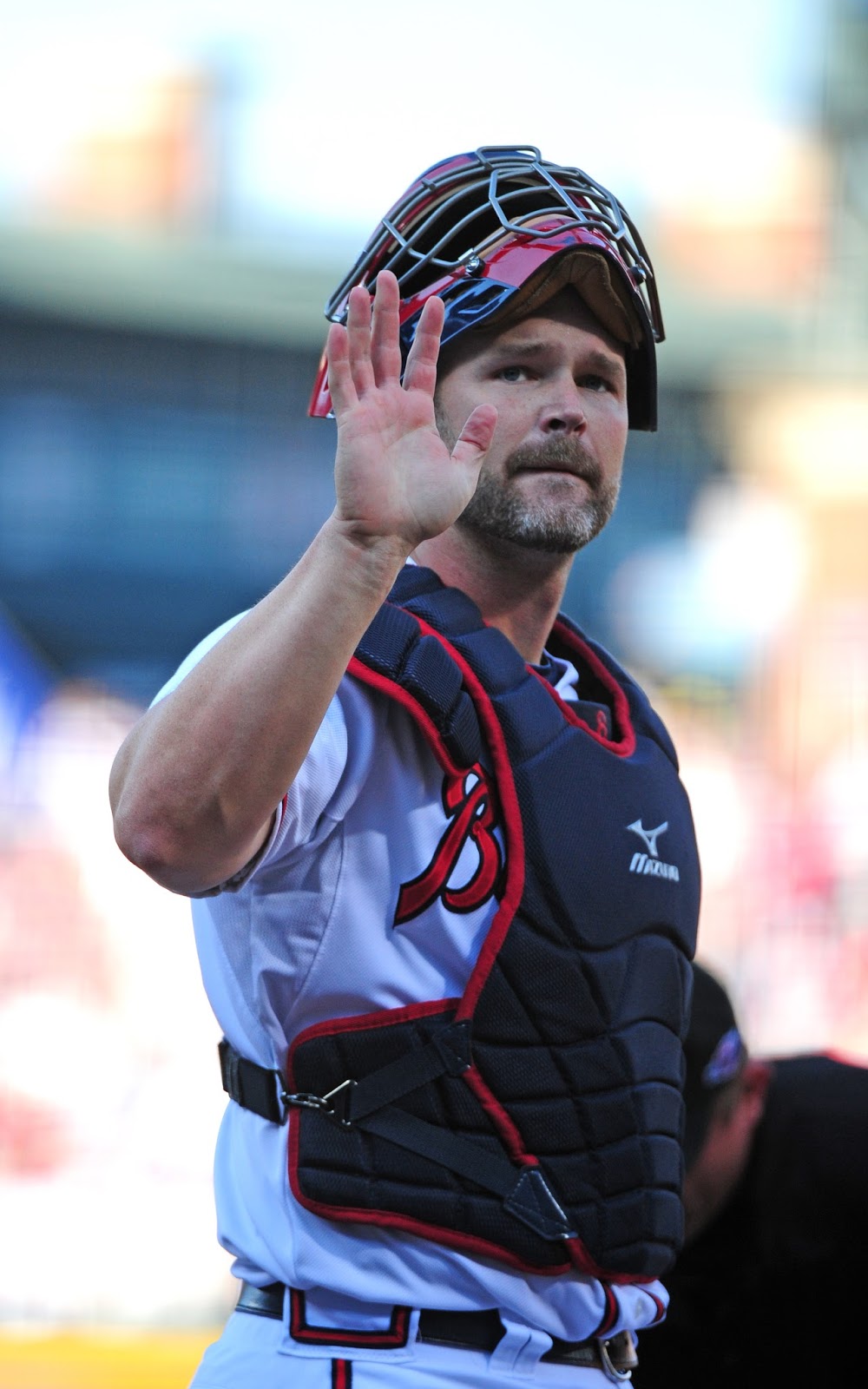
Backup catchers are sort of like backup quarterbacks. You might think spending money on one is a waste of resources until you need him to be there and produce. When that happens, you are happy that you had the foresight to get the best possible backup. For four years, David Ross fulfilled that role for the Atlanta Braves and they are still trying to replace him.

Born in March of 1977 in Bainbridge, Georgia, David Wade Ross later attended the aptly named Florida High School in Tallahassee. The Dodgers tried their luck with Ross in the 19th round of the '95 draft, but he passed and went to college - first at Auburn and then at Florida. It was at Auburn that he teamed up with center fielder and sometimes pitcher, Tim Hudson. Several years later, Hudson and Ross would again be teammates, but we'll get to that.

Ross had transferred to Florida for playing time and it led to him getting picked again by the Dodgers in '98, this time in the 7th round. Expected to be a power hitter behind the plate with advanced defensive skills, Ross began his minor league career in style with a .309/.412/.487 slash with Yakima in Short-Season A-ball after he was drafted. Two years later, a return trip to Florida with the Jacksonville Suns gave Ross his second .800 OPS season. He continued the good run with a .297/.384/.519 triple slash the following season with Las Vegas. His solid game got him to the majors in mid-summer of '02 and again in September. He would notably replace Paul Lo Duca in a 19-1 blistering the Dodgers gave the Diamondbacks. Long-time Cub Mark Grace took the ball to pitch the ninth and Ross put the cherry on the top with a first-pitch homerun. It was his first of what is currently 96 homeruns.

Ross missed much of 2003 before settling in as a backup in '04, though the results were terrible (.170/.253/.291). After failing to beat out Paul Bako for the backup job the next spring, Ross was sent to the Pirates. You might have forgotten he played for the Pirates - I know I did. He struggled with Pittsburgh. A late move to San Diego helped his season stats, but he still finished the year with a .671 OPS. Ross was nearing 30 and looked like a journeyman and not a particularly good one at that.

For the second consecutive spring, Ross was squeezed out of the opening day roster - this time by Rob Bowen - and the Padres dealt Ross to the Reds. It was in Cincinnati that Ross found a little stability. In his first year, he took advantage of the Great American Ball Park's generous dimensions to hit a career-best 21 homeruns with a .932 OPS. His follow-up campaign would see the power sustained (17 homeruns), but he simply could not get on base enough (.271 OBP). He would get a third year with the Reds and the results were a mixed bag. He improved his on-base ability, but his power nearly disappeared. The Reds moved on, releasing Ross that August. He briefly caught on with the Red Sox and would even play a game in the postseason.

That offseason, Atlanta was looking for stability behind Brian McCann. They had gone through Corky Miller, Clint Sammons, and Brayan Pena for two seasons. Pena was the only one to provide any element of offense, but the Braves didn't seem convinced he was a capable enough receiver. McCann had played 145 games, which is still his career-high, and by the end of the year, he continued to produce though he lacked the power he had showed so impressively earlier in the season. Ross would help the Braves in a number of ways. The Braves had gifted Todd Pratt to McCann in the latter's first full season of '06, but the still young-McCann could benefit from a guy who had seen much the game had to offer in Ross. Plus, Ross was seen as a leader for a staff that began the year with 23 year-old Jair Jurrjens and later added 22 year-old Tommy Hanson. While little was expected from his bat, the prevailing assumption was that Ross would be able to contribute a few taters and not be a complete zero at the plate like Miller and Sammons.

Year 1 went about as good as the Braves could have hoped. Ross triple slashed .273/.380/.508 with 7 HR. His pairing with McCann was brilliant and the drop-off was nearly non-existent. His leadership was also present for both McCann and the pitchers he worked with. In the second year of a two-year contract, he continued to excel for the Braves, slashing .289/.392/.479 with 13 doubles, the second-best total for any season of his career. He would go on to appear twice that postseason as a defensive replacement. One of his biggest knocks of his first two seasons came in the fifth inning of the August 31, 2010 game against the visiting Mets. The Braves had began the inning down 2-1, but a two-run double by Jason Heyward and a run-scoring single by Alex Gonzalez had put the Braves on top. A batter after Gonzalez, Ross chased Jon Niese with a Grand Slam to deep left.

After bringing back Ross on a second two-year deal, the Braves catching situation remained the best in baseball in 2011. Ross never matched his production from the first two seasons, but he slashed .263/.333/.428 in 171 PA - a stellar effort from a backup. He picked up his second two-homer game as a Brave on April 26 and on July 2, he smacked his second Grand Slam as a Brave, providing the edge against Jake Arrieta and the Orioles 5-4. On July 27, he tied a 1-0 game with an RBI single against Paul Maholm and the Pirates in the sixth and four innings later, hit a walk-off single to win the game. A year later, he remained sturdy with a .256/.321/.449 slash. While the season would go down as the year Ross started over a hurting and struggling McCann in the ill-fated Wild Card Game, I think 2012 should be all about August 8 in Philadelphia. It was on that night, as the Braves cruised to a ho-hum 12-6 win, that Ross reached first base with two outs on an error. On the second pitch to next hitter, Paul Janish, Ross stole second. In his eleventh year in the majors, Ross has finally stole his first base.

But sure, let's focus on that Wild Card Game. McCann's shoulder was shot and he needed offseason surgery to rectify the situation. The two catchers shared a good deal of time in September rather than there being a clear distinction between the two. It was McCann's worst season - well, until he became a Yankee. Over his final 19 games, McCann had hit just .209 with a .260 OBP and .328 slugging. So, it was not too surprising that Ross played ahead of McCann - yet it still seemed like it was. Ross stepped in and gave the Braves a boost, though. He singled twice and homered over four at-bats. And Fredi Gonzalez's decision probably would have been lauded had the umpires not changed what the meaning of the infield fly rule was. I'm half-kidding, of course.

The Braves had gotten away with paying Ross just $1.625M for the final two years of his Braves' run. Over his four years with Atlanta, he had slashed .269/.353/.463. He deserved a pay raise and the Braves couldn't match what he was worth on the open market. That was not a problem for the Boston Red Sox, who inked Ross to a $3.1M average salary. His season got off to a miserable as he hit the DL in mid-June with concussion issues. When he returned, he was able to regain his place as Jon Lester's personal catcher, which became important in keeping him in the mix for the playoffs. He began to steal time beyond Lester's starts from Jarrod Saltalamacchia and in Game 5 of the World Series, he picked up a go-ahead RBI double off Adam Wainwright that helped the Red Sox win and inch closer to a World Series title. Two days later, with Ross behind the plate, the Red Sox beat the Cards 6-1, giving Ross his first World Series ring.

After another year with Boston that included some miserable results, Ross again hit free agency and joined the Cubs. His first year there was miserable at the plate, though his value in the clubhouse and behind the plate still impressed many. He even pitched two games - and did really well (2 ING, 6 batters up, 6 batters down). He returns for a farewell tour this year that has attracted a great deal of attention, which is a testament to Ross the person moreso than Ross the player.

For four years, the Braves had the best catching situation in baseball with an All-Star and a capable backup. The years since have shown how rare that is to put together. With his career nearly up, one has to wonder what's next after 2016. With how well-liked he is and how his leadership is lauded, hard not to see a coaching future for Ross. Maybe that could be a pathway back to Atlanta. Just spitballing.
Rossy gets some air as Chipper Jones sends a ball through the air against the Phillies on 9/2/12.
Scott Cunningham/Getty Images
Recent Thursday Throwbacks...
Ryan Langerhans (2002-2003, 2005-07)
Special - Rafael Furcal's Near-Signing (2008)
Marquis Grissom (1995-96)
...or view ALL of them.

Thursday, October 8, 2015

Thursday Throwback - Blaine Boyer

(This column used to be called Random Ex-Brave.)

The Baby Braves.

2005's crew of kids who were either fresh-faced rookies or just beginning to establish themselves. Sure, the Braves still had Chipper Jones, but he only played 109 games that year. And yeah, Andruw Jones was a monster that season while John Smoltz anchored a rotation that included just three pitchers who made at least 21 starts. There were still big names, but the Braves capped off their legendary Streak with a 14th division title because of the kids.

Chris Graythen | Getty Sports
Flash forward to 2015, few of those kids are still in the majors. Jeff Francoeur and Kelly Johnson, who often flanked Andruw in the outfield during the second half, are journeymen bench guys at this point. So, too, is Brayan Pena. Brian McCann is a superstar catcher, but he's the outlier. Where's Ryan Langerhans, Wilson Betemit, Andy Marte, Kyle Davies, Roman Colon, Macay McBride, or Joey Devine? Oh, and where exactly is Blaine Boyer?

Minnesota. In fact, you might be surprised to find out just how often Boyer pitched for the Twins in their desperate effort to return to the playoffs this season. I know I was. Boyer finished 2015 with 68 games, his first save since 2011, and a 1.25 WHIP. The number nerd in me looks at a 4.6 K/9 and 2.6 BB/9 and thinks it would be shocking to see Boyer post another 2.49 ERA, but it's certainly not impossible. After all, he did it this year and considering what he's done to even get to this point, it's not a smart idea to count out Boyer.

Born July 11, 1981 in Atlanta as baseball endured a work stoppage, Boyer would later attend George Walton Comprehensive High School (fortunately, shortened to Walton High) in Cobb County. The school would later graduate Billy Burns, the fast outfielder for the A's, but the school's has more notable alumni like Nine Inch Nails and Guns N' Roses guitarist Robin Finck. Oh, and two of the founding members of The Black Crowes.

Boyer was part of a big 2000 class for the Braves in which they had 7 picks in the first 100 selections. Adam Wainwright was a nice pick with #29. After all, he acquired Stephen Drew's brother and we all remember that deal for how awesome it was. Scott Thorman was taken with the next pick, KJ selected #38, Aaron Herr #40, Bubba Nelson #51, Bryan Digby #70, and Boyer was picked with the #100 overall selection of the 2000 draft. And here I thought it was the Frank Wren years that didn't draft well. Ugh! In their defense, they did get Adam LaRoche in the 29th round.

Boyer spent a pair of years in rookie ball before being a member of the final Macon Braves squad in 2002. After fiddling with the starting game the first two seasons, he was moved to the pen with Macon and showed a strikeout arm, but the Braves wanted Boyer to try starting again so, for some reason, he was left in the SALLY League to be a member of the first Rome Braves team. He actually looked notably worse or at least more hittable, but was moved up the ladder finally in 2004. Myrtle Beach often served as a park that made average pitchers look like world beaters. Boyer finished the season with a 2.98 ERA in 28 starts. His K numbers shrunk, but the results looked nice. He opened 2005 in the minors with Mississippi and was struggling, but the 2005 Braves needed arms and he was called up for action on June 12.

After taking a loss in his first outing against the A's, Boyer quickly settled into the seventh inning guy ahead of Jim Brower and Chris Reitsma. Talk about the opposite of a shutdown relief squad. Boyer continued to perform well in his role and even threw two scoreless against the Giants on August 10 before getting his first major league win after Marcus Giles singled in Betemit in the 12th. Boyer got his ERA down to 1.71 after his seventh hold on September 3, but over his final ten games, the wheels came off. Of the 34 batters he faced, 19 reached base. His struggles over those final weeks led to him being left off the roster in favor of a guy like Devine, who would not do so hot in the playoffs. Have I cursed about Chris Burke today?

The bad taste in Boyer's mouth for how 2005 ended wouldn't be resolved anytime soon. He appeared just twice in 2006 because of injuries and in 2007, logged just five games in the majors as the Braves left him in Richmond to both start and relieve to little success.

Now it's time to remember how bad the Braves pitching was in 2008. Usually, I focus on the fact that Jeff Bennett, Chuck James, James Parr, Jo-Jo Reyes, and somebody pretending to be Tom Glavine started 52 games that year. What shouldn't be ignored is that Boyer appeared in 76 games and had a 5.88 ERA! In Atlanta's defense, he wasn't that terrible over the first three months (43 games, 3.63 ERA, 1.19 WHIP), but Boyer gave up three runs on the first day of July and stunk it up from there. Over 33 games, he had a 9.55 ERA. He blew five leads and blew in general, yet Cox said "give me Boyer." I blame John Schuerholz for that. And Cox. And El Nino.

For reasons unknown, Boyer was kept for the 2009 season. At this point, he had a career 5.06 ERA and 1.41 WHIP. Guess they thought he needed more time. After three games and six runs allowed, even the Braves said, "Just because you're from Atlanta doesn't mean you get to be this bad." They traded him to the Cards for Brian Barton, who is a nominee for Barviest Career. 1 G, 0 PA, 1 inning in right field, 1 caught stealing. Well done, Brian. St. Louis tried Boyer in the pen, but he struggled and got hurt.

He was non-tendered after the season and we get our first "Boyer Goes International" leg of the tour. First stop - the Mets, where Boyer made the team coming out of spring training in 2011 and was atrocious in five bullpen appearances. Next stop - the Pirates, where Boyer had a 13.50 ERA in 11 AAA games. After being cut by his second team of the year, the Cards brought Boyer back and he started seven games in the minors. Three ugly ones in A+ ball, four REALLY ugly ones in AAA. They cut him, too. His minor league ERA in 2011 - 10.90. His MLB ERA - 10.80. There's got to be a police code joke in there somewhere.

After the season, Boyer went home and decided that he could continue to get his head beat in or he could head home, enjoy his family, and get a real estate license. The latter does sound inviting so that's exactly what Boyer did. But as players who retire voluntarily tend to do, Boyer had second thoughts and returned to pitch for the Kansas City Royals minor league system. The results were okayish at AAA, but he was still released in May. Boyer thought that this International Tour lacked an international flavor so he headed to Japan to sign with the Hanshin Tigers. He was damn productive for them, posting a 2.67 ERA and 0.89 WHIP.

His work in Japan earned him a contract with the Padres minor league system to open 2014 with former Baby Brave teammate, Francoeur. In the hard-hitting Pacific Coast League, Boyer held his own with a 3.10 ERA in 25 games, including 7 saves. The control, which had been such an issue for him for so long, disappeared. His work in El Paso got him called up in late May and after a brief demotion, he was up in the majors for good after June 12. He finished the year with a 3.57 ERA in 32 games, including a 1.8 BB/9. Still, the Padres moved on after the season and he went hunting for a new contract. It came in the form of a $750K offer from the Twins. He started slow, but after a mechanical adjustment from Everyday Eddie Guardado, the Twins bullpen coach, Boyer got rolling and went through a 22 game stretch between April 17 to June 3 where he allowed just one run in 23.2 ING.

Again, I'm dubious about Boyer's chances to repeat his 2015 success. But again, I could be wrong. To his credit, Boyer seems like a well-liked guy who has kept a great outlook during his struggles. I imagine there is some interest in retaining his services in Minnesota for 2015 and he probably has interest himself.

More Recent Throwbacks...
Juan Berenguer (1991-92)
Charlie Morton (2008)
Freddy Garcia (2013)
...or view ALL of them.