When the 2014-15 offseason is looked it, we will be mesmerized by the amount of turnover. Of the 39 players who played at least one game with the Braves last season, 19 of them are already gone and that does not include Kris Medlen or Brandon Beachy. Outfield stands out as a position in great change and I profiled the starting rotation last week which saw an entire starting staff move on. Let's not ignore how much the pen has changed, though. Of the 440.2 innings thrown by the bullpen last year, 183.1 innings, or 42%, have to be replaced. Of the five most used relievers, three have been traded this offseason. The bullpen will look very different and in my opinion, it is unlikely to be as good.
With that in mind, let's say goodbye to...David Carpenter, Anthony Varvaro, Jordan Walden, Chasen Shreve, Jonny Venters, Cory Gearrin, Pedro Beato, Ryan Buchter. The last four is just piling on and of course, Venters may never throw another major league pitch. Shreve was a promising young reliever who was used in the Manny Banuelos deal, but the biggest losses in innings is from the first three, who have all been significant parts of the Braves bullpen for the last couple of seasons. Losing all three hurts, though when the team is headed towards a rebuild, having a shutdown crew in front of your closer is often considered an unnecessary luxury.
Five pitchers who are returning logged at least 20 innings last year and an additional ten are in the picture for the 2015 season either as surging minor league prospects, free agent acquisitions, or left-over guys with little chance of sticking. Let's start at the top.
Here's a funny number for you. Craig Kimbrel had his worst WHIP in three years. Of pitchers with at least 50 innings in the bag last year, only 20 had a better WHIP. Kimbrel lost the title of best closer in the game last year to Aroldis Chapman, but you'd have a tough time finding many others that have posted a four year start to their career with much more domination than Kimbrel. Granted, the Braves probably don't need a dominating closer, but Kimbrel is signed long term and is unlikely to bring back a significant return unless a team gets very desperate.
But when he looks around this spring, he will see at least three new faces expected to set the stage for what saves Kimbrel does get. 12-year veteran Jason Grilli and 9-year veteran Jim Johnson both have closing experience. Grilli was an All-Star in 2013 and damn effective as his 1.97 FIP showed. He struggled last year, but was actually pitching good ball down the stretch after being traded to the Angels. He should be pretty good, though the fact that he was signed for both his age-38 and age-39 seasons was a little surprising. Remember when I said Kimbrel was 21st in WHIP last year among pitchers with at least 50 innings? Johnson was last, posting a 1.95 WHIP. That number looks a lot nicer as an ERA. That was coming on the heels of back-to-back 50 save seasons with the Orioles. He was never that dominant, but he kept the ball in the park and didn't walk people. Until last year. Another new face is Josh Outman, a lefty reliever, who does one thing and one thing only. Get lefties out.
That leaves three open spots and we can pencil James Russell in for one of those spots provided he doesn't break camp in the rotation. But I mentioned 15 options and that's without adding fifth starter candidates Michael Foltynewicz and Manny Banuelos to the mix as I believe if they aren't in the rotation, they will go to Gwinnett to start games. If Kimbrel, Grilli, Johnson, Outman, and Russell are in the pen already, who gets the remaining two spots among the remaining ten I see as possibilities?
Shae Simmons, if healthy, is a good bet to be one of them. Simmons appeared in 26 games last year and struck out over a batter an inning with a 3.13 FIP. He has the skillset to be at least a very good reliever in the majors if not one getting high leverage innings. But injuries ended his 2014 prematurely. Speaking of a guy who knows about injuries, Arodys Vizcaino is back from a sabbatical with the Cubs of Chicago. The Cubbies graciously rehabbed Vizcaino for us and now he is ready to try and contribute at the major league level. I think he still has at least one option, maybe two, left so the Braves won't be forced to keep or lose him this season, but "if healthy," he still possesses the raw ability that made us sad to see him traded to the Cubs in the first place.
Though he probably doesn't deserve the amount of crap he gets on Twitter, Luis Avilan did himself no favors by stinking up the joint last season. He had a weird 2013 in that he lowered his WHIP, but also lost 3 K/9. That backfired in 2014 as he missed more spots leading to a sharp increase in walks to the point that his BB/K got embarrassingly close, though in his defense, seven of his 21 walks were intentional. With two lefties already in the fold, he's no sure thing. Neither is last year's long guy, David Hale, who is also in on the fifth starter competition. People tell me Hale is better suited to be a starter than a reliever. I find that cute in that people think he's best suited to be a pitcher at all. That sounds mean, but he possibly would make more money on Wall Street if he wants to use that "operations research and financial engineering" degree he got from Princeton to better use.
I'd say Simmons, Vizcaino, Avilan, and Hale have the strongest chance right now to those two spots in the theoretical bullpen, but the Braves could use other options. From the left-hand side, Ian Thomas makes for a fun story as he he was undrafted and signed out of the Atlantic League, but he impressed enough last spring to make the club and did not look overmatched at all. But questions remain as his season ended a month short. Also still around is Juan Jaime. It might be unfair, but every time I saw Jaime, I thought "cool, the Braves brought back Manny Acosta." Yes, Jaime has great velocity, but it looked far too straight and too often, not in the strikezone. I don't think pitchers who subscribe to the Three True Outcomes really succeed on high amounts of Ks, BBs, and HRs. Signed on a minor league deal, Michael Kohn has 126 games in the majors and provided he doesn't walk nearly 8 per nine like he did last season, he could be in the mix as well.
The rest of the names are waiting for their first callup. Ryne Harper is a 37th rounder who has a 2.18 ERA in 148 minor league games along with a 1.16 WHIP and 10.6 K/9. However, the Braves thought so much of him that despite a 1.79 ERA with Mississippi in 2013, they made Harper repeat the level in 2014. One of Harper's teammates last year was John Cornely, who posted a 1.15 WHIP in nearly 70 innings with seven saves. Yet another Mississippi Brave was Brandon Cunniff, who the Braves protected by placing him on the 40-man roster this winter. Like Ian Thomas, Cunniff was signed out of independent ball. He probably won't strike out a small village, but he has great natural sinking movement.
You could really go on with Donnie Veal, Aaron Kurcz, and others, but I'd rather not write a novel today. The 2015 bullpen will look significantly different from the bullpen that often pitched so well last year. That's not to say the new group can't be good themselves, though. I wouldn't bank on it. Still, stranger things have happened. Like me getting to the point where I complain about getting rid of Varvaro.
Showing posts with label Gearrin. Show all posts
Showing posts with label Gearrin. Show all posts
Thursday, January 22, 2015

Friday, November 7, 2014
WOW's Offseason Look at: The Bullpen
Like the starting rotation, the bullpen kept the Braves' dismal hopes alive even as the offense sputtered throughout the season. Only three other teams could say they had relief pitching with a better FIP and that's with David Hale sucking (as he tends to do). Nevertheless, this was a bit of a fall in the rankings from the 2013 bullpen that led the lead in FIP. Will that trend continue going into 2015 or will the Braves show some upward mobility? Hard to really tell as relievers are notoriously fragile and subject to inconsistent performances from year-to-year. However, there should be enough to get by, especially with you-know-who in the traditional closer role, even if that limits him in the eyes of his manager.
Who we got?... Craig Kimbrel, Luis Avilan, Anthony Varvaro, Cory Gearrin, David Hale, Gus Schlosser, Ian Thomas, Juan Jaime, Chasen Shreve, Shae Simmons.
Who's getting Arby?... Jordan Walden, David Carpenter, James Russell, Jonny Venters
Who might be going?... Ryan Buchter, Venters probably
Who might be coming?...John Cornely, Alex Wilson, Nate Hyatt
Braves went through a lot of relievers last season (15 of them) and most are already on their way back in 2015 so Atlanta might be intrigued by the idea of dealing an arbitration-eligible guy to save some green, though they will need better performances out of some of the guys who made their debut just last season. Of course, the pen is led by Kimbrel, who is locked up until at least 2017 after inking a contract extension last winter. Kimbrel wasn't as sharp last season as in previous years and too often seemed to struggle to locate his fastball. Still, he K'd 13.9 per nine and posted a FIP of 1.83. If only the rest of the team had guys who could see a little drop off from two years ago and post ridiculously impressive numbers. He's still the best, though the best is limited to the situations Fredi Gonzalez feels comfortable using him in.
Beyond Kimbrel, the rest of the guys will likely be on one-year deals and the majority of them will be playing for the minimum. Varvaro had his most impressive season and barely missed the cutoff for Super Two, which would have started his arbitration pay-days. As is, he'll get near the minimum and if he puts up 2014-like numbers, he'll get paid pretty well. Fredi transitioned Varvaro from long guy to high-leverage guy and he responded with the best FIP and K-BB rate of his career. On the flipside, Avilan tanked. Only Hale posted a fWAR that was worse as a reliever for the Braves and I've read from very trusted sources that Hale sucks. The writing was kind of on the wall for Avilan, though. In his 2012 rookie season, Avilan's K/9 was 8.3. It was 5.3 the next season and around the same last season. His 2013 BABIP was an unsustainable .204. Add in a 2014 walk-rate that ballooned and you have all the makings of an epic fail. Still, Fredi trusted him. Still, Fredi is the manager. Still, I need my ulcer medication.
A bunch of new guys showed up. Some had hype, others came out of nowhere, and one guy was named Gus. Shae Simmons, or Simbrel, looked like he was going to be a top set-up guy for the Braves. Like a clone of Kimbrel, the diminutive Simmons came with heat and was devastating, but shoulder issues limited him to only 26 games. If fully healthy, Simmons could eventually unseat Kimbrel if the Braves decide they are paying too much for a closer. Southpaw Chasen Shreve has a name that doesn't fit for a guy from Las Vegas, but down the stretch, he became the most trusted left-hander the Braves had even if Fredi didn't want to acknowledge that. He allowed just one earned run in 12.1 ING, walked three, and struck out 15. Shreve found control in 2014 and to go with his brief major league run, he walked just 12 in 64 minor league innings after giving the free pass to 22 in 22 fewer innings the previous season. Heading into 2015, like Simbrel, Shreve looks to have a big role provided he continues to perform and stay healthy. The rest of the names are easy to sum up. Gearrin got hurt, would be non-tendered if he was arbitration-eligible, and is unlikely to be kept simply because he's out of options. Hale is a meh long reliever (he sucks). Ian Thomas was in rookie ball two years ago, broke camp with the team, wasn't terrible (or good), got demoted and was done by the end of July due to injury. Juan Jaime is Manny Acosta Jr. Gus Schlosser is JUST a good name.
Arbitration cases are pretty interesting. Walden spent most of the year having fans of the opposite teams complain that his hop was a balk on twitter. Beyond that, he was very good (though he did hit the DL). The Braves could look to move him to invest his money toward the bench and count on Simbrel to take over his role. Or they could move Carpenter, who spent half of 2014 exercising the demons from Juan Uribe's NLDS homer the previous fall. This provided for some MASSIVELY different splits. Except that they didn't. While Carp's first-half ERA was 4.26, his other rates were pretty similar to the second half. So, while most were saying that Carp was a lost cause, they could have looked at his BABIP (which stood at .448 during the first half) and knew things would change. They did and he finished very strong. James Russell looked like a perfect fit for the Braves. The former Cub was a LOOGY who was team-controlled and could answer their season-long issues with that role. Except for whatever weird reason, Russell wasn't getting out lefties. It's not like Russell started to suck...his FIP was the best of his career...he just couldn't do the thing he was being paid to do and had been successful at doing since coming to the majors. The fact that he used his fastball more this year and used his slider a lot less tells me either two things...one, he was trying to move away from the slider or more likely, he was struggling with his release point and thus, location. He should be fine in 2015.
This would seem like bad news for Venters, though he's heard a lot worse. Three Tommy John's. The number of pitchers who have made a return to the majors from three TJS's is incredibly small. So small that I fit it into the next two words: Jason Isringhausen. No other pitcher is known to have undergone three of the surgeries and make it back to the majors. Venters, who made $1.625M for the second consecutive season with arbitration, will not be given the opportunity to make it for a third straight season and likely won't pitch again until 2016, if ever. He has just one more year of arbitration. The Braves, if they are feeling charitable, could non-tender him and offer him a creative minor league deal. Doubt it, though. The Braves have bigger concerns. Also likely out is another lefty, Ryan Buchter. He was designated for assignment in late September and outrighted to the minors, where I believe he'll become a minor league free agent. His career walk rate...6.1 BB/9.
Braves don't have much coming either. John Cornely was briefly placed on the 40 man roster last year and is back off. The righty did post his best season with Mississippi last year, though, and the Braves liked him enough to send him to the AFL after 2013. Wilson and Hyatt both pitched in Lynchburg last season with Wilson shutting down 16 games to lead the Hillcats in saves. Both would be major stretches especially with so many young guys already in Atlanta.
Depth Chart
1. Kimbrel
2. Carpenter
3. Walden
4. Russell
5. Varvaro
6.
7.
The Braves will likely bring in a veteran or two to fight for jobs, but the bullpen seems like a position the front office probably feels comfortable with. In addition to the five I point out in the depth chart, there are young guys like Shreve and Simmons plus holdovers like Avilan and Hale who would appear to have a good shot to at least add depth to the bullpen heading into 2015. Of course, beyond an injury or two that is bound to occur, a trade might take away at least one from the depth, but the Braves have the ability to make a deal here and feel comfortable enough with what they still have.
Who we got?... Craig Kimbrel, Luis Avilan, Anthony Varvaro, Cory Gearrin, David Hale, Gus Schlosser, Ian Thomas, Juan Jaime, Chasen Shreve, Shae Simmons.
Who's getting Arby?... Jordan Walden, David Carpenter, James Russell, Jonny Venters
Who might be going?... Ryan Buchter, Venters probably
Who might be coming?...John Cornely, Alex Wilson, Nate Hyatt
Braves went through a lot of relievers last season (15 of them) and most are already on their way back in 2015 so Atlanta might be intrigued by the idea of dealing an arbitration-eligible guy to save some green, though they will need better performances out of some of the guys who made their debut just last season. Of course, the pen is led by Kimbrel, who is locked up until at least 2017 after inking a contract extension last winter. Kimbrel wasn't as sharp last season as in previous years and too often seemed to struggle to locate his fastball. Still, he K'd 13.9 per nine and posted a FIP of 1.83. If only the rest of the team had guys who could see a little drop off from two years ago and post ridiculously impressive numbers. He's still the best, though the best is limited to the situations Fredi Gonzalez feels comfortable using him in.
Beyond Kimbrel, the rest of the guys will likely be on one-year deals and the majority of them will be playing for the minimum. Varvaro had his most impressive season and barely missed the cutoff for Super Two, which would have started his arbitration pay-days. As is, he'll get near the minimum and if he puts up 2014-like numbers, he'll get paid pretty well. Fredi transitioned Varvaro from long guy to high-leverage guy and he responded with the best FIP and K-BB rate of his career. On the flipside, Avilan tanked. Only Hale posted a fWAR that was worse as a reliever for the Braves and I've read from very trusted sources that Hale sucks. The writing was kind of on the wall for Avilan, though. In his 2012 rookie season, Avilan's K/9 was 8.3. It was 5.3 the next season and around the same last season. His 2013 BABIP was an unsustainable .204. Add in a 2014 walk-rate that ballooned and you have all the makings of an epic fail. Still, Fredi trusted him. Still, Fredi is the manager. Still, I need my ulcer medication.
A bunch of new guys showed up. Some had hype, others came out of nowhere, and one guy was named Gus. Shae Simmons, or Simbrel, looked like he was going to be a top set-up guy for the Braves. Like a clone of Kimbrel, the diminutive Simmons came with heat and was devastating, but shoulder issues limited him to only 26 games. If fully healthy, Simmons could eventually unseat Kimbrel if the Braves decide they are paying too much for a closer. Southpaw Chasen Shreve has a name that doesn't fit for a guy from Las Vegas, but down the stretch, he became the most trusted left-hander the Braves had even if Fredi didn't want to acknowledge that. He allowed just one earned run in 12.1 ING, walked three, and struck out 15. Shreve found control in 2014 and to go with his brief major league run, he walked just 12 in 64 minor league innings after giving the free pass to 22 in 22 fewer innings the previous season. Heading into 2015, like Simbrel, Shreve looks to have a big role provided he continues to perform and stay healthy. The rest of the names are easy to sum up. Gearrin got hurt, would be non-tendered if he was arbitration-eligible, and is unlikely to be kept simply because he's out of options. Hale is a meh long reliever (he sucks). Ian Thomas was in rookie ball two years ago, broke camp with the team, wasn't terrible (or good), got demoted and was done by the end of July due to injury. Juan Jaime is Manny Acosta Jr. Gus Schlosser is JUST a good name.
Arbitration cases are pretty interesting. Walden spent most of the year having fans of the opposite teams complain that his hop was a balk on twitter. Beyond that, he was very good (though he did hit the DL). The Braves could look to move him to invest his money toward the bench and count on Simbrel to take over his role. Or they could move Carpenter, who spent half of 2014 exercising the demons from Juan Uribe's NLDS homer the previous fall. This provided for some MASSIVELY different splits. Except that they didn't. While Carp's first-half ERA was 4.26, his other rates were pretty similar to the second half. So, while most were saying that Carp was a lost cause, they could have looked at his BABIP (which stood at .448 during the first half) and knew things would change. They did and he finished very strong. James Russell looked like a perfect fit for the Braves. The former Cub was a LOOGY who was team-controlled and could answer their season-long issues with that role. Except for whatever weird reason, Russell wasn't getting out lefties. It's not like Russell started to suck...his FIP was the best of his career...he just couldn't do the thing he was being paid to do and had been successful at doing since coming to the majors. The fact that he used his fastball more this year and used his slider a lot less tells me either two things...one, he was trying to move away from the slider or more likely, he was struggling with his release point and thus, location. He should be fine in 2015.
This would seem like bad news for Venters, though he's heard a lot worse. Three Tommy John's. The number of pitchers who have made a return to the majors from three TJS's is incredibly small. So small that I fit it into the next two words: Jason Isringhausen. No other pitcher is known to have undergone three of the surgeries and make it back to the majors. Venters, who made $1.625M for the second consecutive season with arbitration, will not be given the opportunity to make it for a third straight season and likely won't pitch again until 2016, if ever. He has just one more year of arbitration. The Braves, if they are feeling charitable, could non-tender him and offer him a creative minor league deal. Doubt it, though. The Braves have bigger concerns. Also likely out is another lefty, Ryan Buchter. He was designated for assignment in late September and outrighted to the minors, where I believe he'll become a minor league free agent. His career walk rate...6.1 BB/9.
Braves don't have much coming either. John Cornely was briefly placed on the 40 man roster last year and is back off. The righty did post his best season with Mississippi last year, though, and the Braves liked him enough to send him to the AFL after 2013. Wilson and Hyatt both pitched in Lynchburg last season with Wilson shutting down 16 games to lead the Hillcats in saves. Both would be major stretches especially with so many young guys already in Atlanta.
Depth Chart
1. Kimbrel
2. Carpenter
3. Walden
4. Russell
5. Varvaro
6.
7.
The Braves will likely bring in a veteran or two to fight for jobs, but the bullpen seems like a position the front office probably feels comfortable with. In addition to the five I point out in the depth chart, there are young guys like Shreve and Simmons plus holdovers like Avilan and Hale who would appear to have a good shot to at least add depth to the bullpen heading into 2015. Of course, beyond an injury or two that is bound to occur, a trade might take away at least one from the depth, but the Braves have the ability to make a deal here and feel comfortable enough with what they still have.
Sunday, June 22, 2014
Random Prospect Sunday - Nate Hyatt
I shouldn't try commenting on other teams because I don't have the time, nor inclination, to follow their drafting habits, but it really seems the Braves focus heavily on college relievers who have the ability to accelerate through their minor league system. Today's Random Prospect, Nate Hyatt, is just another example from a group that includes Craig Kimbrel, Shae Simmons, and Cory Gearrin.
Hyatt was born on September 26th, 1990 in Charlotte, North Carolina. Because I like random facts, the Braves lost 5-2 that day to the eventual World Champion Reds, their 92nd loss in a 65-97 season. John Smoltz was outpitched by Jose Rijo despite Ron Gant's 31st homer. Hyatt attended Brevard High School, which has never produced a major league player, before heading to Appalachian State for his college education. With App State, Hyatt tried his luck at both starting and relieving, but eventually transitioned into a full-time closer in his junior season, saving 16 games to lead the Southern Conference and help send the Mountainers to the College World Series Regionals. With App State, Hyatt played often against conference foe and future Braves draftee Ross Heffley, who has also been given the Random Prospect treatment.
The Braves liked what they saw out of Hyatt, who throws in the high 90's, and selected him in the 13th round of the 2012 draft, five picks before Heffley and nine picks before Simmons, who beat Hyatt to the majors. Hyatt spent a little time with Danville before heading to Rome to finish 2012. All told, it was an eye-opening debut for the right-hander, who struck out 37 in 25.2 ING with just 8 walks. He was supposed to have significant control issues. Quickly, it looked like Hyatt could be another fast-rising reliever.
Pegged to open 2013 with Lynchburg, Hyatt's control problems finally surfaced. He walked 30 in 46.2 ING, or basically three more walks per nine innings than he had in 2012. While he did strike out 55 and led the 'Cats with 12 saves, it was a disappointing year. He did show some signs of moving forward when he struck out 17 in his final 13.1 innings of the season where he did not give up an earned run. However, he did still walk nine.
This season, Hyatt is back in Lynchburg and while his 2.45 ERA looks good, he is still walking 5.2 BB/9 and has struck out 28 in 29.1 ING, a respectable total that is the lowest of his career. Much like last year, he started the year with better control and K'd 15 in his first 10.2 ING with just three walks, but has since walked more batters than he struck out.
Hyatt turns 24 in late September, which is entirely too old to be struggling at A ball. The second half of the Carolina League season will be big for Hyatt. If he can spot his fastball and his inconsistent slider, rack up strikeouts, and keep opposing hitters off the base paths, the Braves will find room for him. Otherwise, Hyatt will be passed by more recent draftees and could be a spring training cut. While the Braves have invested and believed in Juan Jaime and Ryan Buchter, other relievers with control issues in the minors, Hyatt's 1.59 WHIP with Lynchburg will not impress Braves management, especially when you factor in falling K rates. Giving up just two homeruns in 100.2 ING is a nice stat. Walking 55 in the same time frame, on the other hand...
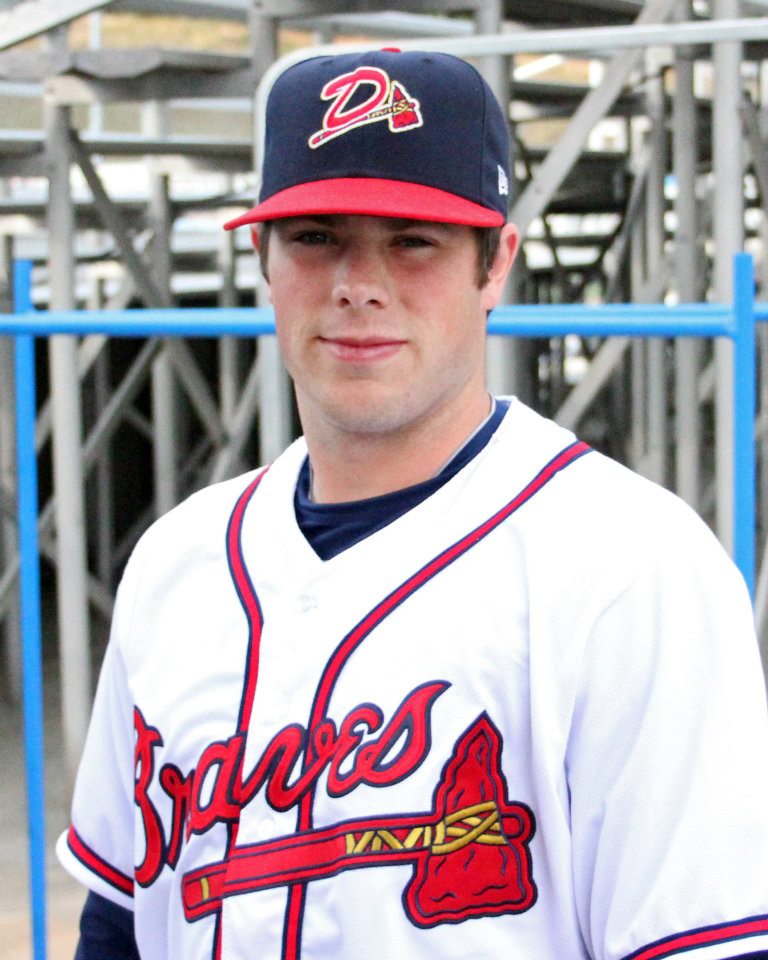 |
| Credit: talkingchop.com |
The Braves liked what they saw out of Hyatt, who throws in the high 90's, and selected him in the 13th round of the 2012 draft, five picks before Heffley and nine picks before Simmons, who beat Hyatt to the majors. Hyatt spent a little time with Danville before heading to Rome to finish 2012. All told, it was an eye-opening debut for the right-hander, who struck out 37 in 25.2 ING with just 8 walks. He was supposed to have significant control issues. Quickly, it looked like Hyatt could be another fast-rising reliever.
Pegged to open 2013 with Lynchburg, Hyatt's control problems finally surfaced. He walked 30 in 46.2 ING, or basically three more walks per nine innings than he had in 2012. While he did strike out 55 and led the 'Cats with 12 saves, it was a disappointing year. He did show some signs of moving forward when he struck out 17 in his final 13.1 innings of the season where he did not give up an earned run. However, he did still walk nine.
This season, Hyatt is back in Lynchburg and while his 2.45 ERA looks good, he is still walking 5.2 BB/9 and has struck out 28 in 29.1 ING, a respectable total that is the lowest of his career. Much like last year, he started the year with better control and K'd 15 in his first 10.2 ING with just three walks, but has since walked more batters than he struck out.
Hyatt turns 24 in late September, which is entirely too old to be struggling at A ball. The second half of the Carolina League season will be big for Hyatt. If he can spot his fastball and his inconsistent slider, rack up strikeouts, and keep opposing hitters off the base paths, the Braves will find room for him. Otherwise, Hyatt will be passed by more recent draftees and could be a spring training cut. While the Braves have invested and believed in Juan Jaime and Ryan Buchter, other relievers with control issues in the minors, Hyatt's 1.59 WHIP with Lynchburg will not impress Braves management, especially when you factor in falling K rates. Giving up just two homeruns in 100.2 ING is a nice stat. Walking 55 in the same time frame, on the other hand...
Tuesday, May 20, 2014
A Look Back: 2007 Draft
We're coming up on the June draft so now was a good time to dust off my series on looking back on recent drafts and seeing what players have made good on the Braves' investment and the many that have not. So far, I have looked at five different drafts from 2008 to 2012. Today, my focus will be on the 2007 draft, a draft that yielded few major league talents, but the ones that it did were big. The 2007 draft followed a disappointing 2006, the season that ended The Streak as the Braves finished 79-83 and 18 games out of first.
As such, the Braves were picking during the first half of the draft for the first time since 1991. They also gained two picks after the Orioles signed Danys Baez, getting a supplemental first rounder (and 33rd overall) along with a second choice in the second round, the 69th overall pick. The Braves got little from those two picks, including a selection of Josh Fields with the additional second round pick. He did not sign, though. As I've done in previous articles, I will touch on the first ten rounds and any interesting players after that.
1. Jason Heyward, OF, Henry County High School (McDonough, GA)
Heyward was ranked the 9th best prospect by Baseball America heading into the draft and his upside was off the charts. According to the Braves, they had Heyward graded over first overall pick, David Price. So, how did he get to the 14th overall selection? His signing bonus demands were very high and some graded, and this is true, Heyward as a left-fielder/first baseman. Miami was a possible destination, but chose 3B Matt Dominguez. After the draft, the Braves signed Heyward to a $1.7M signing bonus and Heyward breezed through the minors, reaching Gwinnett in 2009 just after his 20th birthday. Before 2010, Baseball Prospectus ranked him the #2 prospect in the minors. Baseball America believed that was incorrect, ranking him the best prospect in baseball before 2010.
Heyward would homer in his first game and on-based .393 while finishing second in the Rookie of the Year race. A disappointing 2011 followed, wrecked by injuries, but Heyward appeared to break out in 2012 while hitting behind Michael Bourn. He slashed .269/.335/.479, hit 27 homers, stole 21 bases, and won his first well-deserved Gold Glove. Freak injuries limited him to 104 games last year and he certainly hasn't got off to a good start this season, but Heyward remains all of 24 years-old. There remains a lot of potential that the Braves need to help Heyward reach.
1s. Jon Gilmore, 3B, Iowa City High School
How many 3B were selected in the 2007 draft? 33rd overall pick, Gilmore, was the fifth of the first round. Two more would go before the end of the first. On the plus side, there was a typical midwestern body type for Gilmore with a lot of potential power. However, he was a very raw talent. He handled rookie-league ball well, hitting .317 in 110 games between the GCL and Appy Leagues, though he walked just 17 times and hit five homers. By the end of 2008, he was in Rome, where he hit .186 in 27 games to finish the year. After the season, he was traded to the White Sox as part of the Javier Vazquez deal. Gilmore stayed in the South Atlantic League for 2009 with Kannapolis and his .274 with a career-best 34 walks, but belted just five homers in 130 games. He spent 2010 int he Carolina League and hit .312 and again walked 34 times, but again hit just five homers. After a pair of injury-shorten seasons at AA where he slashed .242/.312/.341, Gilmore was cut after 2012 and has not played professional ball since. Amazing that a .285 hitter in the minors can't get a call, but a .699 OPS from third isn't desired all that much.
2. Freddie Freeman, 1B, El Modena High School (Orange, CA)
A young power hitter out of Carlifornia, Freeman was already 6'5" and 215 lbs when the Braves selected him and convinced him to sign over staying in-state at Cal State Fullerton. He played third base and pitched in high school, but was quickly moved across the field. Like Heyward, he was a quick riser, jumping onto the scene with a 2008 season at Rome where he slashed .316/.378/.521 with 33 2B and 18 homers. A down power year followed with just eight homers, but he got 18 more in 2010 and was a top-20 prospect heading in 2011 when he joined the major league squad. He spent the next three years progressing from a Rookie of the Year runner-up to placing fifth in the 2013 MVP race. This season, he's off to another good start and began the first year of an eight-year contract.
3. Brandon Hicks, SS, Texas A&M
Undrafted out of high school, Hicks was a junior college trasfer to Texas A&M in 2007 and slashed .338/.419/.536 with 21 doubles, 10 homers, and 28 steals while becoming a draftable prospect. Atlanta took him in the third round and gave him nearly $300K to sign. Expected to be a quick riser, Hicks homered seven times between Danville and Rome after he was drafted, posting an .897 OPS. He showed a three true outcomes profile in 2008 with Myrtle Beach, when he hit .234, walked 45 times, struck out 122 times, and hit 19 homers. His .815 OPS with the Pelicans made him an interesting prospect, but his numbers quickly trailed off and he was waived during spring training in 2012. He struggled to stick with Oakland, hitting .172 with 31 K's in 64 AB. After a year in the Mets system, Hicks caught on with the Giants this season and with injuries to Marco Scutaro, Hicks broke camp as the primary 2B. Again, he's a three true outcomes guy. In 37 games coming into Monday, he hit just .195, but posted a .321 OBP and .415 SLG with the hlp of seven homers and 20 walks.
4. Cory Gearrin, RHP, Mercer University
The second pitcher and first signed, Gearrin was a college closer who nailed down 13 saves as a junior at Mercer with a 13.2 K/9. He joined Danville after the draft and would climb the line, mostly as a middle reliever (though he saved 17 with the Pelicans in 2009). The sidearmer got to the bigs in 2011 and while he K'd 25 in 18.1 ING, he got hit hard and walked 12. In 2012, Gearrin was much better, posting a 1.80 ERA in 20 innings. However, he struggled in 2013 and was sent to the minors, where he spent the remainder of 2013 on the injury report. Gearrin had a shot to make the roster this season, but Tommy John ended his season prematurly.
5. Dennis Dixon, OF/QB, University of Oregon
Before Dixon became a Heisman candidate at Oregon, he was a 20th round pick by the Reds in 2003. He ultimately did not sign and went to Oregon to play football. And not baseball. However, that didn't stop the Braves fromwasting using a fifth round selection on Dixon, who hadn't played baseball since high school. Or when he was a 20th round selection. As part of his contract, Dixon would return to Oregon after his summer playing baseball. He hit just .176 in 28 games with two extra base hits. After returning to college, he had a great year with the Ducks, helping them to a 9-4 season. He was again a fifth round pick, this time by the Steelers, and he left baseball behind. In addition to Pittsburgh, Dixon has spent time with the Ravens and Bills. For funsies, other fifth round picks of the 2007 draft after Dixon...3B Will Middlebrooks and P's Marc Rzepczynski and Nate Jones. Not huge loses, but better than one year of rookie ball from Dixon.
6. Michael Fisher, SS, Georgia Tech
Another QB, Fisher stayed with baseball in college rather than play QB (and amazingly, no NFL team took him in the draft). Fisher was an athlete, though, and could switch-hit. However, his arm strength was in question on deep throws in short so his bat would have be tremendous. He hit .289 with a .361 OBP over 63 games split between Danville and Myrtle Beahc in 2007. Surprisingly, he went down to Rome and struggled to a .645 OPS in 2008 before hitting poorly for the Pelicans in 2009. Fisher was cut before 2010 and went home to study real estate, but the Mets eventually came calling. He would spent the next three seasons in the Mets systems, reaching AAA for 96 games, but Fisher never hit. He did pick up a save as a member of the St. Lucie Mets in 2010 so that's something.
7. Travis Jones, 2B, University of South Carolina
Another JuCo transfer, Jones started his post-high school career at Lake City Community College, where he was a 40th round pick by the Phillies in 2005. Instead, he eventually transferred to South Carolina and became a promising prospect at 2B. After signing, it did not take long for Jones to show plus power and on-base skills, slashing .259/.390/.472 at Danville and Rome with most of his time coming with the latter after signing with the team. He blasted 12 homers and hit 16 for Myrtle Beach the following season while adding 17 steals. However, his power bat was short-lived and he hit .249/.350/.355 with 5 HR the following season in 2009. More struggles followed and the Braves cut him in 2010. He hooked up on with New Jersey in the Canadian-American Association, but has been out of professional ball since.
8. Colby Shreve, RHP, College of Southern Nevada
The Braves selected Shreve with a high pick, but he never signed. He went in the sixth round for the Phillies, though Tommy John surgery kept him out of action until 2010. Shreve was finally cut after last season, having never made it to AAA.
9. Tim Ladd, LHP, Georgia Tech
At Tech, Ladd was a left-hand reliever, but not a closer. He did start six games as a junior, but generally was a set-up reliever and not a particularly good one for Georgia Tech. In 64.1 ING, Ladd gave up 83 hits, walked 25, and struck out 43 while ending his career with a 4.62 ERA. He would only pitch in 26 professional games after the Braves took him, starting three, and posting a 1.69 WHIP to go with his 5.00 ERA. All but four games were in a Danville uniform with a few weeks at Rome to close 2008. He hasn't played since.
10. Tommy Palica, LHP, Golden West College (Huntington Beach, CA)
A year after the Yankees spent a 32 rounder on Palica, the Braves came calling in the tenth round. Palica became a bit of a sleeper after a pair of seasons in 2008-2009 where he conquered A-ball while posting WHIP's of 1.14 and 1.30. However, he struggled in AA in 2010 and was cut before the 2011 season. He caught on with the Lincoln Saltdogs of the American Association and a month later, the Phillies came calling. He was awful for Clearwater after signing and after he was once again cut, Palica went back to Lincoln. His luck didn't improve, posting a 7.68 ERA in 2012 and retiring after the season.
Notable picks...
-The Braves nearly had another great 1B from this draft. They took Brandon Belt in the 11th round, but he did not sign. It was the second consecutive year Belt was picked in the 11th round after the Boston Red Sox selected him in 2006. He finally signed after the Giants picked him in the 5th round in 2009.
-24th round selection, right-hand pitcher Mitchell Harris, is an interesting case. Though he didn't sign and was selected in the 13th round by the Cardinals in 2008, he didn't make his debut until last season. Why? He was headed to the Navy after graduating from the Academy. He was denied release in 2012, but was finally released from the military last season and debuted in A ball. He's now in AA and you have to hope he produces.
-A few picks didn't sign, but were re-drafted the following year and joined the system. 27th round selection Adam Milligan finally signed after being a 2008 sixth rounder. 33rd-rounder Craig Kimbrel also signed the following year. Luckily enough.
-Righty Ryan Chaffee, a 43rd round pick, didn't sign and was a 3rd rounder by the Angels in 2008. He's still plugging along in the Angels system, currently with the Salt Lake Bees as a teammate of former Brave Cory Rasmus.
-Finally, one of the most interesting players from the 2007 draft is Benino Pruneda. A diminutive left-hander out of San Jacinto College, Pruneda went in the 31st round and was a potential fast-rising reliever. He struck out 73 in 57.1 ING with the 2008 Rome Braves and K'd 93 in 64.2 ING between the 2010 Myrtle Beach Pelicans and Mississippi Braves. He repeated Mississippi in 2011, striking out 71, but walking a career-worst 40 in 64.1 ING. He was a Baseball America Top 30 prospect entering 2012, but Tommy John surgery killed his 2012 and the following season. Before the injury, his fastball reached 103 mph. He just made it back, making his return on May 1st with Lynchburg and has appeared in six games, striking out 13 and walking five in 9.1 ING. Someone to follow and believe in.
For more reviews on the draft, click any of the following links. 2012, 2011, 2010, 2009, 2008
As such, the Braves were picking during the first half of the draft for the first time since 1991. They also gained two picks after the Orioles signed Danys Baez, getting a supplemental first rounder (and 33rd overall) along with a second choice in the second round, the 69th overall pick. The Braves got little from those two picks, including a selection of Josh Fields with the additional second round pick. He did not sign, though. As I've done in previous articles, I will touch on the first ten rounds and any interesting players after that.
1. Jason Heyward, OF, Henry County High School (McDonough, GA)
Heyward was ranked the 9th best prospect by Baseball America heading into the draft and his upside was off the charts. According to the Braves, they had Heyward graded over first overall pick, David Price. So, how did he get to the 14th overall selection? His signing bonus demands were very high and some graded, and this is true, Heyward as a left-fielder/first baseman. Miami was a possible destination, but chose 3B Matt Dominguez. After the draft, the Braves signed Heyward to a $1.7M signing bonus and Heyward breezed through the minors, reaching Gwinnett in 2009 just after his 20th birthday. Before 2010, Baseball Prospectus ranked him the #2 prospect in the minors. Baseball America believed that was incorrect, ranking him the best prospect in baseball before 2010.
Heyward would homer in his first game and on-based .393 while finishing second in the Rookie of the Year race. A disappointing 2011 followed, wrecked by injuries, but Heyward appeared to break out in 2012 while hitting behind Michael Bourn. He slashed .269/.335/.479, hit 27 homers, stole 21 bases, and won his first well-deserved Gold Glove. Freak injuries limited him to 104 games last year and he certainly hasn't got off to a good start this season, but Heyward remains all of 24 years-old. There remains a lot of potential that the Braves need to help Heyward reach.
1s. Jon Gilmore, 3B, Iowa City High School
How many 3B were selected in the 2007 draft? 33rd overall pick, Gilmore, was the fifth of the first round. Two more would go before the end of the first. On the plus side, there was a typical midwestern body type for Gilmore with a lot of potential power. However, he was a very raw talent. He handled rookie-league ball well, hitting .317 in 110 games between the GCL and Appy Leagues, though he walked just 17 times and hit five homers. By the end of 2008, he was in Rome, where he hit .186 in 27 games to finish the year. After the season, he was traded to the White Sox as part of the Javier Vazquez deal. Gilmore stayed in the South Atlantic League for 2009 with Kannapolis and his .274 with a career-best 34 walks, but belted just five homers in 130 games. He spent 2010 int he Carolina League and hit .312 and again walked 34 times, but again hit just five homers. After a pair of injury-shorten seasons at AA where he slashed .242/.312/.341, Gilmore was cut after 2012 and has not played professional ball since. Amazing that a .285 hitter in the minors can't get a call, but a .699 OPS from third isn't desired all that much.
2. Freddie Freeman, 1B, El Modena High School (Orange, CA)
A young power hitter out of Carlifornia, Freeman was already 6'5" and 215 lbs when the Braves selected him and convinced him to sign over staying in-state at Cal State Fullerton. He played third base and pitched in high school, but was quickly moved across the field. Like Heyward, he was a quick riser, jumping onto the scene with a 2008 season at Rome where he slashed .316/.378/.521 with 33 2B and 18 homers. A down power year followed with just eight homers, but he got 18 more in 2010 and was a top-20 prospect heading in 2011 when he joined the major league squad. He spent the next three years progressing from a Rookie of the Year runner-up to placing fifth in the 2013 MVP race. This season, he's off to another good start and began the first year of an eight-year contract.
3. Brandon Hicks, SS, Texas A&M
Undrafted out of high school, Hicks was a junior college trasfer to Texas A&M in 2007 and slashed .338/.419/.536 with 21 doubles, 10 homers, and 28 steals while becoming a draftable prospect. Atlanta took him in the third round and gave him nearly $300K to sign. Expected to be a quick riser, Hicks homered seven times between Danville and Rome after he was drafted, posting an .897 OPS. He showed a three true outcomes profile in 2008 with Myrtle Beach, when he hit .234, walked 45 times, struck out 122 times, and hit 19 homers. His .815 OPS with the Pelicans made him an interesting prospect, but his numbers quickly trailed off and he was waived during spring training in 2012. He struggled to stick with Oakland, hitting .172 with 31 K's in 64 AB. After a year in the Mets system, Hicks caught on with the Giants this season and with injuries to Marco Scutaro, Hicks broke camp as the primary 2B. Again, he's a three true outcomes guy. In 37 games coming into Monday, he hit just .195, but posted a .321 OBP and .415 SLG with the hlp of seven homers and 20 walks.
4. Cory Gearrin, RHP, Mercer University
The second pitcher and first signed, Gearrin was a college closer who nailed down 13 saves as a junior at Mercer with a 13.2 K/9. He joined Danville after the draft and would climb the line, mostly as a middle reliever (though he saved 17 with the Pelicans in 2009). The sidearmer got to the bigs in 2011 and while he K'd 25 in 18.1 ING, he got hit hard and walked 12. In 2012, Gearrin was much better, posting a 1.80 ERA in 20 innings. However, he struggled in 2013 and was sent to the minors, where he spent the remainder of 2013 on the injury report. Gearrin had a shot to make the roster this season, but Tommy John ended his season prematurly.
5. Dennis Dixon, OF/QB, University of Oregon
Before Dixon became a Heisman candidate at Oregon, he was a 20th round pick by the Reds in 2003. He ultimately did not sign and went to Oregon to play football. And not baseball. However, that didn't stop the Braves from
6. Michael Fisher, SS, Georgia Tech
Another QB, Fisher stayed with baseball in college rather than play QB (and amazingly, no NFL team took him in the draft). Fisher was an athlete, though, and could switch-hit. However, his arm strength was in question on deep throws in short so his bat would have be tremendous. He hit .289 with a .361 OBP over 63 games split between Danville and Myrtle Beahc in 2007. Surprisingly, he went down to Rome and struggled to a .645 OPS in 2008 before hitting poorly for the Pelicans in 2009. Fisher was cut before 2010 and went home to study real estate, but the Mets eventually came calling. He would spent the next three seasons in the Mets systems, reaching AAA for 96 games, but Fisher never hit. He did pick up a save as a member of the St. Lucie Mets in 2010 so that's something.
7. Travis Jones, 2B, University of South Carolina
Another JuCo transfer, Jones started his post-high school career at Lake City Community College, where he was a 40th round pick by the Phillies in 2005. Instead, he eventually transferred to South Carolina and became a promising prospect at 2B. After signing, it did not take long for Jones to show plus power and on-base skills, slashing .259/.390/.472 at Danville and Rome with most of his time coming with the latter after signing with the team. He blasted 12 homers and hit 16 for Myrtle Beach the following season while adding 17 steals. However, his power bat was short-lived and he hit .249/.350/.355 with 5 HR the following season in 2009. More struggles followed and the Braves cut him in 2010. He hooked up on with New Jersey in the Canadian-American Association, but has been out of professional ball since.
8. Colby Shreve, RHP, College of Southern Nevada
The Braves selected Shreve with a high pick, but he never signed. He went in the sixth round for the Phillies, though Tommy John surgery kept him out of action until 2010. Shreve was finally cut after last season, having never made it to AAA.
9. Tim Ladd, LHP, Georgia Tech
At Tech, Ladd was a left-hand reliever, but not a closer. He did start six games as a junior, but generally was a set-up reliever and not a particularly good one for Georgia Tech. In 64.1 ING, Ladd gave up 83 hits, walked 25, and struck out 43 while ending his career with a 4.62 ERA. He would only pitch in 26 professional games after the Braves took him, starting three, and posting a 1.69 WHIP to go with his 5.00 ERA. All but four games were in a Danville uniform with a few weeks at Rome to close 2008. He hasn't played since.
10. Tommy Palica, LHP, Golden West College (Huntington Beach, CA)
A year after the Yankees spent a 32 rounder on Palica, the Braves came calling in the tenth round. Palica became a bit of a sleeper after a pair of seasons in 2008-2009 where he conquered A-ball while posting WHIP's of 1.14 and 1.30. However, he struggled in AA in 2010 and was cut before the 2011 season. He caught on with the Lincoln Saltdogs of the American Association and a month later, the Phillies came calling. He was awful for Clearwater after signing and after he was once again cut, Palica went back to Lincoln. His luck didn't improve, posting a 7.68 ERA in 2012 and retiring after the season.
Notable picks...
-The Braves nearly had another great 1B from this draft. They took Brandon Belt in the 11th round, but he did not sign. It was the second consecutive year Belt was picked in the 11th round after the Boston Red Sox selected him in 2006. He finally signed after the Giants picked him in the 5th round in 2009.
-24th round selection, right-hand pitcher Mitchell Harris, is an interesting case. Though he didn't sign and was selected in the 13th round by the Cardinals in 2008, he didn't make his debut until last season. Why? He was headed to the Navy after graduating from the Academy. He was denied release in 2012, but was finally released from the military last season and debuted in A ball. He's now in AA and you have to hope he produces.
-A few picks didn't sign, but were re-drafted the following year and joined the system. 27th round selection Adam Milligan finally signed after being a 2008 sixth rounder. 33rd-rounder Craig Kimbrel also signed the following year. Luckily enough.
-Righty Ryan Chaffee, a 43rd round pick, didn't sign and was a 3rd rounder by the Angels in 2008. He's still plugging along in the Angels system, currently with the Salt Lake Bees as a teammate of former Brave Cory Rasmus.
-Finally, one of the most interesting players from the 2007 draft is Benino Pruneda. A diminutive left-hander out of San Jacinto College, Pruneda went in the 31st round and was a potential fast-rising reliever. He struck out 73 in 57.1 ING with the 2008 Rome Braves and K'd 93 in 64.2 ING between the 2010 Myrtle Beach Pelicans and Mississippi Braves. He repeated Mississippi in 2011, striking out 71, but walking a career-worst 40 in 64.1 ING. He was a Baseball America Top 30 prospect entering 2012, but Tommy John surgery killed his 2012 and the following season. Before the injury, his fastball reached 103 mph. He just made it back, making his return on May 1st with Lynchburg and has appeared in six games, striking out 13 and walking five in 9.1 ING. Someone to follow and believe in.
For more reviews on the draft, click any of the following links. 2012, 2011, 2010, 2009, 2008
Saturday, July 20, 2013
Taking the Bait
Recently, MLB Trade Rumors spoke of trade bait for the many contenders, specifically saying that the Braves only had one notable guy who would grab the attention of other General Managers. In the article, Marc Hulet contends that "the Braves haven't really made the amateur draft a priority in recent years and that has hurt the organization's depth." I find that fairly absurd. Recent graduates from the amateur draft to the major leagues include Alex Wood (2012, 2nd round); Andrelton Simmons, Joey Terdoslavich, and Evan Gattis (2010 picks); Mike Minor (2009, 1st round); and five members from the 2008 draft led by third rounder Craig Kimbrel. Four of those five from 2008 were used in trades to better the major league team along with 2011 2nd rounder Nick Ahmed. Certainly, the Braves are waiting for a variety of players they took in higher rounds to make good on their investment, but the notion that the Braves haven't made the draft much of a priority is preposterous.
That said, I do like the idea behind Hulet's article - listing trade bait. And since only one Brave was mentioned in that article, here are a few more that might intrigue other teams, separated by level.
Atlanta
Alex Wood just started at Gwinnett, but for our purposes, we will include him with the major league roster because he has a good month of time with Atlanta. A trade including Wood seems unlikely, but if the Braves feel they can make a masterstroke with a retainable player that could put them over the hump, it seems ridiculous to not consider it. Cory Gearrin seems unlikely simply because he went down-hill fairly fast, but he does have nearly a strikeout an inning over 69.1 major league innings and can be tough on righties. Joey Terdoslavich made the Hulet article and seems primed to make someone's wish list for his switch-hitting offensive skillset, but finding a place for Terdo is difficult because his defense is a weakness no matter where you go. For an AL team seeking out cheap, major-league ready offense, Terdo could be a fine addition. Tyler Pastornicky doesn't seem to have an abundance of trade value after falling on his face as a starter last year, but as a final piece for a team in need of an upgrade in middle infield depth, Pastornicky could be attractive, especially if the team that acquires him just send a utility infielder the Braves way.
Gwinnett
Todd Cunningham could have a career that mimics the one Reed Johnson has had. Nice fourth outfielder, can play center, will be exposed in an everyday situation. Still, you would like to think there is a team out there that would take Cunningham in a trade to enhanced their outfield depth with the switch-hitter. Clearly, 2013 has not gone the way Sean Gilmartin would have liked. He reached Gwinnett last season for seven starts after a tremendous run in Mississippi and was even considered a challenger for Julio Teheran in spring training. Like Teheran last year, though, Gilmartin has not had a good season after failing to secure a roster spot in the spring. Extra-base hits are plentiful and an increased walk rate from a pitcher who relies on control is not good. Still, a team might be interested in the mature lefty who posted a 1.22 WHIP in 157 innings last year. While Cory Rasmus looked bad in his limited action this year with Atlanta, his 11.3 K/9 with Gwinnett might be enticing. Ryan Buchter is in a similar boat, though not as refined as Rasmus. His ridiculous 14.7 K/9 stands out, but his spotty control only gives him a 1.86 K/BB rate. Finally, there is Cody Martin, who is having a breakout season. The righty, who was drafted out of Gonzaga in 2011, forced a promotion from AA in mid-June and has been good for his first six games, five starts, with the G-Braves. The K's are definitely there. Wondering, though, if the overall game is. Could be a nice sell-high possibility.
Mississippi
The Braves have waited for Edward Salcedo for some time and the former shortstop has shown good power and speed with 10 HR and 13 steals on the year. He also improved his walk rate to a small degree, tying his last season total of 33 walks in his 90th game, 40 fewer than last year. The Braves have another year before they must make a 40 man roster decision with Salcedo. If the scouts and managers still like him, chances are Atlanta won't put him up for sell. Christian Bethancourt has stagnated in AA for 127 games since the beginning of 2012. The defensive skills are there and the Braves were probably overjoyed he was selected to the Futures Game. However, you have to hit. He's still very young, but his future seems cloudy with Gattis in the majors. In addition, Atlanta added him to the 40-man roster to avoid losing him in the Rule 5 and have already used one option on him. The clock has started. By the end of spring training 2016, Bethancourt, who will only be 24, must be kept. Maybe the Braves see what others think before it comes to that. Tommy La Stella has shown he can hit, posting a .905 OPS in 47 games this year. However, the second baseman has failed to show he can stay healthy. Still, a team might be intrigued by a .895 OPS in 200 minor league games. Outfielder Robby Hefflinger hit 21 homers in 74 games at Lynchburg before his promotion. But we knew he had dynamic power before the season. His plate discipline is still questionable. If a team has a false sense of how valuable he is due to his power, make the deal.
Gus Schlosser is in the Zeke Spruill mold. You won't get the strikeouts that accompany big prospects, but he has a history of success at every stop. Lefty Ian Thomas was signed out of the independent leagues last year and has good K numbers, but is already 26. Juan Jaime is similar to Gwinnett's Buchter in that he picks up obscene strikeout numbers out of the bullpen, but also struggles to consistently spot his heat, which can reach triple digits. J.R. Graham entered 2013 as a potential fast riser, but injuries have derailed him this season and he might not take the mound again until next season. Aaron Northcraft has always seemed on the verge of a breakout campaign, but everyone is still waiting. After a seven-inning no-hitter last year, I wrote about him here.
Lynchburg
Kyle Kubitza is having a strong season for the Hillcats, OPSing .821 with his ISO checking in at .190. His strong walk rates and above-average defense at third might be more attractive for the Braves, who lack a long-term option at third base. Kubitza only has Salcedo in front of him and while Salcedo has tools, Kubitza has the numbers. Still, as a trade piece, Kubitza is only improving his value. From the pitching side, Ryan Weber has yet to get away from Lynchburg despite playing for them in each of the last three seasons, but he has been considerably better this year with a 1.08 WHIP, 7.6 K/9, and absurd 5.1 K/BB. Less than a month from his 23rd birthday, Weber seems prime to get a shot at Mississippi provided he is not traded before then. Carlos Perez has been around for some time. The 21 year-old made his state-side debut in 2009 in the Gulf Coast League and big things were predicted for him. Injuries did him in, but he never pitched that well either. Now a reliever, Perez recently finally got to the 'Burg after 20 games with Rome. The lefty could be a nice final piece in a trade offer.
Rome
Only in his second season since he was selected as a 2012 sixth rounder out of TCU, outfielder Josh Elander forced his way to Lynchburg after spending most of the season with the Rome Braves, slashing his way to a .318/.381/.536 start to his first taste of full-season ball. The Texan won't give you a lot of speed and he will strikeout, but his propensity to walk and hit for power makes him a sleeper. Recently, I wrote about Jose Peraza. He has the skills to remain at short and the potential to be a leadoff hitter in the majors with his combination of on-base ability and speed. Former Georgia Bulldog Levi Hyams joined Elander in Lynchburg and the second baseman OPS'd .785 before the promotion with 12 steals. Lucas Sims was the Braves' first rounder last season and the young hurler has been tremendous for Rome so far, posting a 1.09 WHIP and 9.7 K/9. The righty could be a prime prospect in a trade, but the fact that he is some time away from making his debut in the bigs makes that notion unlikely.
While the Braves system does lack the guys that battle for slots on the Top 50 prospect lists, the Braves do have some pieces that will garner interest and scouting from other organizations beyond Terdo. However, without impact potential following a number of graduations to the majors and trades, the Braves might have trouble matching the offers other teams may present for some targeted players. This may keep the Braves from acquiring the top bullpen arms available, but don't be surprised if they still find some quality with their lot of good, often projection-able, young talent.
That said, I do like the idea behind Hulet's article - listing trade bait. And since only one Brave was mentioned in that article, here are a few more that might intrigue other teams, separated by level.
Atlanta
Alex Wood just started at Gwinnett, but for our purposes, we will include him with the major league roster because he has a good month of time with Atlanta. A trade including Wood seems unlikely, but if the Braves feel they can make a masterstroke with a retainable player that could put them over the hump, it seems ridiculous to not consider it. Cory Gearrin seems unlikely simply because he went down-hill fairly fast, but he does have nearly a strikeout an inning over 69.1 major league innings and can be tough on righties. Joey Terdoslavich made the Hulet article and seems primed to make someone's wish list for his switch-hitting offensive skillset, but finding a place for Terdo is difficult because his defense is a weakness no matter where you go. For an AL team seeking out cheap, major-league ready offense, Terdo could be a fine addition. Tyler Pastornicky doesn't seem to have an abundance of trade value after falling on his face as a starter last year, but as a final piece for a team in need of an upgrade in middle infield depth, Pastornicky could be attractive, especially if the team that acquires him just send a utility infielder the Braves way.
Gwinnett
Todd Cunningham could have a career that mimics the one Reed Johnson has had. Nice fourth outfielder, can play center, will be exposed in an everyday situation. Still, you would like to think there is a team out there that would take Cunningham in a trade to enhanced their outfield depth with the switch-hitter. Clearly, 2013 has not gone the way Sean Gilmartin would have liked. He reached Gwinnett last season for seven starts after a tremendous run in Mississippi and was even considered a challenger for Julio Teheran in spring training. Like Teheran last year, though, Gilmartin has not had a good season after failing to secure a roster spot in the spring. Extra-base hits are plentiful and an increased walk rate from a pitcher who relies on control is not good. Still, a team might be interested in the mature lefty who posted a 1.22 WHIP in 157 innings last year. While Cory Rasmus looked bad in his limited action this year with Atlanta, his 11.3 K/9 with Gwinnett might be enticing. Ryan Buchter is in a similar boat, though not as refined as Rasmus. His ridiculous 14.7 K/9 stands out, but his spotty control only gives him a 1.86 K/BB rate. Finally, there is Cody Martin, who is having a breakout season. The righty, who was drafted out of Gonzaga in 2011, forced a promotion from AA in mid-June and has been good for his first six games, five starts, with the G-Braves. The K's are definitely there. Wondering, though, if the overall game is. Could be a nice sell-high possibility.
Mississippi
The Braves have waited for Edward Salcedo for some time and the former shortstop has shown good power and speed with 10 HR and 13 steals on the year. He also improved his walk rate to a small degree, tying his last season total of 33 walks in his 90th game, 40 fewer than last year. The Braves have another year before they must make a 40 man roster decision with Salcedo. If the scouts and managers still like him, chances are Atlanta won't put him up for sell. Christian Bethancourt has stagnated in AA for 127 games since the beginning of 2012. The defensive skills are there and the Braves were probably overjoyed he was selected to the Futures Game. However, you have to hit. He's still very young, but his future seems cloudy with Gattis in the majors. In addition, Atlanta added him to the 40-man roster to avoid losing him in the Rule 5 and have already used one option on him. The clock has started. By the end of spring training 2016, Bethancourt, who will only be 24, must be kept. Maybe the Braves see what others think before it comes to that. Tommy La Stella has shown he can hit, posting a .905 OPS in 47 games this year. However, the second baseman has failed to show he can stay healthy. Still, a team might be intrigued by a .895 OPS in 200 minor league games. Outfielder Robby Hefflinger hit 21 homers in 74 games at Lynchburg before his promotion. But we knew he had dynamic power before the season. His plate discipline is still questionable. If a team has a false sense of how valuable he is due to his power, make the deal.
Gus Schlosser is in the Zeke Spruill mold. You won't get the strikeouts that accompany big prospects, but he has a history of success at every stop. Lefty Ian Thomas was signed out of the independent leagues last year and has good K numbers, but is already 26. Juan Jaime is similar to Gwinnett's Buchter in that he picks up obscene strikeout numbers out of the bullpen, but also struggles to consistently spot his heat, which can reach triple digits. J.R. Graham entered 2013 as a potential fast riser, but injuries have derailed him this season and he might not take the mound again until next season. Aaron Northcraft has always seemed on the verge of a breakout campaign, but everyone is still waiting. After a seven-inning no-hitter last year, I wrote about him here.
Lynchburg
Kyle Kubitza is having a strong season for the Hillcats, OPSing .821 with his ISO checking in at .190. His strong walk rates and above-average defense at third might be more attractive for the Braves, who lack a long-term option at third base. Kubitza only has Salcedo in front of him and while Salcedo has tools, Kubitza has the numbers. Still, as a trade piece, Kubitza is only improving his value. From the pitching side, Ryan Weber has yet to get away from Lynchburg despite playing for them in each of the last three seasons, but he has been considerably better this year with a 1.08 WHIP, 7.6 K/9, and absurd 5.1 K/BB. Less than a month from his 23rd birthday, Weber seems prime to get a shot at Mississippi provided he is not traded before then. Carlos Perez has been around for some time. The 21 year-old made his state-side debut in 2009 in the Gulf Coast League and big things were predicted for him. Injuries did him in, but he never pitched that well either. Now a reliever, Perez recently finally got to the 'Burg after 20 games with Rome. The lefty could be a nice final piece in a trade offer.
Rome
Only in his second season since he was selected as a 2012 sixth rounder out of TCU, outfielder Josh Elander forced his way to Lynchburg after spending most of the season with the Rome Braves, slashing his way to a .318/.381/.536 start to his first taste of full-season ball. The Texan won't give you a lot of speed and he will strikeout, but his propensity to walk and hit for power makes him a sleeper. Recently, I wrote about Jose Peraza. He has the skills to remain at short and the potential to be a leadoff hitter in the majors with his combination of on-base ability and speed. Former Georgia Bulldog Levi Hyams joined Elander in Lynchburg and the second baseman OPS'd .785 before the promotion with 12 steals. Lucas Sims was the Braves' first rounder last season and the young hurler has been tremendous for Rome so far, posting a 1.09 WHIP and 9.7 K/9. The righty could be a prime prospect in a trade, but the fact that he is some time away from making his debut in the bigs makes that notion unlikely.
While the Braves system does lack the guys that battle for slots on the Top 50 prospect lists, the Braves do have some pieces that will garner interest and scouting from other organizations beyond Terdo. However, without impact potential following a number of graduations to the majors and trades, the Braves might have trouble matching the offers other teams may present for some targeted players. This may keep the Braves from acquiring the top bullpen arms available, but don't be surprised if they still find some quality with their lot of good, often projection-able, young talent.
Monday, July 15, 2013
Stock Report: Midseason Edition (Part 1 of 3)
With Atlanta reaching the All-Star Break, the Braves have a lot to be thankful for. A four-day break to hopefully get some of their outfielders healthy is chief among them. In addition, it allows them the opportunity to evaluate the stock of their roster in preparation for trade considerations. Today, I start a similar effort and over the next three days, we will go over 37 players, 35 who have played this season and two more that would have if not for injury.
Starting Pitchers
Brandon Beachy
2013 Salary: $510,000
2014 Status: Arbitration-Eligible for the First Time
Entering the season as a wild card, Beachy was on target to make it back to the Braves a few weeks ago before a setback kept him out of the picture. It also gave Atlanta a reprieve on a decision that has been quite difficult to this point. With no starters truly struggling, where Beachy fits into the picture for the 2013 Braves is still a confusing option. Regardless, his future remains considerable as a pair of starters are free agents. With that in mind, the news that Beachy threw three innings for Gwinnett in a rehab start last week is promising. Getting him back will allow Beachy a chance to shake off the rust. While his 2.00 ERA from last year is a little concerning considering his 4.14 xFIP, if his first 237.2 innings in the majors is any indication, Atlanta's rotation is in line for a big boost.
2014 Projection: One-year deal through arbitration
Tim Hudson
2013 Salary: $9,000,000
2014 Status: Free Agent
The writing has been on the wall for Huddy. Four young starters who have some level of success in the majors, arbitration-raises on the horizon, and Huddy's advanced age (just turned 38 on Sunday) decrease the chances that Hudson will be a Brave in 2014. I wouldn't say the door is closed because depending on his price tag and willingness to come back, Hudson could continue his reign as an Atlanta Brave in 2014, but the likelihood is definitely low. Huddy has remained quite consistent during his time with the Braves, pitching around his career numbers with astounding regularity. This season is no different. With a good deal of certainty, you can expect a K/9 rate around 6, 2.5 BB/9, 55% groundball rate, and an xFIP in the neighborhood of 3.80. The going-rate for that seems like it might be out of the Braves' budget.
2014 Projection: Likely leaving via free agency.
Paul Maholm
2013 Salary: $6,500,000
2014 Status: Free Agent
Like Hudson, Maholm is heading to free agency. Also like Hudson, Maholm has been fairly consistent as far as full-season numbers go. Unlike Hudson, Maholm has done it for less time and after a promising start to this season, he has looked like the fifth starter he was before 2012. Still, considering he's essentially a Huddy-Lite from the left-hand side, he is on target for some good money in 2014. Depending on how Beachy looks, Maholm seems like a possible trade possibility.
2014 Projection: Likely leaving via free agency, though I would not be too surprised if he is traded before the deadline.
Kris Medlen
2013 Salary: $2,600,000
2014 Status: Arbitration-Eligible for the Second Time
What's to make of Medlen? At times, the name of Greg Maddux gets thrown around as a comparison? Last season, he was a budding ace after a tremendous two-month run. This season, he has been a middle-of-the-rotation guy, often not terrible but rarely superb. His K/9 is down, his BB/9 and HR/9 are up, and even his groundball rate is down. Outside of his changeup, none of his pitches have been difficult for the opposing hitters. I imagine 2014 could be an important catalyst for Medlen to either be a Brave long-term or a trade piece.
2014 Projection: One-year contract through arbitration.
Mike Minor
2013 Salary: $505,000
2014 Status: Likely Super Two, Arbitration-Eligible for the First Time
The expected Super Two cut-off line was 2 years, 119 days and Minor will finish 2013 with 2 years, 138 days so he is likely to reach arbitration this season. Minor, like Maholm, has seen his numbers fall. While he still carries a 3.02 ERA, his FIP of 3.34 and xFIP of 3.60 gives a better glimpse of how Minor has pitched this season. He is on pace for a big strikeout number considering is 8.48 K/9 number. If Minor has reached his ceiling, he's a solid guy in the staff. If he still has room to grow, it's going to come from a develop of a breaking pitch. While Minor throws both a curveball and slider, both have been below-average throughout his career and especially this season. Developing one or the other could be the difference in Minor being a star in this game or a just a good one.
2014 Projection: One year contract through arbitration, but a possible 3-4 year extension might be discussed.
Julio Teheran
2013 Salary: $450,000
2014 Status: Not arbitration-eligible
The Braves need a cheap option in the staff and Teheran is that guy. Fortunately for them, he might be their best. Teheran has shown almost ridiculous control this season and after a troublesome beginning, he has a season mimicking the year Minor has put up. A few less strikeouts and more hits allowed, but amazing K/BB rates and quite a few homers allowed. You can win while giving up homers if you keep runners off base. It seems reasonable to expect the hits allowed to fall and with that, Teheran's numbers will look even better. Also like Minor, a better breaking ball could be the difference for Teheran.
2014 Projection: Renewed contract
Relief Pitchers
Luis Avilan
2013 Salary: $491,500
2014 Status: Not arbitration-eligible
As the bullpen depth became a true concern, Avilan stepped up and has performed quite admirably. Despite what seems like one of the strangest K/9 rate in baseball considering that it has been under 5 for most of the season, Avilan has seemed capable of taking on an important role in the bullpen. There are concerns. His xFIP is a good deal higher than his FIP which is a good deal higher than his ERA. His groundball rate is over 50% and he typically handles lefties so there is value there, but I just don't know if I can yet trust Avilan.
2014 Projection: Renewed contract
Luis Ayala
2013 Salary: $1,000,000
2014 Status: Free Agent
Acquired early in April, Ayala missed considerable time this season with an anxiety disorder. When the Braves traded for him, his primary value seemed to be in the Chad Durbin role from 2012, a veteran for low leverage situations. Those guys stick around, but often find themselves hearing the words "designated for assignment" at some point.
2014 Projection: If he's a Brave for the rest of the season, he leaves as a free agent
David Carpenter
2013 Salary: Unknown, likely prorated minimum
2014 Status: Not arbitration-eligible
A surprise so far this season, Carpenter has finally broke through while a member of his fifth organization after Atlanta claimed him off waivers last November. A power arm with bouts of wildness, Carpenter seems like a lucky guy so far this season with a .278 BABIP and a 90.6% LOB%. Still, you take your chances when a guy is striking out well over a batter an inning and keeping his xFIP under 4.00.
2014 Projection: Renewed contract
Cory Gearrin
2013 Salary: $491,250
2014 Status: Not arbitration-eligible
Gearrin got off to a good start in 2013 and looked like he might finally replace Peter Moylan. However, things got bad and bad got worse and Gearrin was optioned earlier this month. The glimpses of success from 2012 that made him intriguing as a bullpen option (20 K's in 20 innings, 2.25 BB/9) quickly disappeared this season. At 27, Gearrin lacks youth and (I believe) Atlanta used his last option. Chances are, Gearrin will find a new home soon.
2014 Projection: Designated for Assignment.
Craig Kimbrel
2013 Salary: $655,000
2014 Status: Arbitration-eligible for the First Time
I have wrote about Kimbrel twice this week, most extensively here. There must be a growing interest in locking up Kimbrel long-term. To that, I preach patience. How often are closers truly healthy for a five year period? Since arriving four years ago, and becoming the full-time closer in 2011, Kimbrel has shown a tremendous ability in the late innings. His 2012 campaign was truly historic. But the attrition rate on relievers is high, on closers even higher. I'm not sure Atlanta would be smart to lock up Kimbrel long-term just yet.
2014 Projection: One year contract through arbitration
Cristhian Martinez
2013 Salary: $749,750
2014 Status: Arbitration-eligible for the Second Time
I believe Martinez's abilities have been undervalued by Braves fans. Maybe I just think the value of a low-leverage, multiple-inning guy is higher than it may seem. However, you can't go into arbitration with Martinez after two games and a shoulder surgery, especially when he is a Super 2 guy. Thanks for the memories, Lispy.
2014 Projection: Non-Tender
Tomorrow, I will go over the rest of the relievers and start in on position players.
Starting Pitchers
Brandon Beachy
2013 Salary: $510,000
2014 Status: Arbitration-Eligible for the First Time
Entering the season as a wild card, Beachy was on target to make it back to the Braves a few weeks ago before a setback kept him out of the picture. It also gave Atlanta a reprieve on a decision that has been quite difficult to this point. With no starters truly struggling, where Beachy fits into the picture for the 2013 Braves is still a confusing option. Regardless, his future remains considerable as a pair of starters are free agents. With that in mind, the news that Beachy threw three innings for Gwinnett in a rehab start last week is promising. Getting him back will allow Beachy a chance to shake off the rust. While his 2.00 ERA from last year is a little concerning considering his 4.14 xFIP, if his first 237.2 innings in the majors is any indication, Atlanta's rotation is in line for a big boost.
2014 Projection: One-year deal through arbitration
Tim Hudson
2013 Salary: $9,000,000
2014 Status: Free Agent
The writing has been on the wall for Huddy. Four young starters who have some level of success in the majors, arbitration-raises on the horizon, and Huddy's advanced age (just turned 38 on Sunday) decrease the chances that Hudson will be a Brave in 2014. I wouldn't say the door is closed because depending on his price tag and willingness to come back, Hudson could continue his reign as an Atlanta Brave in 2014, but the likelihood is definitely low. Huddy has remained quite consistent during his time with the Braves, pitching around his career numbers with astounding regularity. This season is no different. With a good deal of certainty, you can expect a K/9 rate around 6, 2.5 BB/9, 55% groundball rate, and an xFIP in the neighborhood of 3.80. The going-rate for that seems like it might be out of the Braves' budget.
2014 Projection: Likely leaving via free agency.
Paul Maholm
2013 Salary: $6,500,000
2014 Status: Free Agent
Like Hudson, Maholm is heading to free agency. Also like Hudson, Maholm has been fairly consistent as far as full-season numbers go. Unlike Hudson, Maholm has done it for less time and after a promising start to this season, he has looked like the fifth starter he was before 2012. Still, considering he's essentially a Huddy-Lite from the left-hand side, he is on target for some good money in 2014. Depending on how Beachy looks, Maholm seems like a possible trade possibility.
2014 Projection: Likely leaving via free agency, though I would not be too surprised if he is traded before the deadline.
Kris Medlen
2013 Salary: $2,600,000
2014 Status: Arbitration-Eligible for the Second Time
What's to make of Medlen? At times, the name of Greg Maddux gets thrown around as a comparison? Last season, he was a budding ace after a tremendous two-month run. This season, he has been a middle-of-the-rotation guy, often not terrible but rarely superb. His K/9 is down, his BB/9 and HR/9 are up, and even his groundball rate is down. Outside of his changeup, none of his pitches have been difficult for the opposing hitters. I imagine 2014 could be an important catalyst for Medlen to either be a Brave long-term or a trade piece.
2014 Projection: One-year contract through arbitration.
Mike Minor
2013 Salary: $505,000
2014 Status: Likely Super Two, Arbitration-Eligible for the First Time
The expected Super Two cut-off line was 2 years, 119 days and Minor will finish 2013 with 2 years, 138 days so he is likely to reach arbitration this season. Minor, like Maholm, has seen his numbers fall. While he still carries a 3.02 ERA, his FIP of 3.34 and xFIP of 3.60 gives a better glimpse of how Minor has pitched this season. He is on pace for a big strikeout number considering is 8.48 K/9 number. If Minor has reached his ceiling, he's a solid guy in the staff. If he still has room to grow, it's going to come from a develop of a breaking pitch. While Minor throws both a curveball and slider, both have been below-average throughout his career and especially this season. Developing one or the other could be the difference in Minor being a star in this game or a just a good one.
2014 Projection: One year contract through arbitration, but a possible 3-4 year extension might be discussed.
Julio Teheran
2013 Salary: $450,000
2014 Status: Not arbitration-eligible
The Braves need a cheap option in the staff and Teheran is that guy. Fortunately for them, he might be their best. Teheran has shown almost ridiculous control this season and after a troublesome beginning, he has a season mimicking the year Minor has put up. A few less strikeouts and more hits allowed, but amazing K/BB rates and quite a few homers allowed. You can win while giving up homers if you keep runners off base. It seems reasonable to expect the hits allowed to fall and with that, Teheran's numbers will look even better. Also like Minor, a better breaking ball could be the difference for Teheran.
2014 Projection: Renewed contract
Relief Pitchers
Luis Avilan
2013 Salary: $491,500
2014 Status: Not arbitration-eligible
As the bullpen depth became a true concern, Avilan stepped up and has performed quite admirably. Despite what seems like one of the strangest K/9 rate in baseball considering that it has been under 5 for most of the season, Avilan has seemed capable of taking on an important role in the bullpen. There are concerns. His xFIP is a good deal higher than his FIP which is a good deal higher than his ERA. His groundball rate is over 50% and he typically handles lefties so there is value there, but I just don't know if I can yet trust Avilan.
2014 Projection: Renewed contract
Luis Ayala
2013 Salary: $1,000,000
2014 Status: Free Agent
Acquired early in April, Ayala missed considerable time this season with an anxiety disorder. When the Braves traded for him, his primary value seemed to be in the Chad Durbin role from 2012, a veteran for low leverage situations. Those guys stick around, but often find themselves hearing the words "designated for assignment" at some point.
2014 Projection: If he's a Brave for the rest of the season, he leaves as a free agent
David Carpenter
2013 Salary: Unknown, likely prorated minimum
2014 Status: Not arbitration-eligible
A surprise so far this season, Carpenter has finally broke through while a member of his fifth organization after Atlanta claimed him off waivers last November. A power arm with bouts of wildness, Carpenter seems like a lucky guy so far this season with a .278 BABIP and a 90.6% LOB%. Still, you take your chances when a guy is striking out well over a batter an inning and keeping his xFIP under 4.00.
2014 Projection: Renewed contract
Cory Gearrin
2013 Salary: $491,250
2014 Status: Not arbitration-eligible
Gearrin got off to a good start in 2013 and looked like he might finally replace Peter Moylan. However, things got bad and bad got worse and Gearrin was optioned earlier this month. The glimpses of success from 2012 that made him intriguing as a bullpen option (20 K's in 20 innings, 2.25 BB/9) quickly disappeared this season. At 27, Gearrin lacks youth and (I believe) Atlanta used his last option. Chances are, Gearrin will find a new home soon.
2014 Projection: Designated for Assignment.
Craig Kimbrel
2013 Salary: $655,000
2014 Status: Arbitration-eligible for the First Time
I have wrote about Kimbrel twice this week, most extensively here. There must be a growing interest in locking up Kimbrel long-term. To that, I preach patience. How often are closers truly healthy for a five year period? Since arriving four years ago, and becoming the full-time closer in 2011, Kimbrel has shown a tremendous ability in the late innings. His 2012 campaign was truly historic. But the attrition rate on relievers is high, on closers even higher. I'm not sure Atlanta would be smart to lock up Kimbrel long-term just yet.
2014 Projection: One year contract through arbitration
Cristhian Martinez
2013 Salary: $749,750
2014 Status: Arbitration-eligible for the Second Time
I believe Martinez's abilities have been undervalued by Braves fans. Maybe I just think the value of a low-leverage, multiple-inning guy is higher than it may seem. However, you can't go into arbitration with Martinez after two games and a shoulder surgery, especially when he is a Super 2 guy. Thanks for the memories, Lispy.
2014 Projection: Non-Tender
Tomorrow, I will go over the rest of the relievers and start in on position players.
Monday, July 1, 2013
The Best (and Worst) of June
Last year, after every month, I looked at some mostly useless monthly splits stats to give the best and worst awards for pitchers, position hitters, and a rookie of the month. So, let's get back at it.
Rookie of the Month
Julio Teheran - Evan Gattis's injury opened this one up a little easier for Teheran, but it's difficult to believe Teheran wouldn't have won it outright. Teheran finished June with 10.3 K/9 and 1.1 BB/9 in five starts with a 2.71 FIP and a xFIP of 3.03. Teheran has easily put last year's struggles behind him and with Mike Minor, the Braves have a pair of cornerstones.
Worst Position Player of the Month
Justin Upton - After his tremendous April, Upton struggled mightily in May and was awful in June. He slashed just .226/.336/.280. A 12.6 BB% does little to better how awful Upton was in June. is ISO of .054 was only better than Andrelton Simmons and worse than Reed Johnson and Ramiro Pena. Atlanta needs the younger Upton to hit closer to his April numbers soon if they are going to some damage in the fall.
Dishonerable Mention - Ramiro Pena (3 H in 23 PA), Andrelton Simmons (.225/.268/.267)
Worst Pitcher of the Month
Cory Gearrin - Typically, I don't like giving this to relievers because one bad outing can warp your numbers. However, even though he logged five innings, he seemed to be as ineffective as any pitcher the Braves have had all season. He opened the month as a primary right-handed reliever, he ended as the rarely called-upon seventh guy, forced to watch as David Carpenter of all people got calls ahead of him. Gearrin walked more people than he struck out and had an xFIP of 5.98. He's simply taking up a spot at this point.
Dishonerable Mention - Anthony Varvaro (2.2 K/9, 5.71 xFIP), Paul Maholm (4.38 FIP)
Best Position Player of the Month
Jason Heyward - It took him some time, but Heyward is clicking. He finished June with a .312/.370/495 slash and with his tremendous defense, that was enough to get over the 1 WAR bar for the month, finishing with 1.2 WAR. His .375 wOBA led the team as well. If Heyward can continue to put up months similar to June, people will forget his early season numbers.
Honorable Mention - B.J. Upton (.238/.359/.452), Dan Uggla (nearly 20 BB%, .202 ISO), Freddie Freeman (.291/.392/.466)
Best Pitcher of the Month
Julio Teheran - He gets this barely over the honorable mention chiefly based on his K/BB ridiculous rate. He got some assistance from a 90.6 LOB%, but his numbers in five starts were tremedous. Teheran does a great job at getting hitters to swing at his outside-the-zone stuff and after a troublesome start to his year, there is little doubt that Teheran belongs.
Honorable Mention - Kris Medlen (2.52 FIP, 7.5 K/9)
Rookie of the Month
Julio Teheran - Evan Gattis's injury opened this one up a little easier for Teheran, but it's difficult to believe Teheran wouldn't have won it outright. Teheran finished June with 10.3 K/9 and 1.1 BB/9 in five starts with a 2.71 FIP and a xFIP of 3.03. Teheran has easily put last year's struggles behind him and with Mike Minor, the Braves have a pair of cornerstones.
Worst Position Player of the Month
Justin Upton - After his tremendous April, Upton struggled mightily in May and was awful in June. He slashed just .226/.336/.280. A 12.6 BB% does little to better how awful Upton was in June. is ISO of .054 was only better than Andrelton Simmons and worse than Reed Johnson and Ramiro Pena. Atlanta needs the younger Upton to hit closer to his April numbers soon if they are going to some damage in the fall.
Dishonerable Mention - Ramiro Pena (3 H in 23 PA), Andrelton Simmons (.225/.268/.267)
Worst Pitcher of the Month
Cory Gearrin - Typically, I don't like giving this to relievers because one bad outing can warp your numbers. However, even though he logged five innings, he seemed to be as ineffective as any pitcher the Braves have had all season. He opened the month as a primary right-handed reliever, he ended as the rarely called-upon seventh guy, forced to watch as David Carpenter of all people got calls ahead of him. Gearrin walked more people than he struck out and had an xFIP of 5.98. He's simply taking up a spot at this point.
Dishonerable Mention - Anthony Varvaro (2.2 K/9, 5.71 xFIP), Paul Maholm (4.38 FIP)
Best Position Player of the Month
Jason Heyward - It took him some time, but Heyward is clicking. He finished June with a .312/.370/495 slash and with his tremendous defense, that was enough to get over the 1 WAR bar for the month, finishing with 1.2 WAR. His .375 wOBA led the team as well. If Heyward can continue to put up months similar to June, people will forget his early season numbers.
Honorable Mention - B.J. Upton (.238/.359/.452), Dan Uggla (nearly 20 BB%, .202 ISO), Freddie Freeman (.291/.392/.466)
Best Pitcher of the Month
Julio Teheran - He gets this barely over the honorable mention chiefly based on his K/BB ridiculous rate. He got some assistance from a 90.6 LOB%, but his numbers in five starts were tremedous. Teheran does a great job at getting hitters to swing at his outside-the-zone stuff and after a troublesome start to his year, there is little doubt that Teheran belongs.
Honorable Mention - Kris Medlen (2.52 FIP, 7.5 K/9)
Subscribe to:
Posts (Atom)