-->
Showing posts with label Maholm. Show all posts

Thursday, March 9, 2017

Thursday Throwback - Reed Johnson

Sometimes, moves just don't pan out like they ought to. That was the case of the 2012 midseason trade that sent Reed Johnson, along with Paul Maholm, to the Braves. The trade was born out of a move that didn't happen and ultimately, failed to deliver despite looking like a good deal on paper for Frank Wren. Even when Wren made the right move, it just didn't seem to work.

But long before that trade, Reed Johnson was born a few weeks before Christmas in 1976. A product of Riverside, California, Johnson was a star in both baseball and soccer in high school. His success there landed him a coveted scholarship opportunity with Cal-State Fullerton, where he was an Academic All-American and posted strong offensive numbers as a catalyst for the Titans' offense. Undrafted out of high school, Johnson played well enough during his college years to move into the 17th round of the draft, which is where the Blue Jays took him. The '99 draft wasn't very good for the Jays. They took Alex Rios with their first round pick and he did develop into a decent player, but only three other players made it to the majors, including Johnson, the second-best player taken that year by Toronto.

After a summer of adjusting to pro ball, Johnson became an overnight prospect in 2000. He spent the year at two different A-ball stops and slashed .298/.420/.479, flashing plus-plus plate discipline and enough power and speed to be a very intriguing prospect. In 2001, this time at Double-A, Johnson became a name to watch. Spending the year with the Tennessee Smokies, Johnson slashed .314/.384/.451. The walk total was a bit of a letdown, but Johnson filled out his baseball card with 29 doubles, four triples, 13 homers, and 42 steals. The Southern League All-Star looked like he was a great late-round find for the Blue Jays and a player that could help them very soon.

After missing most of 2002 with injury, Johnson worked his way into the picture for the big league club in 2003. After opening the year in the minors, Johnson would soon establish himself as a major league performer with a strong summer. In 114 games in the majors, Johnson hit .294 with 10 homers and a .353 on-base percentage. The Jays had opened the year with super sub Frank Catalanotto in right field, but an injury to Shannon Stewart opened left for Catalanotto and allowed Johnson to slide into right field. Bobby Kielty would later join the team, cutting into Johnson's playing time, but Johnson proved his worth by being the Blue Jays' most used leadoff hitter.

For the next two years, Johnson was the regular left fielder for the Jays and was unspectacular in his job before a breakout 2006 campaign saw Johnson hit .319/.390/.479 with 12 homers. He led the AL in getting hit by a pitch that season as well. However, his success was short-lived. During an injury-marred 2007 season, he hit just .236 over 79 games. Johnson struggled the next spring as well and with the Jays feeling a roster crush, Toronto surprisingly released Johnson as spring training was nearing its end. The five-year pro would not remain available for long as he landed with the Cubs. A bench bat and platoon player, Johnson was a perfect fit in Chicago. He OPS'd .778 his first season with the Cubbies before slashing .255/.330/.412 during an injury-shortened 2009 season.

Johnson took his talents out west and played for the Dodgers in 2010, which wasn't much of a trip from the city he was born (Riverside). He struggled with in Los Angeles, though, and lasted just one year before returning to the Cubs in 2011. Like he had never left, his success returned.

That brings us to the 2012 season. The Cubs were in the first year of their rebuild under Theo Epstein. The former Red Sox mastermind had just hired Jed Hoyer to be their General Manager. That season, the Cubs were breaking in young Anthony Rizzo at first base (who, interestingly enough, Hoyer had dealt to the Cubs as the Padres' GM) and Chicago was trying to add young talent to the mix to build what eventually would become a winner. Meanwhile, the Atlanta Braves were trying to get back to the playoffs after their 2011 collapse during then-manager Fredi Gonzalez's first year at the helm. The Cubs and Braves seemed like a perfect match and a week before the trading deadline, a deal seemed imminent. However, neither Johnson, nor lefthander Paul Maholm, were part of it.

Atlanta was desperate to add a starter to their team that they could count on. With Jair Jurrjens looking like a lost cause, the Braves had turned to Ben Sheets. 25 year-old Tommy Hanson was struggling and Brandon Beachy, also 25, had made just 13 starts before going down with injury. They still had Tim Hudson while Mike Minor was improving, as a team with playoff aspirations, Atlanta did not have the kind of rotation that would be able to compete against the big boys of the National League. Atlanta thought they had found their man in Ryan Dempster. The former closer had been excellent to begin 2012 with a 2.11 ERA through his first 15 starts. While Dempster wasn't an ace, he was the kind of bulldog starter that gave his manager and general manager a bit more confidence than hoping Sheets could make it through the summer or that Hanson could turn the corner.

Wren and Hoyer found the right mix of players that would make the deal happen. Atlanta would send young Randall Delgado to the Cubs, which would finally separate the four pitchers of the future (Minor, Delgado, Julio Teheran, and Arodys Vizcaino). Another prospect would head to Chicago as well and the Braves would get Dempster. One little problem, though. With over 14 years of experience, including eight full seasons with the Cubs, Dempster qualified as a 10-5 player and could nix any deal. Dempster was open to a trade, but preferred to head out west where he could join his good buddy Ted Lilly and the Dodgers. While Dempster weighed his options - and definitely held out hope for a move to the Dodgers - the Braves grew agitated. All the perimeters were agreed upon and the deal had been leaked out to the public. Wren set a deadline for Dempster, but the right-hander refused to make a decision as he held out hope Los Angeles would step up. Atlanta ultimately took themselves out of the process rather than watch Dempster play the part of the girl with a date to the Prom all lined up, but is still hoping to go with the high school quarterback rather than the dude that actually wants to be with her. Not that I know anything about that...

The Braves still wanted a pitcher, but could not find a Dempster-like arm on the trade market. Instead, they called Hoyer up and asked about Maholm. A long time Pirate, Maholm had joined the Cubs the previous offseason and he was also having a good season. Not a great one like Dempster, but would give the Braves a serviceable left-hand arm for their rotation. Meanwhile, the Braves did find their front-of-the-rotation arm by moving Kris Medlen into the rotation.  Coming along for the ride with Maholm and some bags of cash was Johnson. The Braves were stacked in the outfield with rookie Jason Heyward joining Michael Bourn and Martin Prado, but the prospect of adding a right-handed bat like Johnson to pair with Eric Hinske coming off the bench was a great fit. The Braves still broke up their four previously untouchable arms by sending Arodys Vizcaino to the Cubs in the deal along with reliever Jaye Chapman. Vizcaino was on the mend after having Tommy John surgery that spring.

Johnson got into 43 games down the stretch for the Braves and hit .270. He would get fairly regular time with Prado moving all over the field and helped to give the Braves their first real backup option to Bourn during the 2012 season. Both Prado and Bourn would be gone the next winter and would be replaced by Justin and Melvin "B.J" Upton Jr. Johnson, a free agent, liked Atlanta enough to return for a second year. He missed all of August with Achilles tendinitis, but missed even more time because Johnson was not a regular in the mix for the Braves even with the failures of the elder Upton. Instead, Johnson took a back seat to Jordan Schafer, who had returned after being claimed on waivers, and rookie Evan Gattis, who occasionally played left field to get his bat into the lineup more often. Johnson received five fewer plate appearances than Gerald Laird during the 2013 season and Johnson struggled to connect the bat to the ball with any authority.

During his year-and-a-half with the Braves, Johnson hit .256/.308/.332 with one homer, a pinch-hit two-run shot off former Braves farmhand Todd Redmond - then a member of Johnson's first team, the Jays. Johnson would struggle during a 2014 season spent as a reserve in Miami and continued his tour through the NL East with a stop in Washington next. A torn tendon in his left calf limited him to just 17 games with the Nats. He returned to DC the following year, but failed to make the roster coming out of camp last spring. I do not know if he's given up the dream of playing baseball again or not, but at 40 years-old, it seems unlikely that he'll continue his career.

His time with the Braves was short and ultimately uneventful. In the end, like many of Wren's deals, it just never worked like it should have. Of course, the Braves ended up re-acquiring Arodys Vizcaino from this deal so it cost precious little for Atlanta - even if it wasn't the deal they wanted.

Previous Throwbacks...
Mike Mordecai (1994-97)
David Ross (2009-12)
Ryan Langerhans (2002-03, 2005-07)

...or view ALL of them.

Thursday, April 14, 2016

Thursday Throwback - David Ross

Scott Cunningham/Getty Images
(For my take on Hector Olivera, click here.)

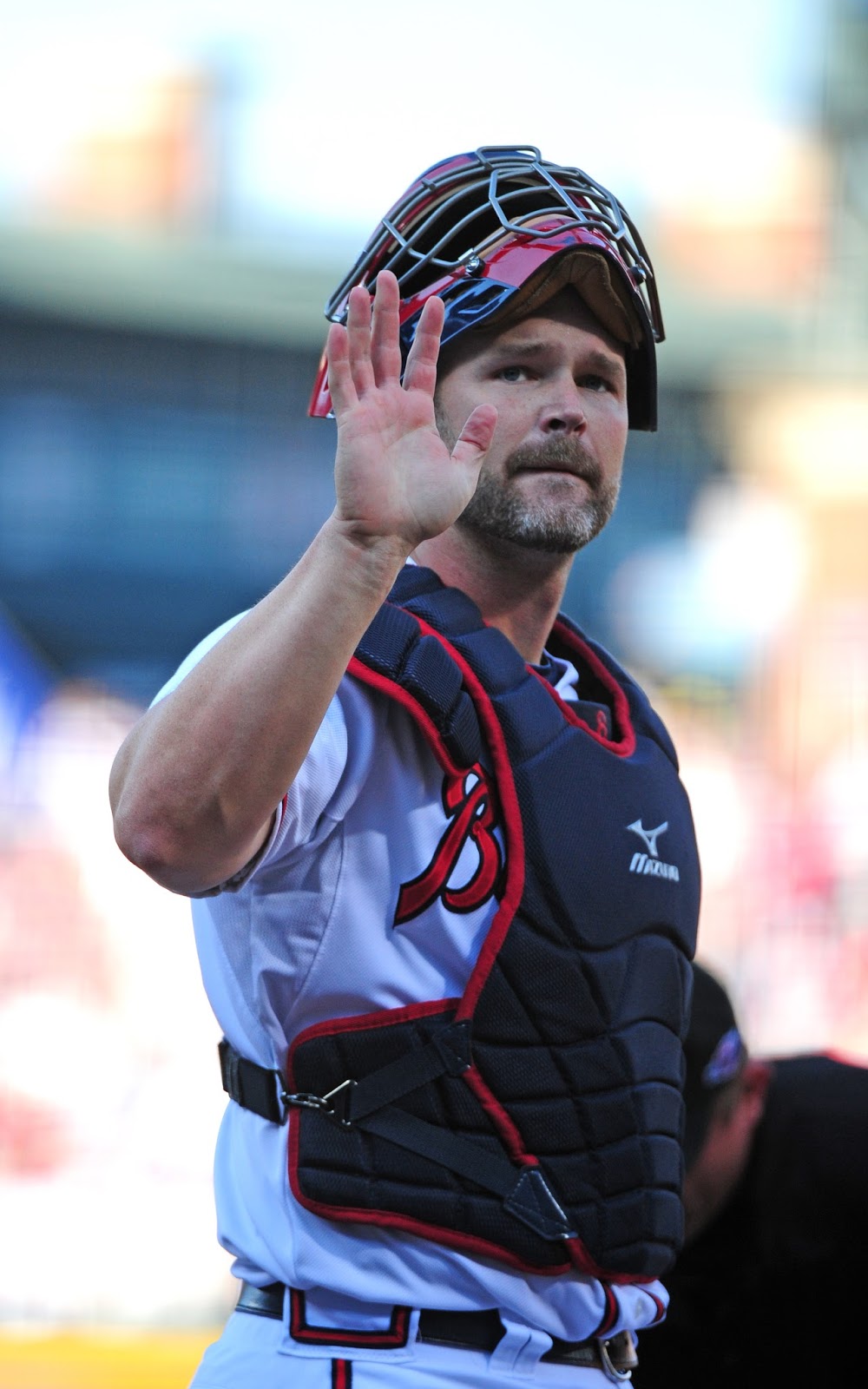
Backup catchers are sort of like backup quarterbacks. You might think spending money on one is a waste of resources until you need him to be there and produce. When that happens, you are happy that you had the foresight to get the best possible backup. For four years, David Ross fulfilled that role for the Atlanta Braves and they are still trying to replace him.

Born in March of 1977 in Bainbridge, Georgia, David Wade Ross later attended the aptly named Florida High School in Tallahassee. The Dodgers tried their luck with Ross in the 19th round of the '95 draft, but he passed and went to college - first at Auburn and then at Florida. It was at Auburn that he teamed up with center fielder and sometimes pitcher, Tim Hudson. Several years later, Hudson and Ross would again be teammates, but we'll get to that.

Ross had transferred to Florida for playing time and it led to him getting picked again by the Dodgers in '98, this time in the 7th round. Expected to be a power hitter behind the plate with advanced defensive skills, Ross began his minor league career in style with a .309/.412/.487 slash with Yakima in Short-Season A-ball after he was drafted. Two years later, a return trip to Florida with the Jacksonville Suns gave Ross his second .800 OPS season. He continued the good run with a .297/.384/.519 triple slash the following season with Las Vegas. His solid game got him to the majors in mid-summer of '02 and again in September. He would notably replace Paul Lo Duca in a 19-1 blistering the Dodgers gave the Diamondbacks. Long-time Cub Mark Grace took the ball to pitch the ninth and Ross put the cherry on the top with a first-pitch homerun. It was his first of what is currently 96 homeruns.

Ross missed much of 2003 before settling in as a backup in '04, though the results were terrible (.170/.253/.291). After failing to beat out Paul Bako for the backup job the next spring, Ross was sent to the Pirates. You might have forgotten he played for the Pirates - I know I did. He struggled with Pittsburgh. A late move to San Diego helped his season stats, but he still finished the year with a .671 OPS. Ross was nearing 30 and looked like a journeyman and not a particularly good one at that.

For the second consecutive spring, Ross was squeezed out of the opening day roster - this time by Rob Bowen - and the Padres dealt Ross to the Reds. It was in Cincinnati that Ross found a little stability. In his first year, he took advantage of the Great American Ball Park's generous dimensions to hit a career-best 21 homeruns with a .932 OPS. His follow-up campaign would see the power sustained (17 homeruns), but he simply could not get on base enough (.271 OBP). He would get a third year with the Reds and the results were a mixed bag. He improved his on-base ability, but his power nearly disappeared. The Reds moved on, releasing Ross that August. He briefly caught on with the Red Sox and would even play a game in the postseason.

That offseason, Atlanta was looking for stability behind Brian McCann. They had gone through Corky Miller, Clint Sammons, and Brayan Pena for two seasons. Pena was the only one to provide any element of offense, but the Braves didn't seem convinced he was a capable enough receiver. McCann had played 145 games, which is still his career-high, and by the end of the year, he continued to produce though he lacked the power he had showed so impressively earlier in the season. Ross would help the Braves in a number of ways. The Braves had gifted Todd Pratt to McCann in the latter's first full season of '06, but the still young-McCann could benefit from a guy who had seen much the game had to offer in Ross. Plus, Ross was seen as a leader for a staff that began the year with 23 year-old Jair Jurrjens and later added 22 year-old Tommy Hanson. While little was expected from his bat, the prevailing assumption was that Ross would be able to contribute a few taters and not be a complete zero at the plate like Miller and Sammons.

Year 1 went about as good as the Braves could have hoped. Ross triple slashed .273/.380/.508 with 7 HR. His pairing with McCann was brilliant and the drop-off was nearly non-existent. His leadership was also present for both McCann and the pitchers he worked with. In the second year of a two-year contract, he continued to excel for the Braves, slashing .289/.392/.479 with 13 doubles, the second-best total for any season of his career. He would go on to appear twice that postseason as a defensive replacement. One of his biggest knocks of his first two seasons came in the fifth inning of the August 31, 2010 game against the visiting Mets. The Braves had began the inning down 2-1, but a two-run double by Jason Heyward and a run-scoring single by Alex Gonzalez had put the Braves on top. A batter after Gonzalez, Ross chased Jon Niese with a Grand Slam to deep left.

After bringing back Ross on a second two-year deal, the Braves catching situation remained the best in baseball in 2011. Ross never matched his production from the first two seasons, but he slashed .263/.333/.428 in 171 PA - a stellar effort from a backup. He picked up his second two-homer game as a Brave on April 26 and on July 2, he smacked his second Grand Slam as a Brave, providing the edge against Jake Arrieta and the Orioles 5-4. On July 27, he tied a 1-0 game with an RBI single against Paul Maholm and the Pirates in the sixth and four innings later, hit a walk-off single to win the game. A year later, he remained sturdy with a .256/.321/.449 slash. While the season would go down as the year Ross started over a hurting and struggling McCann in the ill-fated Wild Card Game, I think 2012 should be all about August 8 in Philadelphia. It was on that night, as the Braves cruised to a ho-hum 12-6 win, that Ross reached first base with two outs on an error. On the second pitch to next hitter, Paul Janish, Ross stole second. In his eleventh year in the majors, Ross has finally stole his first base.

But sure, let's focus on that Wild Card Game. McCann's shoulder was shot and he needed offseason surgery to rectify the situation. The two catchers shared a good deal of time in September rather than there being a clear distinction between the two. It was McCann's worst season - well, until he became a Yankee. Over his final 19 games, McCann had hit just .209 with a .260 OBP and .328 slugging. So, it was not too surprising that Ross played ahead of McCann - yet it still seemed like it was. Ross stepped in and gave the Braves a boost, though. He singled twice and homered over four at-bats. And Fredi Gonzalez's decision probably would have been lauded had the umpires not changed what the meaning of the infield fly rule was. I'm half-kidding, of course.

The Braves had gotten away with paying Ross just $1.625M for the final two years of his Braves' run. Over his four years with Atlanta, he had slashed .269/.353/.463. He deserved a pay raise and the Braves couldn't match what he was worth on the open market. That was not a problem for the Boston Red Sox, who inked Ross to a $3.1M average salary. His season got off to a miserable as he hit the DL in mid-June with concussion issues. When he returned, he was able to regain his place as Jon Lester's personal catcher, which became important in keeping him in the mix for the playoffs. He began to steal time beyond Lester's starts from Jarrod Saltalamacchia and in Game 5 of the World Series, he picked up a go-ahead RBI double off Adam Wainwright that helped the Red Sox win and inch closer to a World Series title. Two days later, with Ross behind the plate, the Red Sox beat the Cards 6-1, giving Ross his first World Series ring.

After another year with Boston that included some miserable results, Ross again hit free agency and joined the Cubs. His first year there was miserable at the plate, though his value in the clubhouse and behind the plate still impressed many. He even pitched two games - and did really well (2 ING, 6 batters up, 6 batters down). He returns for a farewell tour this year that has attracted a great deal of attention, which is a testament to Ross the person moreso than Ross the player.

For four years, the Braves had the best catching situation in baseball with an All-Star and a capable backup. The years since have shown how rare that is to put together. With his career nearly up, one has to wonder what's next after 2016. With how well-liked he is and how his leadership is lauded, hard not to see a coaching future for Ross. Maybe that could be a pathway back to Atlanta. Just spitballing.
Rossy gets some air as Chipper Jones sends a ball through the air against the Phillies on 9/2/12.
Scott Cunningham/Getty Images
Recent Thursday Throwbacks...
Ryan Langerhans (2002-2003, 2005-07)
Special - Rafael Furcal's Near-Signing (2008)
Marquis Grissom (1995-96)
...or view ALL of them.

Thursday, September 17, 2015

Reviewing Hart's Trades: La Stella/Vizcaino

The Braves have been active in John Hart's first season at the helm to the tune of SIXTEEN TRADES! And I had to ignore a lot of the minor deals to come to that number. Sixteen deals involving major league talent going one direction or in both. Sixteen deals that include over 50 different players, a few draft picks, lots of cash, and two Uptons. It's been friggin unreal to see what the Braves have done.

With most of the season in our rear view, it's time to start reviewing each one of these trades. This series is going take a little while to get through, but hey, it gives me something to write about.

The Trade
Tommy La Stella to the Cubs for Arodys Vizcaino and $830,000 in international bonus slot money for the 2014-15 signing period. I reviewed the deal at the time here.

The Rationale
From the Braves side, La Stella was a well-liked - yet limited - prospect who started 86 games at second base during the previous season. The Braves felt so little about his defense that he was allowed to complete just 60 of his starts - a Chris Johnson-esque handling - and while TLS showed the plate discipline many lauded him for (36 BB/40 K), the Braves were not sold. His defense, again, was an issue, but TLS also was short on tools in his offensive game. With Gwinnett that season, he hit just one homer and stole as many bases as he was caught stealing (one) in 47 games. In 88 games, mostly with Mississippi, in 2013, he hit just a handful of homers. While there was optimism he could add enough doubles to fill out the stats card, it made for a guy who needed a high average (in the .290's) range to be productive. While TLS was propped up as the anti-Dan Uggla, that didn't make him a hot prospect.

Meanwhile, Vizcaino was returning to the Braves - where he made his debut as a 20 year-old in 2011. Despite that, he's almost two years younger than La Stella. Vizzy was a top prospect back in the day who, after he broke down with arm troubles, was traded to the Cubs in 2012 for Reed Johnson, Paul Maholm, and bags of cash. The Cubs had high hopes for him, but continued injury issues kept him out until 2013. He would appear in 45 games total with just a handful coming with the Cubs, who finally saw the guy they traded for three years before. The results weren't exciting, but the high-end potential still had a shot.

Short-Term Results
Neither player got off to a good start. TLS got hurt in his second game after opening the year in the starting lineup and batting ninth. For Vizzy, a PED-related suspension followed an underwhelming spring training (he had already been demoted to Gwinnett before the suspension had been announced). That left both players out of action until the summer. Vizzy began his 2015 season in Rome and would make his way up the ladder over eight ballgames with bad results across the board except for strikeouts (which the Braves were happy to see).

Once re-instated, Vizzy began as a middle reliever, but his importance would quickly increase with the injury to Jason Grilli and trade of Jim Johnson. By August, Vizzy was named the closer for the rest of the way - though the sad state of the Braves provides few closing opportunities. In 27 games, Vizzy has a 2.16 ERA and 1.28 WHIP to go with 25 K's in 25 innings. The walks (11) are a little on the high side and after allowing one run in his first 20.2 ING, he has been charged with five earned in 4.1 ING with two of them coming off the bat of Yoenis Cespedes. Overall, however, Vizzy has been excellent for the Braves and a rare bright spot in a bullpen that has looked awful.

La Stella made it back to the field just over a month after being hurt for some rehab games, but a setback made him miss June and most of July before finally getting back into the fold just as July was ending. He hit nice enough to get a recall to Chicago before rosters expanded and regularly been used as a 2B, 3B, and PH. The results have been pretty overall, though, and TLS is hitting just .205 in 43 PA over 18 games with the Cubs. In his defense, he's matched both his HR and SB output that he had with the Braves in 2014 (1 HR, 2 SB).

Long-Term Outlook
For TLS, he seems like a forgotten man in a system that keeps churning out infield prospects, but that hasn't changed anything from the moment the Cubs acquired him. He's a decent enough left-hand bat to have around for depth purposes, but he's likely going to need a change of scenery or a big hot streak to get much of a deep look with the Cubs.

For Vizcaino, though, the Braves have an exciting arm that will form the foundation of the 2016 bullpen. Whether the Braves grab an established arm to handle ninth inning duties or hand the title back to Grilli remains to be seen as Vizcaino certainly has the potential and velocity to be a shutdown reliever. He might not crack into the elite status of excellant relievers, but Vizzy's got a realistic opportunity to be a very solid pitcher out of the pen for the next several years. He'll also be arbitration-eligible for the first time this offseason. It's a weird case to keep an eye on because while we've seen some cool stuff from him, he lacks the totals you might except for a reliever who made his debut in 2011 (his next game will be career #50). I have a conservative $800K allocated to him going into next season, but that's a shot in the dark projection.

Probably the bigger picture look at this is from the international bonus slot money that came from the Cubs. After the trade, the Braves had a lot of international signings (which was a little unusual because the signing period began several months before). Of those signed that have already made their debut: LHP Jhonny Diaz (DSL, 3.63 ERA), LHP Kelvin Rodriguez (GCL, 18 K's in 24 ING), RHP Odalvi Javier (GCL, 2.37 ERA, 18 K in 19 ING), RHP Carlos Lopez (DSL, 3.64 ERA, 1.18 WHIP), RHP Bladimir Matos (GCL, 4.58 ERA), RHP Ali Pantoja (DSL, 3.16 ERA, 10 K/9), C Carlos Centeno (DSL, .533 OPS), C William Contreras (DSL, .783 OPS), SS Angel Perez (GCL/Rome, .503 OPS), IF Luis Mejia (DSL, .706 OPS), OF Leudys Baez (Dan/Rome, .697 OPS, 5 HR, 6 SB), OF Randy Ventura (DSL, .815 OPS, 55 SB), OF Isranel Wilson (GCL, 10 HR, .828 OPS).

A lot of names, I know, but at least two of them will be on some Top 30 prospect lists for the Braves (the last two). Now, knowing how much money the Braves were able to increase their available bonus pool by because the La Stella trade is difficult to pinpoint because I don't know how much money the Braves already had in reserve (they used a lot of it to sign Juan Yepez), but suffice it to say, their ability to add talent without a big penalty was increased by the TLS/Vizzy trade. That part of the deal won't get a lot of talk, but it could be just as important in the long run.

Overall, this was a shrewd low-cost, high-reward deal that is already paying dividends.

Thursday, August 20, 2015

Random Ex-Brave: Freddy Garcia

His career with the Braves lasted just 27.1 regular season innings, but Freddy Garcia humorously became a part of Braves lore by uttering a simple statement. "I just make pitch." Yes, Freddy, that you do.

Stephen Dunn | Getty Images
Garcia originally arrived in the majors in 1999 for a Seattle pitching staff that was still looking for answers in the post-Randy Johnson world. Speaking of the Big Unit, that's how Garcia joined the Mariners after being an Astros prospect. In his rookie year, he threw his first of a dozen career complete games on August 7, but took the loss. 17 days later, he toyed with a Detroit team that would lose 92 games that year, shutting them down for his first of four career shutouts while striking out 12. He needed 139 pitches to do it and the game was a career best for him in terms of Game Score (89) and set what would be his career high for strikeouts in one game (matched three years later against the Rangers).

Limited to just 21 games in 2000, the 24 year-old Garcia had his finest single season the following year. He paced the American League in ERA and innings while picking up a trio of shutouts. He was even better in the second half, increasing his strikeout numbers while walking fewer as the Mariners won 116 games. Garcia was an All-Star that season and in 2002, though his numbers aren't nearly as good. With the Mariners slumping two years later, they sent the righty to the White Sox for a trio of players, including Mike Morse. He stuck with the White Sox for two more seasons and pitched his final 200 inning campaign in 2006 - the 7th time in 8 years he had accomplished the feat. His highlight in the South Side came on October 26, 2005. With the White Sox leading the Astros 3-0 in the World Series, Garcia faced Brandon Backe. Yeah, pitching wasn't all that good back then. Each pitcher went seven scoreless innings with seven K's before the Astros went with Brad Lidge in the 8th. Willie Harris hit for Garcia and singled. Two outs, another former Brave, Jermaine Dye drove him in with a single. When Bobby Jenks induced a groundout from Orlando Palmeiro, Garcia was credited with a win in his only World Series game - a deciding one at that.

It might be tempting to read ERAs like 4.51 in his final year with the M's and 4.53 with the White Sox in 2006 and think that Garcia wasn't a solid middle-of-the-rotation arm, but over six years where he logged 200 innings or more (2001-06), Garcia averaged 3.7 fWAR. He was a good performer - often underrated as a result of never being overpowering. He was a bit better than Russ Ortiz or essentially a pitcher that's good, but looks even better on a great team.

But Garcia would struggle badly in 2007-10. Dealt by the White Sox to the Phils for Gavin Floyd and Gio Gonzalez (ouch) because his former GM, Pat Gillick, still liked him, Garcia couldn't stay healthy for the Phils in 2007. He finished the year with 58 innings over eleven starts. Despite pitching for a team that finished 16 games over .500, the Phillies were just 5-6 with Garcia on the mound. He reached free agency for the first time and nobody came calling to his liking. It wasn't until August 12 of 2009 that he finally got signed - by the Tigers. He made three starts in September and got beat around a little. After the year, he signed with the Mets, but failed to make their 2009 squad and was cut before the season.

A few months later, the White Sox brought him back and he would start nine games with them, showing improved control. That bought him a return trip in 2010 and he made 28 starts, though all of his numbers suffered and despite a nine-start run the previous year being worth 1.5 fWAR, he managed just 1.4 in three times as many starts in 2010.

Still, Garcia was now a guy who provided veteran "presents" and a team looking for depth could use that. Right before pitchers and catchers were scheduled to report to camp in 2011, the Yankees added Garcia. Along with Bartolo Colon, the two righties helped to stabilize the staff while youngins' Ivan Nova and Phil Hughes matured. Garcia posted the second lowest ERA of his career at 3.62 and appeared in his first game out of the pen since 2011. The Yankees resigned Garcia for the following year, but he couldn't stay in the rotation this time and suffered through a 5.20 ERA in a shade over a hundred innings.

2013 would be an interesting year for Garcia. He signed with the Padres, but couldn't earn a spot on a rotation that sported the likes of Eric Stults, Edinson Volquez, Jason Marquis and Clayton Richard. Instead, he was cut and picked up by the Orioles. It would be his first extended stint in the minors since 1998. Over 13 starts, he did his job to the tune of a 2.84 ERA. He also saw time with the major league club, though the results were ugly (5.77 ERA, 6.73 FIP, 2.7 HR/9). By late August, he was back in AAA and probably looking at a possible recall to the majors in September for blow-out game duty only, but luckily for him, the Braves were desperate.

Atlanta had seen Tim Hudson go down in a heap in Shea Stadium and Paul Maholm was working his way back from his own injury. Atlanta was looking for adding support in case Alex Wood, who was in his first full professional season, faltered. Enter Garcia, who started one game for Gwinnett after the Braves "purchased him" before joining the influx of players once rosters expanded for September. He appeared in three games out of the bullpen with his first outing lasting 4.2 scoreless in relief of Wood, who had surrendered seven runs to the Marlins. The Braves ultimately flip-flopped Wood and Garcia with the latter joining the staff for three starts between September 12-24. The Braves won two of them and Garcia pitched well enough to win the one that Atlanta lose (7 ING, 1 R to the Nats).

The Braves chose Garcia as the fourth starter over Maholm and prepared for the NLDS. Atlanta would split a pair of games at home before heading to LA and getting smacked around 13-6 in Game 3. With a win-or-go home game tabbed for Monday, October 7, the Braves saw the Dodgers go with Clayton Kershaw on short rest while Garcia took the ball for the Braves. Kershaw, who graduated high school the same year of Garcia's final 200 inning campaign, was a tough task even on short rest, but Garcia wasn't worried. He told David O'Brien, "I don't panic. I just make pitch." It was a stupid rallying cry, but it gave us hope. Maybe he could just pitch and get this series back to Atlanta.

His fifth pitch to Dodgers leadoff batter Carl Crawford was a homer. His sixth pitch to Crawford in the third was also a homer. But the Braves bounced back in the 4th. A single, an error, and a wild pitch set up Chris Johnson, who singled in a run. A groundout led to a game-tying run and Garcia was back even with the Dodgers' ace. He was pinch-hit for in the seventh with Elliot Johnson on third after a triple. Jose Constanza rocketed a 2-1 pitch up the middle for an RBI. Suddenly, Garcia was the pitcher of record. Just need nine more outs.

But had the Braves done that, we would have never seen dejected Craig Kimbrel with his arms crossed. So, I guess that's something. After Juan Uribe broke David Carpenter and the Braves lost, Atlanta was still impressed enough to bring back Garcia to compete for a starting spot. Injuries seemed to help his chances, but the signing of Ervin Santana and surprising pitching of David Hale led the Braves to cut Garcia. He would not pitch again until the winter leagues. He was a late spring pick-up by the Dodgers heading into 2015, but lasted a month before being cut from their AAA roster. Since June, he's pitched in the Mexican League.

Garcia has slightly more than 2,250 innings in the major leagues and been a part of some good teams. He rarely impressed so much that fans of other teams wanted him on their team, but - especially before 2007 - he often pitched well enough that his own team's fans were pretty confident they had a good chance to win after Garcia took the mound. Now 38, Garcia may try to stick around through next spring and hope he gets an opportunity to make a roster. Hey, if his old teammate Colon can still do it, why not Garcia?

More Random Ex-Braves
John Thomson
Kent Mercker
George Lombard

Tuesday, July 14, 2015

Once a Brave, Always a Brave - NL Central

I considered doing a special version of this series with the All-Star Game, but that would have been pretty short with, by my count, just two former ex-Braves in the All-Star Game. So, let's move on to this week's target, former Braves in the NL Central. As usual, this list should not be considered exhaustive. There might be - and probably are - a few misses. If you notice them, feel free to comment below.

Chicago Cubs
P James Russell - Released shortly before the season because the Braves liked their options in-house better and Russell had displayed reverse splits last year, the Braves could have used Russell after all. He quickly hooked back up with the Cubs and after a short run in the minors, he has been a pretty decent option out of the pen for Chicago. His peripherals don't look so pretty, but it's hard to put a negative spin on a 1.71 ERA.

P Rafael Soriano (AA) - Nobody was anxious to bring Soriano on board last winter and now, he's working himself into game-shape for an eventual promotion to the Cubs' pen. So far, he's appeared in four games for Tennessee. I assume he'll be in the mix once the MLB schedule gets going again.

C David Ross - There were a lot of people who wanted to bring Ross back this offseason. In the first half, Ross has hit a miserable buck-89 with no homers. That said, he has always been good behind the plate, though his caught stealing percentage has been well under 30% the last two years. He does remain a great option at pitch framing and Statcorner ranks him sixth among catchers. That's pretty good considering he's caught 2000 less pitches than the top five. He also tossed a scoreless inning earlier this year.

2B Tommy La Stella - He's missed most of the year with an oblique/ribs injury that he suffered after just two games. Considering how Jace Peterson has effectively replaced him, TLS had no place in Atlanta. With young Cubs firmly entrenched at second-and-third, TLS will likely be stuck playing backup whenever he is able to get back.

Cincinnati Reds
P J.J. Hoover - After a rough sophomore year, Hoover has bounced back to be the best Reds reliever not from Cuba this year. He's done something new this year, though. I personally watched him three or four times when he was a Myrtle Beach Pelican a few years ago and the one reason I never bought into him was that he routinely got the ball too high, where it got blasted. This year, he has a GB% of 43% which is about a 15% climb over his previous work. It's cost him in terms of strikeouts and SIERA hates him for it, but I like it.

P Jason Marquis - Unfortunately, Marquis is no longer a Red. His return to the bigs after missing 2014 lasted nine starts. If you'd like to read more about Marquis's career, read my Random Ex-Brave report on him from May.

OF Jason Bourgeois - Hard not to love a guy like Bourgeois. He's never logged more than 252 PA in a season in the majors, has played in 257 games in parts of eight years in the majors, and turned 33 last January. But here he is...still struggling to stick. He never played for the big-league Braves, but did spent 119 games with Richmond in 2005. If I recall correctly, he had a decent spring and some thought he could stick, but he didn't. The only positions he hasn't played professionally are pitcher, catcher, and first base.

OF Jose Constanza (AAA) - Yeah, the bat licker lives. He's hit just .256 in 41 games with Louisville after the Braves cut him before the season. Before that, he had spent four years with the franchise - mostly spent at Gwinnett. He did get into 112 games in the big leagues and routinely played ahead of Jason Heyward in 2011.

Milwaukee Brewers
P Jaye Chapman (AAA) - A long, long time ago, or 2012, the Braves traded Arodys Vizcaino to the Cubs for a pair of major league veterans in the form of Reed Johnson and Paul Maholm. Joining Vizcaino was Chapman, a 16th round pick back in 2005 who was a draft-and-follow (meaning he signed the next year). Chapman got into 14 games down the stretch for the Cubs and posted a 3.75 ERA. He hasn't been in the majors again since. Instead, the reliever missed most of 2013 with injury, pitched 50 games with Bridgeport of the Atlantic League last year, and has gotten the call 36 times over two different levels this year.

2B Pete Orr (AAA) - Orr has been around so long that he played for the Jamestown Jammers back when the Braves had a short-season A ball team. Orr was part of the Baby Braves movement in 2005 when he hit .300. Subsequent efforts over the next two year were steadily worse and Atlanta released him following 2007. Unlike a lot of AAAA filler, he hasn't been in a new uniform each year. He spent three years in the Nats' system, three with the Phils, and is in year 2 of the Brewers organization. He is a career .266 hitter in the minors and stole his 200th career base last year.

OF Kyle Wren (AAA) - Traded away because he had Wren Stink all over him, Frank's son hasn't homered since 2013. But after hitting well in AA, he was promoted to Colorado Springs. Despite hitting in what is a hitter's league with the thin air of Colorado Springs, Wren has struggled over his first 23 games in AAA. Still, he is a career .298 hitter with 106 steals in 268 games so I imagine he'll get it going.

Pittsburgh Pirates
P Jeff Locke - While his All-Star season was impressive (at least until after the break), Locke has been pretty average since then. He still walks too many and the arbitration-pending southpaw will be an interesting decision for the Pirates to make. They'll probably give him a long-term deal like they gave to...

P Charlie Morton - Morton is still owed at least $9M. He's good enough when he can stay healthy, though he has never made 30 MLB starts in a season and won't buck that trend this year. Now 31 years-old, Morton has pitched in parts of eight years in the majors. It really doesn't feel like it's been that long. Guess I'm getting a little old.

UT Wilkin Castillo (AAA) - One of Jose Constanza's teammates on the 2011 G-Braves, Wilkin is an interesting guy to have around. Over a career that began in Missoula as part of the Diamondbacks organization in 2004, Wilkin has played every single position and finished the feat this year with Indianapolis as he pitched for the first time. With Gwinnett, he hit just .262 being mostly utilized as a catcher, though he did play 1B, 2B, 3B, and LF as well.

3B Edward Salcedo (AA) - Maybe the biggest international signing bust during the Frank Wren era, Salcedo was traded to the Pirates after Wren's firing. He's hit just .233 with ONE homerun this year. He has added 1B, LF, and even pitcher to his positional flexibility. He walked three (included one intentionally) and surrendered a one while retiring one of five batters. Unlike most hitters who pitch out of need, it wasn't a bloodbath Salcedo was finishing. It was an 18-inning game on June 11th where both sides were out of pitchers. Getting the win was Brock Stassi. He's usually a first baseman, but he did throw three innings that night.

OF Gorkys Hernandez - The final player the Braves gave up for Nate McLouth in 2009? Gorkys. He would make his debut with the Pirates in 2012, but was soon traded to the Marlins, who traded him to the Royals, who sold him to the White Sox. Anywho, last offseason, he signed with the Pirates and recently was promoted to the majors where, for the first time, the Pirates have all three of the guys they got for McLouth on the roster at the same time. Baseball's fun!

St. Louis Cardinals
P Adam Wainwright - Tore his achilles back in April, but he apparently wants to pitch again this season, especially once the Cards head to the playoffs. That's a tough guy. The Cardinals obviously need him...with their 2.71 ERA this year and all.

P Jordan Walden - He got off to a good start, pitching in 12 games where he allowed just one run, but bicep inflammation has had him out of action since the end of April. He has yet to appear in a rehab game, but might be back before the end of July.

OF Jason Heyward - More of the same for Heyward, though he has been healthy. Great defense in right field, amazing speed on the bases where he also adds smart baserunning, and just okay offense at the plate. Some of the power is back (two homeruns off last year's total), but some of his walks have been sacrificed for power. Overall, the soon-to-be free agent is going to have a tough time convincing someone he deserves $200M without a 2004 Carlos Beltran-like postseason.

Recently Profiled in Once a Brave, Always a Brave...
NL East
AL West
AL Central

Sunday, February 1, 2015

Braves With a New Year Remodel

The title is a little off, I'll admit. After all, this entire offseason has been a remodel with the Atlanta Braves experienced a great amount of turnover that began with the firing of Frank Wren. Still, this last week saw a flurry of activity, though most of this was on minor league deals. We said goodbye to a pair of Braves I hated seeing with the tomahawk on their chest while we also welcomed more new faces we don't know much about. Let's recap.

Braves Sign C John Buck to Minor League Deal


Let's go back to the year 2010. Oil was gushing into the Gulf of Mexico, miners were rescued in Chile, and NBC pulled the plug on Conan O'Brien. North of the border, Buck would homer 20 times and go to an All-Star Game. All of these things would be outliers during Buck's career, including the one year in Toronto. He would get big money from the Marlins before being shipped back to Toronto in the mega deal where the Marlins transferred their entire payroll to Toronto. The Jays didn't keep Buck long, moving him to Flushing in the R.A. Dickey trade. He wasn't even allowed to stay in New York long before they sent him to the Pirates. Overall, Buck has not posted an OPS higher than .683 since that 2010 year with the Jays and spent last year with the Mariners, Angels, and Anaheim's AAA squad. He still provides pop as evidence by his 15 homers in 2013 with the Mets, but he doesn't have much of a hit tool nor does he take walks. Still, he will provide decent support at Gwinnett. Historically, Buck has plus grades at blocking pitches, but sucks at pitch framing (which the Braves sucked at in general last year.)

Braves Designate OF Jose Constanza for Assignment


After finally completing the contract for Dian Toscano, the Braves did something that probably made their manager cry himself to sleep. Constanza has appeared in 112 games with the Braves over the last three years, though most of his playing time came in 2011 when Fredi Gonzalez played Constanza over Jason Heyward because Fredi sucks as a manager. Well, that's not fair. Heyward was struggling and Constanza had fooled the entire league into pitching batting practice to him. I guess licking a bat is some weird voodoo? Constanza's kind of funny in that he is allergic to extra base hits. He batting .314 for Gwinnett in 88 games, but managed just 15 extra base hits. Last year, in nearly 500 PA, he had 12. Mind-boggling.

Braves sign P Eric Stults to Minor League Deal


Having added a few young prospects to the mix along with Wandy Rodriguez, the Braves continued to add to their plethora of guys you might be surprised are still in the league. Stults, a 35 year-old left-hander, settled into a full-time starting role for the terrible Padres the last two years and was better in 2013 than he was in 2014 (3.53 FIP vs. 4.63 FIP). Stults is your rare 88 mph fastball throwing pitcher who does not induce enough groundballs and lives on the outside corner. But he doesn't put many batters away so he's stuck trying to get guys out with a myriad of unimpressive pitches. Ultimately, I guess he's not much worse than Paul Maholm, but that's a low bar to set for a guy.

Braves sign C Jesus Flores to a Minor League Deal


Another guy in the mix in case an injury or A.J. Pierzynski's utter incompetence, the Braves sign the former National to both give them spring depth and compete with Buck for playing time with Gwinnett. Flores is an interesting story. A Rule 5 pick by Washington, Flores joined the Nats in 2007 when he otherwise would have been in AA for the Mets. Naturally, he struggled. But the Nats sucked back then and could deal with a raw catcher on the bench. How much that hurt his development - that is the bigger picture. Flores would get a majority of the starts in 2008 and did show some pop, but not much else. Over the next four years, he was largely a supporting cast member who dealt with a series of injuries while appearing in around 130 games for the Nats. He has spent the last two seasons in the minors. Injuries remain a concern and he hasn't really hit since a nice 29-game run with the Nats in 2009. Probably more of a backup in case Buck starts the year in the majors.

Braves Trade P's David Hale and Gus Schlosser to the Rockies for C's Jose Briceno and Chris O'Dowd


Before I get into the meat of the week's biggest deal, isn't it a little weird that the Braves traded one kid of a fired GM (Kyle Wren) and acquired a kid of another currently unemployed former GM. Granted, Chris's dad, Dan, stepped down after 2014, but it is still kinda funny. To me, at least.

This one caught a lot of people off guard in that Hale seemed like a strong contender for the fifth spot in the rotation. I have gone over more than a few times why I was not a big fan of Hale's, but he still had a big chance to open the season with the Braves either as a starter or a return to long relieving. Hale was what I like to call a "casual fan's guy." The casual fan sees a 3.30 ERA and maybe they saw someone tweet about Hale's sparkling 2.45 ERA as a starter and doesn't understand why the Braves would ever trade Hale. These fans took to social media to call Hale a "stud" and one person sarcastically remarked, "yeah, because you can't have enough pitching." I understand the sentiment. Hell, I hated on the guy at every turn, but I grant you that the Braves could do worse than Hale. Not much worse, but I digress. Now, whereas the casual fan sees those numbers, the more dedicated fan sees a nearly equal K/BB (1.13) and a 1.47 WHIP and thinks "something doesn't quite match up with that ERA." When that happens, you almost hope the guy gets traded before the bottom falls out. Though, I will miss Schlosser. Just enough guys named Gus in baseball.

As for what the Braves got, O'Dowd isn't much of a prospect, though neither was Wren. He gives the team some catching depth who likely will be at Mississippi next year to hold the seat warm for...Briceno. He's the only real prospect in this deal. Just 22, Briceno has played five seasons of professional ball including the last three in the states. In that time, he has slashed .280/.342/.433, which are respectable numbers for a catcher. He's noted for having a strong arm and scouts seem to believe he has enough potential to max out as a starter in the majors. He likely will be at Carolina this year, though he could jump to Mississippi quickly. Trading a pair of players who had little future with your team to get a guy like Briceno is a smart move by Hart and maybe a move we look at a few years from now as a big trade.

Monday, June 30, 2014

Trade Winds: The Perennial Losing Chicago Cubs

Unlike the teams I've profiled that would appear to be sellers, the Cubs did not add salary this season. In fact, they dropped about $14M in payroll from 2013, continuing a downward trend that began after about $144M budgeted for 2010. With at least five free agents pending, the Cubs certainly will be attempting to have a similar July that they did last year when they cashed in Scott Feldman, Matt Garza, Scott Hairston, and Alfonso Soriano. Theo Epstein and company are shrewd in trades, especially when there is a seller's market like with Garza.

On the plus side for the Cubs, they have shown improvement so far. Their .425 winning percentage is better than the last two seasons and their run differential of -14 gives the impression that the Cubs are rather competitive.  And there is a beginning of a core in Chicago that should help them get better provided they can find talent to surround those players. That's where the trade deadline comes in. While buyers will often end up regretting the deals they make if it doesn't result in a ring, sellers can grab young, team-controlled talent.

Would the Cubs make attractive partners for Atlanta? First, let's look at the pending free agents, the players the Cubs would feel the most pressure to trade rather than possibly get nothing depending on a qualifying offer.

Amazingly, no one wanted Jason Hammel this offseason. He didn't find employment until right before the season when the Cubs locked him up to an one-year, $6M contract. Hammel had been a very good starter for the Orioles in 2012 with a 3.29 FIP and 1.24 WHIP, but his numbers were poor last season. Unlike other average starters, Hammel's issue was that he wasn't an innings eater. He threw 170+ in three consecutive seasons for the Rockies between 2009-10, but his average in the five years since becoming a starter was 156 innings. Teams will pay for less than spectacular talent, but they expect innings. One of Hammel's teammates in Chicago, Edwin Jackson, has made an entire career of just throwing innings.

Since joining Chicago, Hammel has had probably his best run of pitching of his career. The 31 year-old has a 2.98 ERA and 3.11 FIP to match it. If that wasn't good enough, his WHIP of 1.01 is ridiculous considering his career and he already has one more strikeout than he did last season. Hammel looks like he's headed to a big pay day. Will it come after a couple of months with a Braves jersey on? Well, the Braves are linked to Hammel and with the injury to Gavin Floyd and recent string of "meh" outings from Aaron Harang, the interest would appear genuine. Hammel would seem easier to acquire than Jeff Samardzija, but can we buy into Hammel? His numbers show no real sign of a possible return to the mean, except that he does have the best control of his career (1.8 BB/9 compared to 3 BB/9 in his career). However, the Braves aren't the only team that could use Hammel. Unlike others, the Braves don't have a deep minor league system. Hammel would seem like a tough player to acquire without getting very creative and possibly adding a third team.

Emilio Bonifacio would also be a target, but he carries a certain amount of risk. Bonifacio has yet to begin baseball activities after being placed on the DL on June 13th with a strained right oblique. One of the most difficult injuries to get a read on is oblique injuries, as our old friend Tim Hudson knows. Provided he starts to progress, Bonifacio should be targeted by many teams for his flexibility, speed, and switch-hit bat. He was a big pick-up for the Royals last year as they tried to make a run toward a Wild Card spot and he hit .285 with a .700 OPS and 16 steals. Bonifacio has experience at all three outfield positions along with all of the infield spots except for first. He's hitting .261 and is overexposed as a starter. As a backup, he fits a nice 25th man role.

Chicago's other free agents are unlikely to attract much attention from Atlanta. They have no need for catcher John Baker and the other two, Nate Schierholtz and Carlos Villanueva, have been pretty bad this season. Offensively, outside of Bonifacio, there would seem to not be a decent fit. None of their players fit much of a role for the Braves.

Of course, of guys the Braves can team-control past this season, Samardzija would appear to intrigue the Braves. Averaging 8.6 K's every nine innings with a 1.20 WHIP, the former Notre Dame receiver has been talked about more about his win-loss record than anything. He recently declined an extension offer and the Cubs might want to cash in a huge chip when his value is at its highest. Problem with Samardzija for the Braves is that they have been burned by the big trade before. Giving up a lot of talent and not being able to sign Samardzija to a long-term contract would be a tough pill to swallow. Of course, if the Braves win it all, it becomes definitely easier to swallow that pill with a smile. Still, I can't see the Braves making the midseason blockbuster trade in this case.

They could instead seek out the price on lefty James Russell. With one more year of team control through arbitration left for Russell, he would appear to be a good target, though his numbers this season are not tremendous against lefties (.220/.304/.415). However, he's been very good of late and in his last 19 games, he has pitched 15 innings with only one unearned run allowed to go with eight hits, four walks, and 12 K's. He is a very good groundball pitcher.  While his numbers are good against righties this season, it probably is a little flukish and Russell should be kept from facing lefties. If the Cubs don't want to deal Russell, they might be more open to trading Wesley Wright, who they got last season from the Astros. He's similar to Russell as a LOOGY, though his K rate is a little down. Either pitcher would appear to fit a roll and keep the Cubs from possibly paying $4M or so for two LOOGY's next season.

The Cubs seem like a perfect target for a two birds, one stone type trade, the kind of move the Braves made two years to get Paul Maholm and Reed Johnson from the Cubs. Bonifacio and one of the lefties would appear to fill two holes for the Braves, pending Bonifacio's health. It would probably be less demanding of a trade than the Padres and Diamondbacks would demand for Seth Smith and Joe Thatcher, though the quality of the package is significantly less, too. Either way, the Cubs are a team to keep an eye on for Atlanta. I doubt the Braves make a move this July for a starter, but the Cubs have other pieces the Braves might be keeping an eye on. While reports will talk about how the Braves's scouts are at Cubs games to see a starter, it might be the other roster pieces they see as potential fits that the scouts are really there to see.

Wednesday, June 11, 2014

A Fun Coors Night

Some notes from Tuesday's slugfest in Coors Field...

It was the most runs scored since September 2nd when the Braves smacked the hapless Mets 13-5. It was the most runs during a road game since last July 6th, a 13-4 win over the Phillies. Last year, the Braves scored ten runs in Coors Field with both of the Uptons going back-to-back in a 10-2 win. The last time the Braves scored 13 at Coors Field came on May 5th, 2012. They were down 6-0 after Mike Minor got blasted (sound familiar?), but outscored the Rockies 13-3 after the second inning. Livan Hernandez recorded the final five outs for his only major league save.

The last time the Braves scored at least tens while surrendering ten runs was July 20th, 2012 against the Nationals. That was a game in which the Braves battled back from 9-0 after five to take the lead in the 9th, only to have Craig Kimbrel blow it by giving up a homer to Danny Espinosa. Paul Janish (of all people) singled home Dan Uggla (of all people) on a popfly that eluded the drawn-in infield and Chad Durbin (OF ALL PEOPLE) picked up the save with a shutdown eleventh to conserve the 11-10 win. This was also the last time the Braves scored at least ten runs and a reliever picked up a save. Kimbrel hadn't done it since May 30th, 2012 against the Cardinals, conserving a 10-7 win.

The last time the Braves scored at least 13 runs while surrendering at least ten runs was May 2nd, 2012. Played at Turner Field, the Braves fell behind 6-0 by the bottom of the fifth, battled back and took an 8-6 lead, fell behind 12-8, pulled ahead 13-12, and again Kimbrel blew it in the ninth. In the bottom of the 11th, Chipper Jones hit a two-run walkoff homer that absolutely deflated the Phillies.

The Braves not only scored 13 runs, a season high, but they banged out 16 hits. That was one more than the 15 they had in a 9-3 win against the Marlins on May 19th. The Braves are 10-0 when they have more than ten hits and 13-3 when they have at least ten. The Braves never had exactly 16 hits last season, but they had more than 16 four times, most recently when they finished a 12-5 thrashing of the Phillies with 17 hits last September 29th in the final game of the year. The game included Christian Bethancourt's only current major league at-bat, a strikeout. Elliot Johnson (SERIOUSLY, OF ALL PEOPLE) had 5 RBI and Gerald Laird went 4 for 4. The last road game with 16 or more hits was last July 6th when the Braves had 18 hits while humbling the Phillies.

The Braves have given up ten or more runs twice this season, the other time coming on May 14th against the Giants. Unlike that game, all ten runs this time were earned. The last time that happened was last July 20th, when the White Sox beat the Braves 10-6. That game was started by Paul Maholm, who got the call in all three of the starts the Braves gave up ten runs last season.

Three of five inherited runners scored last night, the most this season. The Braves allowed three inherited runners to score in a 3-1 loss last September 21st to the Cubs.

So...last night was a little weird, though not too strange. Fortunately, it ended in a victory. I had really no problem with Minor being left out as long as he was. In a true Coors Field game, your pitcher forgets about his ERA and just tries to give you innings. Minor didn't have it, but kept the Braves from using the entire bullpen. Hopefully, the offense takes a little of Coors Field with them after the series.