-->
Showing posts with label WilliamContreras. Show all posts

Wednesday, October 11, 2017

Organizational Overview: Catcher

WhatProsWear
Yesterday, we began a series looking at the best prospects by position starting with catcher, but I'd be remiss if we didn't also look at where the Braves stand at catcher right now. After all, just because a position is a strength in the minors doesn't need help right now. Conversely, a position like first base looks pretty weak in the minors, but the Braves aren't that interested in addressing that because of who they have in the majors.

This series of articles will look at both the recent past - especially 2017 - and the foreseeable future. It will take into account the current major league roster, the current depth in the minors, and the future of the position. Think of this series as a way to look at the strengths and weaknesses of a roster before attempting to fix problems moving forward. I will use some of the information I already released about the current roster makeup as a reminder.

Signed: Kurt Suzuki ($3.5M)
Arbitration: None
Renewal: David Freitas and Tony Sanchez
Option: Tyler Flowers ($4M, $300K buyout)
Current Projection: $7.5M

On a roster in flux, there is some degree of stability behind the plate. Tyler Flowers will almost certainly be brought back for 2018 and once again will be paired with Kurt Suzuki. We will get to the details on how effective this duo was in 2017, but it's very important to remember that the price per value here is exceptionally high. The Braves are essentially paying the price for a medium-grade starter for two catchers who are capable of being starters in the majors. However, both are probably better for the time share they played under last season. Catchers are naturally prone to breaking down as the season progresses, but the Braves avoided that by having their duo share the load.

The other 40-man options right now are unlikely to be in the mix by opening day. Freitas is Triple-A filler while Sanchez, more known for his defense, didn't even catch an inning after being acquired at the waiver-trade deadline.

Comparison - The Majors

The duo of Flowers and Suzuki lack the name recognition and neither will be All-Stars in 2018, but for one year, they gave the Braves the best production from behind the plate in the league. Only four teams received at least 4 WAR from their catchers in 2017 and only the Braves pushed over the 5 WAR cliff - finishing with 5.1 fWAR to be exact. They were tied for fourth in homers, third in ISO, first in wOBA, and first in wRC+. Defensively, they were slightly below-average - largely because Flowers gives up defensive value for framing - something he's the best at in baseball.

Because the Braves can keep both Flowers and Suzuki moving forward, the position looks to have zero upheaval heading into 2018. It might be a pipe dream to expect the Braves to get another 5-win season from their catchers - it was shocking that it happened once - but both Flowers and Suzuki credit Kevin Seitzer for their improvements at the plate and the Braves certainly could bring back Seitzer for another season. That would keep a good team together for another year, though the Braves are rumored to look at some considerable alterations to their coaching staff despite bringing back Brian Snitker.

Regardless, the Braves should rank among the top 10 or so teams heading into 2018 behind the plate even if individually, both of their catchers are ranked much lower. The Cubs, Dodgers, Giants, Yankees, Marlins, and possibly the Mariners should all rank ahead of them on the strength of their number one catcher. The Orioles and Tigers, a combined 7.2 fWAR between them, will be tasked with rebuilding their catching situation. Welington Castillo could return to the Orioles, but after a big year, he'll likely seek out a long-term deal rather than come back on a player's option while the Tigers already dealt Alex Avila last season.

Obviously, there are a lot of dominoes that will fall this offseason, but the fact the Braves have two respectable catchers who put up the kind of numbers that they did in 2017 makes this position a strength heading into 2018 compared to the rest of the league.

Comparison - Immediate Depth

I don't want you to get the wrong idea - this is simply what kind of depth is already projected to be in the minors who could be on the major league roster when the season opens next year. The Braves have a lot of catching prospects - and I'll get back to them - but their best prospects are not likely going to be in the mix next April. However, the Braves do have Kade Scivicque and that isn't the worst thing in the world. Scivicque missed our Top 5, but is probably a Top 50 prospect in this loaded system so don't sleep on him. He doesn't project as much more than a backup in the majors, but is smart and capable behind the plate. He has some gap power and while aggressive at the plate, will make enough solid contact to possibly post a good average if the BABIP allow it.

The Braves could bring back Freitas or Sanchez for more depth and they also have Sal Giardina and Joseph Odom, who both appeared in Gwinnett last year. Neither, however, project as much more than organizational filler and the Braves don't need Freitas or the rarely utilized Sanchez. Beyond them, you have last year's Double-A duo of Jonathan Morales and Alex Jackson. Morales is a lot like Giardina and Odom, but Jackson is a legit prospect if he can stay behind the plate. Actually, with his bat, he's a legit prospect anywhere, but he brings more value as a catcher. Reports were mixed about Jackson, but he did appear to look much more comfortable as the season progressed after moving from the outfield. If he continues to respond to coaching, Jackson could be knocking on the door sometime next summer. Despite not being in the mix when the season opens, Jackson is still slated to open 2018 in Gwinnett if only because that's where the at-bats because there's so much depth behind him. Even if an injury opened a spot in the bigs, I think Scivicque is ahead of Jackson for the time being, but at some point in 2018, that's going to change.

I'd classify the immediate depth as average, but trending up.

Comparison - The Future

The Braves might not have any of their catchers make one of the big Top 100 Prospects list this winter, but the depth here is off-the-charts. I already mentioned Jackson, and he received the most points for our top catching prospect in our recent list. The great thing about the catching depth is that it's spread out pretty well. Here's a brief projection with the Top 5 catching prospects and others that likely will be in the mix.

Gwinnett: Alex Jackson (#1), Kade Scivicque (Honorable mention), Joseph Odom.
Mississippi: Brett Cumberland (#3), Jonathan Morales, Sal Giardina
Florida: Lucas Herbert (#5), Carlos Martinez, Tanner Murphy
Rome: William Contreras (#2), Hagen Owenby
Danville: Abrahan Gutierrez (#4), Alan Crowley, Zack Soria

Not too shabby. The best combinations of offense/defense of the group are likely 2-3 years away in Contreras and Gutierrez, but there's a pair of good offensive talents in Herbert and Cumberland with a lottery ticket in Herbert mixed in whose bat could develop well enough to increase his prospect standing. This list does not include Drew Lugbauer, who was classified as a first basemen due to where he played the most. Still, Lugbauer gives the Braves another possibility even if it's as a part-time catcher/corner infielder coming off the bench.

No matter how you slice it, the future is a major strength for the Braves and likely one of the best catching prospect situations in baseball - if not the best.

The Big Picture

When it comes to the catcher position, there are few teams in a better position than the Braves. Sure, the chances of the Braves having the best production in baseball from their catchers in 2018 is not high, but there's also a strong chance that both Flowers and Suzuki perform well enough to lead the Braves to a solid season from behind the plate. The coming attractions, though, is where the Braves turn the catcher position into something special. It's hard not to think the Braves should be good behind the plate for the next decade.

Tuesday, October 10, 2017

WOW's Top 5 Catching Prospects

The 2017 season for the Atlanta Braves has come to a close and now we begin to look forward into 2018 and beyond. This week, we begin a series that looks at each position and the prospects that the organization currently have - starting with a position of great depth in catcher. It wasn’t long ago that the Braves had Cristian Bethancourt and that was about it. Nowadays, that has changed as all five catchers who made this list likely will be in our preseason Top 50 (provided they aren’t traded). In fact, a sixth catcher will likely get included in our Top 50 who wasn’t voted into this Top 5. That’s how deep this position is now.

Later this week, we’ll publish the first base list, which is...well, not quite as deep. Or deep at all.

Here’s how we arrived at our list. - each of the three writers at Walk-Off Walk voted on their Top 5 catchers (plus one extra) and we took the composite rank. Ties are broken by the individual’s highest ranking among the voters. Positions are determined by which position a person played the most at (with a few exceptions).

Also receiving votes: Kade Scivicque

Top 5 Atlanta Braves Catching Prospects


Jeff Morris - Follow on Twitter
1. Alex Jackson

Tommy: With Jackson, the question is less his bat, but it's still worth starting there because he had the kind of year many expected would be the norm for him after being the sixth overall selection of the 2014 draft by Seattle. He slashed .267/.328/.480 on the year with 19 homeruns while taking his first swings at both High-A and Double-A ball. Now, we can't NOT mention the 26% strikeout rate with a walk rate about 20% less, but it's still a solid showing for his Age-21 season. This was also Year 1 of the catching experiment. A backstop in high school, Jackson was converted to the outfield after the Mariners selected him and remained there for the first three years of his career. He wasn't an asset behind the plate, but he looked more and more comfortable as the season progressed and the Braves gave him more and more time as a catcher. Early returns on his framing were encouraging in that he looks average there. I say that's encouraging because if your baseline is average, that means you could improve to make framing a solid skill. He's got the arm for the position, but the footwork and pop-time will need a good deal of work. Keep in mind - this season was about finding out if Jackson could catch at a reasonable level. I think he can do that enough to stay there. He may never be a defensive marvel, but he could be better than Evan Gattis and with his offensive potential, that's plenty of value. Of course, a switch back to the outfield remains a possibility.

Ryan: I saw some video early in the season of Alex Jackson behind the plate and it was being nice to say he needed work. However, I watched quite of bit of him catching throughout the season and he improved considerably. By season’s end, one could squint and see a catcher in the making. Still, it was barely over a 50 game sample and that’s just not enough to prove/disprove anything. I think he ends up being a catcher at the big league level but it could take 2 more full years for that to happen.

Stephen: So, I’m usually the low man on Jackson’s ability to stay at catcher. I personally asked two scouts while at AA game what his future position would be and both said outfield without hesitation. This lines up with just about everything I’ve read from scouts and evaluators. He’s still young enough where nothing is written in stone but if his bat starts advancing at a higher rate than his glove, the organization is going to have to decide whether a Bryce Harper-like path is optimal for Alex. If putting him in the OF gets him in the lineup quicker, they might make the move. The biggest thing he has to work at the plate is the K rate. Get that under 20% and he’s a major league hitter right now. I’ve got high hopes for Jackson as a hitter and as a LF, I think he’s a major league regular.


Jeff Morris - Follow on Twitter
2. William Contreras

Tommy: The only reason - and I mean the only reason - that Contreras wasn’t my #1 was because he’s still in rookie ball and I think Jackson’s bat is so good that he’s on a path to the majors regardless of position. That said, I may change my mind by the time we reconvene for a preseason Top 50. Contreras is a joy to watch from a defensive standpoint. Such a joy that you almost forget that he hit .290/.379/.432 this season as a 19-year-old in the college-age Appalachian League. The defense, though, is worth the price of admission (well, at least in the minors). He’s smooth behind the plate and athletic. The framing is difficult to judge at this point, but he seems to have a feel for it. Footwork needs improvement, but the arm is a true 70-grade weapon - at least. Frankly, the more I write about him, the more I want to change my vote. If you followed me on Twitter during the Danville Braves' games I saw this year, you know that my man crush for Contreras grew every time I saw him. In an organization full of exciting prospects, only a select few are more intriguing to me than Contreras.

Ryan: Contreras is the guy that we as Braves fans should be most excited about in terms of a real catcher. He’s got the pedigree (obviously) and every scout out there drools about his athletic ability behind the plate. However, passed balls and blocking balls have been an early problem and that brings nightmares of Christian Bethancourt back into my mind. Hopefully, Contreras will disprove my insecurities this upcoming season and take that step forward that Bethancourt could never seemingly get past. If so, he’s the number #1 catching prospect for the Braves and could be knocking on the door of number #1 in baseball by the end of 2018.

Stephen: The other reason I think Atlanta will be more inclined to move Jackson to the OF is the emergence of Contreras. The reason I ranked him number one on my personal list is one, there’s zero doubt he stays at catcher, and two, his bat is much more than just an afterthought. Everything he does behind the plate is smooth and will only get smoother to go along with a howitzer hanging off his right shoulder. The bat is quick and produces hard contact consistently, putting up wRC+ of 125, 120, and 121 in his first 3 seasons. He’s going to have to hit the ball in the air more to produce more power but the talent is real and tools are there.

Jeff Morris - Follow on Twitter
3. Brett Cumberland

Tommy: Cumberland's season was a study in streaks. As May 17th began, Cumberland was slashing .183/.426/.338 due to 30 BB+HBP in 101 PA. From that date until his promotion to High-A a month later, Cumberland hit .317/.437/.663. A similar story happened after the promotion as he hit .188/.297/.281 in his first 20 games with Florida, but rebounded to hit .314/.430/.407 the rest of the way. All told, Cumberland slashed his way to .266/.409/.445 with Rome and Florida, hitting 27 doubles, 11 home runs, and being hit-by-a-pitch FORTY-ONE times! That's, well, unusual. As pitchers' control improves while he progresses through the system, the HBP numbers seem likely to fall. Frankly, for Cumberland's safety, that might be for the best. Guys in the majors throw hard, Brett. You don't want to get hit that frequently by the ball. Similar to Jackson, there are a lot of issues behind the plate for Cumberland and I'm less positive about his chances of putting it together well enough to play long-term behind the plate than I am Jackson. He's smart, works hard, and will give it everything he has, but a move to first base might be inevitable for Cumberland - though I wouldn't mind being wrong.

Ryan: Short and sweet, in my opinion, Cumberland’s going to have to hit a TON in the Minors to get a shot in the Majors as a catcher (very similar to Gattis). I just don’t see it happening, but like Tommy said, I would love it if it did. He works hard and that is a skillset in itself.

Stephen: I have very little faith Cumberland stays at catcher but the power is real and eventually I think he can be used as a nice piece in a deal with AL club looking for 1B/DH. Like Tommy said, the numbers are artificially inflated by HBP numbers that can’t be counted on as consistent production so he’s going to need to continue to develop at the plate the make up for having very little defensive value.

4. Abrahan Gutierrez

Tommy: Gutierrez may have been a guy that could have benefitted from a year in the Dominican Summer League. Just 17 years-old, he was thrown to the wolves in the Gulf Coast League and faced just one pitcher all season he was older than. Nevertheless, he held his own with a .264/.319/.357 slash over 141 PA with a homer in his final at-bat of the year. Defensively, he might not be Contreras' equal, but might be a tad more athletic behind the plate and did cut down 38% of potential base stealers. Potential-wise, though I love me some Contreras, Gutierrez still has the highest ceiling of any of these catchers on the list from an overall talent perspective.

Ryan: Can’t say much other than I think the bat improves, especially in the power department. At 17, he’s a big dude (6’2, 214 lbs) and already has a healthy K and BB rate so if the power develops, he’ll be another catching stud.

Stephen: Gutierrez is young and tooled up. Wasn’t a great debut season for him but it wasn’t a disaster either. He’ll get plenty of time to develop his skills and the best thing he has going for him is he’s young and tooled up.


Jeff Morris - Follow on Twitter
5. Lucas Herbert

Tommy: I was in the Outfield Fly Rule facebook group during the 2016 draft and after Cumberland was selected, I believe it was Brent Blackwell who stated if you combined Herbert's defense with Cumberland's bat, you'd have one of the best catching prospects in baseball. A torn meniscus killed Herbert's 2015 season almost before it began, but he was still given an aggressive promotion to Rome with only five plate appearances in rookie ball to open 2016. It didn't go so hot and early returns this season were pretty abysmal as well (.195/.290/.352 over the first nearly 150 PA). He improved after that, hitting .267/.318/.377 after June 4. It's not going to stand out much on this list, but progression was important for the kid with the questionable bat. Defensively, he has a great arm and is smooth behind the plate. Like all young catchers, the footwork and framing need improvement, but he's a leader on-and-off the field with a strong work ethic and a desire to improve. I'm not sure if the whole package will ever come together for him, but he could be a sleeper heading into 2018.

Ryan: While Herbert repeating Low-A in 2017 was a setback in itself, his overall slash-line improved as AVG, OBP, and SLG all went up, while his K% went down. Also, it’s worth noting that catchers tend to take longer to develop offensively, so keep an eye on Herbert. If his OPS gets to the .750ish range in 2018, he could move quickly as his defense is top notch.

Stephen: I’m watching Jeff Mathis play in post-season baseball after finishing his 13th season as a major league catcher. I bring this up because Jeff Mathis has a career wRC+ of 50. FIFTY. Point is, if you can get the defensive part of the position, you can have a legitimate career. This is the reason Lucas might have the highest floor among Braves’ catching prospects despite having probably the lowest ceiling. Dude can flat out play defense.

Did you disagree with our ranking? Let us know in the comments.

Thursday, September 7, 2017

2017 Danville Braves Review

2017 Minor League Recaps
DSL
GCL

Kevin Maitan and manager Nestor Perez | Tommy Poe, Walkoffwalk.net
Last week marked the end of the Danville Braves' 2017 season. They finished 36-32, matching their expected win-loss record. It wasn't enough for Danville to return to the playoffs as they finished well behind Pulaski for the second East Division postseason spot, but it was the third time in four years Danville has finished with a .500 or better record. The season was noteworthy for its many promotions with guys like Isranel Wilson and Leudys Baez leaving the team to test their talents in the South Atlantic League while hotshot prospects like Kevin Maitan, Drew Waters, Jeffrey Ramos, and Juan Carlos Encarnacion joined the team a month or so after the season began.

The biggest moment this season for the D-Braves came on August 8. In Game 1 of a doubleheader, Bruce Zimmermann walked the second batter he faced. He would retire the next five in order. Jake Belinda set down a dozen straight hitters before John Curtis got two strikeouts and a flyout to end the doubleheader shortened game with a 5-0 win. Oh, it was also the team's first no-hitter since 2009.

Speaking of the Danville pitching staff, with an ERA of 3.71, the Braves took home the Team ERA title in a league where the average ERA was 4.48. Danville also surrendered 32 home runs, nine fewer than second place. The D-Braves were hurt by a defense that committed the second-most errors (111) and caught just 23% of potential base stealers.

Offensively, Danville was essentially the league average as they finished in the middle of the pack in a variety of categories. Drew Lugbauer nearly took home to APPY League home run title, which would have been quite an accomplishment considering he was with Danville for only half of the season before a promotion to Rome. He finished one homer short of the league-lead.

Let's focus in on some of the Danville standouts. I'll skip over some of Danville's prospects who received more playing time with a different minor league squad.

Danville Pitcher of the Year - Dilmer Mejia
It wasn't a good start to the 2017 campaign for Mejia, whose prospect status has waned over a few injury-shortened seasons, but Mejia turned it around in August. He was used more as a piggyback reliever, only starting one of the five games he pitched that month, but he still tossed 22.2 innings and more than anything, the hits stopped falling, giving him an ERA of well under 2.00 for the final month of action. It dropped his season ERA a shade under 4 at 3.91. All season long, Mejia flashed tremendous control (just ten walks in 50.2 innings) and finished with a career-high 9.2 K/9. It's not enough to get him back into the discussion as one of the top pitching prospects in the system, but Mejia only turned 20 in July so his season might keep him in the Braves' good graces moving forward as the now four-year veteran finally gets a shot in Rome.

Danville Player of the Year - William Contreras
Jeff Morris - Follow on Twitter
While many Danville stars moved up the ladder to play with Rome, Contreras remained - in no small part because the catching situation is packed ahead of him. The only D-Brave to be named a postseason All-Star, Contreras slashed .290/.379/.432 over 198 PA this season with ten doubles, a triple, and four home-runs. And while questions might continue to remain about his bat, the skills behind the plate continue to blossom. Contreras only caught 23% of base stealers this year, though Danville pitchers rarely did him any favors. He'll continue to clean up his footwork, but the arm strength and accuracy is not in question. I'm not a scout, but if I had to attach a grade to his arm, it'd be at least a 70-grade. Contreras also shows good athleticism behind the plate, which gives me some degree of confidence to suggest that his glove will probably be good enough to get him to the majors. Again, people remain split on his offensive potential, but this year opened some eyes. He showed very good plate discipline and pitch recognition while flashing impressive power for a 19-year-old. He's going to be a guy to watch in 2018 as he makes the jump to full-season ball and if my opinion means anything (it doesn't), I wouldn't be shocked to see Contreras soar up the prospect rankings into the Top 20 or even Top 15 by this time next year.

Other Names to Remember
Kyle Muller, LHP - I saw a number of D-Braves games this season, but sadly, none of the games I saw included Muller. Drafted with Joey Wentz, Ian Anderson, and Bryse Wilson last year, Muller hasn't been on the same trajectory as that trio. While they were serving as the backbone of the Rome staff, Muller was struggling through an uneven season in Danville. The strikeouts were solid, but he rarely had a really nice outing. He also was shut down for a few weeks in early August. Like I said, I didn't get to see him pitch and I'm not down on him, but he's clearly behind the other three top prep arms selected last June. He'll try to get his prospect status humming again in the right direction next spring in Rome. To put a bow on his season, the Danville defense had issues for most of the year - especially early on - and that likely played some role in limiting Muller's effectiveness.

Kevin Maitan, SS - Let's just throw out his triple slash of .220/.273/.323. Seriously, toss it in the trash. We're talking about a 17-year-old hitter in a league where the average pitcher was 20.7 years-old. Also, Maitan did start to figure it out some toward the end of the season, slashing .259/.318/.414 over his final 15 G (66 PA). I watched Maitan a few times during the season and you can definitely see a guy who is in a heavier weight class than he should be right now. At the same time, you also see glimpses of the player that was ranked #77 in the Baseball America preseason Top 100 before he had even swung a bat professionally. He's bulked up noticeably compared to the lean kid that signed last year and contrary to what really smart people on twitter might say, it appears to be all muscle. He whiffed a lot as he was catching up to professional speed fastballs, but when he connects, he hits the ball as hard as anyone I saw this year in the Appalachian League. So, with Maitan right now, you kind of have to throw most of the numbers in the trash and look for those glimpses to see when he starts to figure it out. As the season progressed, those glimpses became more common. Defensively, Maitan seems destined to outgrow shortstop. I feel the instincts are there, but the range isn't. He does flash a good arm, though. The Braves are aggressive with promotions and despite the fact Maitan won't turn 18 until February, you have to imagine he's penciled in right now to begin 2018 in Rome. Again, that might be a bit too much for him, but when the light switch gets turned on for Maitan, watch out!

Drew Waters, OF - Similar story to Maitan. Waters had a bit more success with a .255/.331/.383 line and I saw him smash a homer the other way in a park that isn't so easy to hit homers. But I also saw the bad. In the first game I saw him play, he struck out four consecutive times on a hot July day. He looked absolutely befuddled at the plate and even lost grip on his bat twice in the same plate appearance. Again, he was looking better late in August than in mid-July when he joined Danville, hitting .266/.329/.453 over his final 15 games (70 PA). Waters looks very comfortable in center field and I think the range is solid enough for him to stick in center moving forward. He's going to have to make a lot more contact in the future, but that 5-tool talent is something to be excited about. A lot of smart people are convinced that by midseason next year, Waters will be the top Braves outfield prospect left in the minors.

Cruz | Jeff Morris - Follow on Twitter
Derian Cruz, 2B - The Braves moved Cruz away from shortstop and he responded with better defense. Unfortunately, the bat just never showed up this season for Cruz, who began the year struggling in Rome before joining Danville. Nobody played in more games this year for the Braves than Cruz, but he only slashed .235/.281/.315 as a D-Brave. Cruz was initially rated higher coming out of the 2015 J2 class than Cristian Pache, but it's safe to say that right now, Cruz's stock is falling while Pache's is rising. All of that said, Cruz won't turn 19 until October 3 so while he has a bit more experience than Maitan and Waters, he's still very young. The Braves will likely give Cruz a chance to bounce back with Rome to open 2018 as other infielders push their way into the mix in Danville. I'm not convinced he'll ever live up to his pre-signing hype, but it's way too early to write him off.

Justin Smith, OF - One of my favorite players that the Braves drafted after the top three picks in June, Smith is a former Miami Hurricane who found himself at junior college level. He's got good size, athleticism, and some pop that, unfortunately, we didn't see enough of while in Danville. That said, eight of his 28 hits went for extra bases, including three homers, and I think Smith has sleeper written all over him heading into 2018. The at-bats for Rome in the outfield could be tough to come by with Waters and Jeffrey Ramos heading there along with a couple of players I haven't mentioned yet in this recap, but if Smith spends the winter training wisely for the 2018 season, he could surprise some onlookers. Not me, though. I'm already on the bus.

Gary Schwartz, OF - As Bradley Keller and Lugbauer moved on to Rome, Schwartz received more playing time, becoming the regular right fielder, and bashed five homers and seven doubles in 73 PA in August. He walked 13 times to 11 strikeouts and OPS'd over a thousand, which made his full-season numbers jump to .281/.398/.531. In a three-game run after a promotion to Florida, he went 1-for-9 with 5 K's, but I imagine an assignment with Rome is more likely next year. Drafted a few months ago in the 16th round, Schwartz is an alum of Grand Canyon University, the same school that once produced Tim Salmon. So, there's that. I like Schwartz if only because his name invites scores of Spaceballs commentary.

Michel | Jeff Morris - Follow on Twitter
Shean Michel, OF - Also referred to as Raysheandall or simply "Ray," Michel was one of the pop-up prospects that literally seemed to come out of nowhere. Michel has actually been in the organization for three years, but didn't impress much in a 26-game run in the GCL last year or his start at that level this season over five games. But when the former NFL player Sanders Commings basically gave up on his baseball dream, it opened up some playing time in Danville for Michel and he took off. Over 145 PA, he hit .326/.378/.424 with nine doubles, two triples, and seven steals. He also showed good range all over the outfield with a nice arm. Grade-wise, Michel won't stand out - especially at the plate. That said, I've seen this guy smack the ball the other way so he's not all dink-and-dunk in the batter's box. Like Smith, Michel is one of my guys that I probably like more than others. Also like Smith, I can't wait to see what he does at Rome next spring.

Bradley Keller, OF - It took him three years, but we finally saw some of the reasons the Braves made Keller their 15th-round selection back in 2015. Over 33 games in Danville, the right-hand hitting outfielder slashed .306/.360/.597 with six home runs. With Keller already having experience both in Rome and Danville before this season, the Braves had reason to believe that Keller's production would be sustainable following a promotion back to Rome to end the season. That hope ultimately wasn't realized. His OPS fell nearly .400 points over 25 games in the South Atlantic League. That's probably not so promising. That said, there's a good deal to like about Keller as a sleeper-type outfielder, but outside of this year's 33-game run with Danville, we just haven't seen it enough. He'll likely return to Rome to open 2018 and try to improve on the .169/.219/.312 triple slash he's put up in the SALLY over the last two years (78 G).

Odalvi Javier, RHP - I saw more of Javier than any other pitcher this season and came away impressed - especially with his bulldog nature on the mound. He's not going to reach the majors on his stuff, but on his pitchability. He has a good fastball and some decent secondary pitches, but I wouldn't attach a plus 50-grade to any of them and also don't see a lot of projection for the pitches as he ages. That said, Javier knows what he's doing on the mound and is stubborn and tenacious. He hit a league-high 11 batters this year despite solid control and that's largely due to the fact that he understands he'll have to pitch inside to get out the opposition. He was also a workhouse for Danville, throwing the fourth-most innings in the league. I don't like doing comps, but something about Javier reminds me of Luis Avilan, though the latter was left-handed. Regardless, both pitched themselves into promotions without the kind of skill set top prospects have because they were confident hurlers with a chip on their shoulder. I can tell you that Javier is a guy I'll be watching next year.

Bruce Zimmermann, LHP - Though he made eleven starts, Zimmermann is a reliever and was treated as such (23.1 innings). He responded with great strikeout numbers and good enough control moving forward. A fifth rounder out of Mount Olive College (Go Pickles?), Zimmermann is the type of player the Braves have had good success at developing over the last few years: Small college relievers with big-time stuff. Zimmermann has that and it'll be interesting to see what kind of push he gets. The Braves are aggressive with college picks so I wouldn't be shocked to see Zimmermann jump Rome if there's room in Florida next spring.

Jaret Hellinger, LHP - Similar to Javier, Hellinger gets by on pitchability. He's not as aggressive as Javier, but the Braves have long liked his arm. I'm wondering if he's one of the guys who gets moved to the pen next year as the Braves try to find enough starting spots for all of their pitchers next spring. Hellinger puts up decent numbers across the board, but nothing really stands out.

Huascar Ynoa, RHP - Acquired in the Jaime Garcia trade, Ynoa matched his pre-trade ERA with a 5.26 run, but I think the Braves have a nice piece here just the same. The Twins worked with Ynoa to limit his pitch offerings to aid his control. It worked but also took away from of his specialness. The Braves opened him up more to use more pitches and his cutter was especially difficult on hitters. Ynoa's results aren't where anyone wants them, but I like his pitches a good deal and wouldn't be shocked to see him take a big step forward next year.

Jasseel De La Cruz, RHP - Speaking of guys whose results didn't match their stuff - compared to guys like Javier where the opposite is true - De La Cruz came up from the GCL level and had a few decent outings, but mostly struggled with the Braves. His mechanics can come out of whack, but he's another one of those lottery tickets that could turn into a useful pitcher.

Zach Rice, LHP - One of the few holdovers from the 2016 roster, Rice made a huge jump in control. After walking a batter an inning last year, he cut it down by more than half and, unsurprisingly, threw more innings as a result. His one saving grace from last year, a strikeout rate of 10.2 per nine, only improved with better control as well. An 18th-rounder in 2016 out of UNC, Rice looks primed to take on the challenge of Rome next year.

John Curtis, LHP - There were times this year where the D-Braves would use four pitchers in a game and all of them were left-handed. Curtis screams LOOGY. Great deception on the mound and a heavy fastball that can be difficult to barrel up. Another one of the 69 left-handers the Braves drafted back in June, Curtis was a guy that I would have liked to see in Rome before the season ended. He had the feel of a pitcher stuck at a level below him.

Dyals | Tommy Poe, Walkoffwalk.net
Cutter Dyals, RHP - Looking for the future Peter Moylan? It could be Dyals. He drops down and throws a fastball with plenty of life. I believe he also has a slider, but am not positive. Whatever it was, it got a good deal of late movement on it. I'm not sure he'll be good enough against left-hand batters as he progresses, but he's fun to watch.

Landon Hughes, RHP - Picked in the seventh round out of Georgia Southern, Hughes is hard to miss with his curly blonde hair. On the mound, though, he was one of the APPY League's top relievers. Over 15 games, 10 of which he finished with 5 saves, Hughes logged 21.1 innings and gave up just four runs. That's something you're capable of doing when you only walk five. He also struck out 27. Hughes throws quality strikes with a purpose and has enough natural stuff to possibly be a relief arm that makes quick work of the Braves' minor league system. He did appear once in Rome and was uncharacteristically wild, walking three over 1.1 ING. Despite that, I wouldn't be shocked if Hughes is in Florida to open 2018.

Quick Stats
36-32, 6th-most in RS, 2nd-fewest runs given up

Leaders
RS - Derian Cruz, 32
H - Cruz, 50
2B - Bradley Keller, 14
3B - Isranel Wilson, 3
HR - Drew Lugbauer, 10
RBI - Lugbauer, 27
SB - Cruz, 11
AVG - Ray Michel, .326
OBP - Garrison Schwartz, .398
SLG - Keller, .597
ISO - Lugbauer, .330
wOBA - Keller, .445
wRC+ - Keller, 144

(min. 30 ING for rate stats)
W - Jacob Belinda, 6
G - Kelvin Rodriguez, 19
GS - Odalvi Javier, 13
SV - Landon Hughes, 5
IP - Javier, 63
BB - Javier, 22
BB% - Dilmer Mejia, 4.7% (lowest)
K - Mejia, 52
K% - Mejia, 24.4%
ERA - Javier, 3.14
FIP - Mejia, 2.87

Friday, August 11, 2017

Braves Catching Turning Into a Strength

In the major leagues, few teams have had a better situation behind the plate than the Braves this season. With Tyler Flowers and Kurt Suzuki, the Braves have a pair of players who have been productive all season long at the plate and in Flowers' case, they have the game's best framer. But both are over 30 and may not around when the Braves next make the playoffs. Today, let's look at the minor league situation and see if the Braves will have replacements.

It wasn't that long ago that the Braves had one catching prospect - Christian Bethancourt. It was easy to look past his flaws because he was really Atlanta's only hope. Similar things happened over the years with Scott Thorman at first base and Kyle Davies at starter. Atlanta didn't have many other options so what options the Braves did have seemed better than they actually were.

While the Braves will still have to wait a few years for their guys to develop, the catcher position is starting to turn from an organizational weakness to one of strength. From trades to the draft to the international market, the Atlanta Braves have acquired a good deal of talented catchers that might usher in the next Javy Lopez or Brian McCann - catchers who were both offensively and, to some degree, defensively able.

Seven catchers made our Top 50 Midseason Prospect list. The seven prospects run the gamut from the strong defender to the strong hitter to the guys who are a bit of both. Moving forward, their development might prompt the Braves to avoid spending richly on a free agent and go with a cheaper, younger, and maybe an even better option. With all that in mind, let's take a look level-by-level.

Gwinnett
Kade Scivicque, #43 in the Midseason Top 50 - Acquired in last summer's Erick Aybar trade with the Tigers, Scivicque had a strong Arizona Fall League showing after the trade, but hasn't been able to continue that success this season. Slashing .261/.314/.345 mostly at Mississippi, Scivicque hasn't really regressed compared to last season, but it's still not close to his AFL numbers. Unfortunately, Scivicque has not graded well defensively this season according to Baseball Prospectus's Advanced Metrics for catchers (-4.6 FRAA). These metrics have their issues, but do help frame the discussion. Scivicque was expected to be a decent little hitter who could improve behind the plate. At this rate, that might be too much to expect. Scivicque made out Top 50 at midseason, but without a strong finish, it could be the final time he holds that distinction. On the plus side, at 24 years-old, he's the youngest catcher to play at Gwinnett with the exception of Bethancourt in at least a part-time role - period. Seriously, since their inaugural season in 2009, the Gwinnett Braves have been a home for the, as Outfield Fly Rule's Brent Blackwell recently put it, Fraternal Order of Replacement Backstops (FORB). These are guys who just travel from one organization to the next getting playing time as a "good handler of young pitchers." Scivicque might not be a great prospect, but he is - at the very least - a prospect.

Mississippi
Jeff Morris - Follow on Twitter
Alex Jackson, #11 - The bat is back for Jackson. He hit .272/.333/.502 with Florida while smashing 14 HR. To be fair, his walk and strikeout rates are concerning, but Jackson was drafted for his massive raw power and with already a new career-high in home runs set this year, the Braves are very happy with his development at the plate. Behind it, he's still a work in progress. When he was drafted, Jackson's arm was not the problem and still isn't. He's got a showcase cannon either from behind the plate or in the outfield. The problem was that defensively, his skills were behind the curve. Three years of playing outfield have done little to help with that. I think the Braves will wait until this offseason - at the earliest - before attempting to judge Jackson's defense. If they've seen progression throughout the year, he might continue to wear the tools of ignorance. If not, it might be time to shift him back to the outfield. Regardless, his bat plays no matter where he ultimately lines up.

Joseph Odom - The recent trade of Anthony Recker brought Odom to Gwinnett, but only for a couple of days before he was exchanged with Scivicque. Odom has generally not hit well since he was drafted out of Huntingdon College back in 2013, but he increased his OPS each year to a personal-best .758 last year between Carolina and Mississippi. He doesn't profile as a big prospect, but there is enough pop and plate discipline here that, when combined with solid reports of his defensive capabilities, it makes Odom a potential future member of FORB.

Jonathan Morales - In three years, Morales has gone from interesting prospect to we're-still-hoping to nearly-forgotten-to-the-point-a-blogger-has-to-do-a-last-second-edit-before-publishing-this-article-because-I-forgot-about-him. Got all that? Morales slashed .304/.377/.511 in the Gulf Coast League back in 2015, but his OPS fell a bit over two hundred points with Rome the following year. He wasn't really setting the world on fire in Florida over the first few months this year, but with other higher-rated prospects pushing him, he was moved up the chain. Morales does rank solidly in catching metrics, though he's playing nearly as much first base now. To get back in the Braves' good graces, we're going to need to see some production at the plate soon, though.

Florida
Jeff Morris - Follow on Twitter
Brett Cumberland, #26 - Don't look now, but Bcumbo Slice (his twitter handle) is starting to figure it out at Florida. Cumberland got off to a tough start in Rome, going 6-for-45 to begin the year with a .582 OPS. His next 179 PA looked like this - .308/.469/.623 with 9 HR. He was brought up a level last June and again, it was tough sledding early. In his first 59 AB, he had just 10 hits, including one homer. However, he's been on fire since, hitting .377/.482/.478 with seven doubles. It's not a big sample size, but Cumberland's got the skillset to be a big bat. Like Jackson, the question has remained whether he'll remain a catcher with that big bat or be forced to move to another position. Unfortunately, there is a reason to agree with Baseball Prospectus' Steve Givarz when he said of Cumberland, "His glove? Hey he’s a good hitter let’s focus on that!" It's not that he can't stay at catcher, but there's significant doubt whether or not his defense will ultimately take away from his overall value. You don't have to be a superb defender and a good hitter, but the team would like to know that your glove is good enough to not embarrass the team should you stick at the position. Furthermore, there is a reasonable concern that Cumberland's hit-by-pitch numbers are soft. Going back to college, he's always got hit by a healthy number of pitches (38 total this year). However, pitcher's control improves as you climb the minor league ladder. He has just one more unintentional walk this season than he does HBP so it's a big part of his game. What happens if pitchers avoid hitting him?

Tanner Murphy - I was a big fan of Murphy after he hit .242/.361/.389 with Danville in 2014 and earned a lot of praise along the way. However, his numbers have only regressed since. He seemed to turn the corner last season, hitting .297/.411/.337 after the All-Star Break, but he has struggled to duplicate the success since. While his defense remains solid, Murphy is struggling to find at-bats behind higher-rated prospects added to the system since Murphy's selection in 2013. When Bethancourt arrived in the majors, Murphy was the top catching prospect still in the minors. Now, he's not even in the Top 5.

Rome
Lucas Herbert, #36 - The good news is that Herbert's numbers have looked quite a good deal better with Rome than they did in 2016. The bad news is that they still don't look that great. On the year, Kolby Allard's former high school catcher is hitting .258/.317/.390 with 7 HR. A name comes up on his Baseball Prospectus page as a top similarity that might not make Braves' fans happy - Christian Bethancourt in 2012. While no one wants to compare the two, the idea is pretty fair - both had reputations as strong defenders with questionable offensive potential. Now, let's be generous here and remember that Herbert basically lost a season of development after he went down with an injury in his first professional game in the Gulf Coast League in 2015. Let's also recall that at 20 years-old with really one year of experience, one would expect Herbert's 2017 level of production considering his profile coming out of high school. Nevertheless, success has been hard to come by for Herbert to this point. His offensive game is still raw and he could be a sleeper candidate next year if it starts to come together, though

Carlos Martinez - Where did this come from? Martinez hit in the .220's the last two seasons for Danville but has found a way to hit .301 this season. Of course, when your BABIP jumps to .352 when it was never higher than .269, that helps. Martinez also has one of the strangest numbers in the system - an .010 ISO. Of his 31 hits, 30 are singles. That's astounding. It's also reason to believe that Martinez, even at his best, is not a prospect.

Drew Lugbauer, #44 - A recent callup from Danville, Lugbauer has yet to stop hitting. On the year, the former Michigan Wolverine is hitting .272/.374/.551 with nine doubles, a triple, and ten homeruns. All of the four-baggers came with Danville before the promotion to Rome. He's shared an equal amount of time between first base, third base, and catcher and hasn't looked that bad at the corners. His footwork behind the plate is not crisp, though, and he's failed to throw out any of the nine baserunners that have attempted to steal on him. Despite including him in this discussion, it's harder to see him staying behind the plate than either Jackson or Cumberland. He'll have to improve dramatically in that regard to continue to receive regular time as a catcher. The good news is that Lugbauer could present the Braves, if he develops well, with an interesting option that can catch if needed, but also play the corner infield positions. Such a player would have been nice in Atlanta this year with the production the Braves have received from both catchers and the hesitancy to use one or the other in a pinch hitting appearance.

Danville
Jeff Morris - Follow on Twitter
William Contreras, #50 - I gave Contreras a #46 ranking in our Midseason Top 50 and Ryan Cothran ranked him two spots higher. I don't know about Ryan or Stephen Tolbert (who had him unranked), but Contreras is primed to be one of my biggest risers when we reconvene for a postseason update. The brother of the Cubs' Wilson, William OPS'd .783 and .721 over two years spent in the DSL and GCL before this year. Lauded for his defense, the bat was considered more of a question. This season, he's had the best year combining both offense and defense of any of the Braves' minor league catchers. Hitting .336/.426/.496 with 3 HR, Contreras has regularly flashed a bat capable of doing big things despite all but 19 of his 141 PA coming against pitchers older than he is. He also has shown a good command of the strikezone, walking four more times than he has struck out. His defense is very fluid behind the plate and only getting better as he refines his footwork and framing. Of the games I've personally seen this season, no catcher has prompted the umpire to receive more complaints from batters upset about strike calls. That tells me that he's capable at framing. But while all of his tools are solid, his biggest weapon is a cannon of an arm that he's not shy about showing at any time. He keeps his infielders on their toes as he's willing to try to pick off runners. He'll even gun it around the horn after a strikeout. I haven't seen a better defensive catcher this season in the Appalachian League and he's still only 19 years-old.

Hagan Owenby - Drafted more for his bat, Owenby played a good deal of first base and DH before Lugbauer's promotion just to get him into action. He's a leader on the field and does a good job working with his pitchers, but his defense isn't very good right now (he has five of Danville's 11 passed balls to this point). At the plate, he has a nice line-drive stroke that might develop more power as he progresses. His performances at first base were pretty ugly and I feel confident that he'll last at catcher, but I don't have the same amount of confidence that the bat will ever be enough to make up for defensive problems behind the plate.

Alan Crowley - Some people are drafted just to be backup catchers in the minors. Crowley is one of those guys. He did ride a high BABIP to a .327 average over 56 PA with Rome last year, but less balls are dropping this year and his .163 average is a result.

GCL
Jeff Morris - Follow on Twitter
Abraham Gutierrez, #33 - While Kevin Maitan received most of the coverage during last year's international signing spree by the Braves, Gutierrez is a pretty impressive prospect as well. He jumped to the states to begin this season with the GCL squad and the 17-year-old has hit a respectable .261/.327/.330. He's also thrown out 39% of baserunners, which is no small feat considering the ability for teenage pitchers to hold runners. Gutierrez's scouting report includes amazing athletism behind the plate, a strong arm, and a quick-and-powerful stroke at the plate. The emergence of Contreras this year as the best full-package catching prospect shouldn't negate Gutierrez, who still might have the best potential of any Braves minor league catching prospect.

Ricardo Rodriguez - Acquired in the Christian Bethancourt trade, Rodriguez has been stuck with the Gulf Coast League Braves due to a weak offensive profile and not enough at-bats for all of the Braves catching prospects. Rodriguez is one of the guys who might get more extended look if the Braves opened some playing time by adding a second rookie team in the GCL or adding a short-season A-ball team for their college-age draftees like Owenby or Crowley. Rodriguez, by the way, has a strong glove and flashed a decent enough bat in the Dominican Summer League two years ago. It's been missing-in-action since coming stateside, though.

The Braves have more catchers, but these are some of the bigger names. What would your Top 5 Braves catching prospects look like? And do you think Jackson, Cumberland, and/or Lugbauer will stay at catcher long-term? Let me know in the comments.

Friday, July 21, 2017

Danville Braves Observations From a Dramatic Double Header

On Wednesday evening, I got out of the house for a change and drove the 50 or so minutes to get to American Legion Post 325 Field for a doubleheader between the Greenville Astros and Danville Braves. The Braves won the first game - an exciting affair that ended with a runner gunned down at the plate and a near-fight. The nightcap was lost 2-1 in extra innings. I had some thoughts.

Danville's WOW Midseason Top 50 Prospects 
Like most of Atlanta's minor league teams, you first want to see them for their star power. Each team with the exception of the DSL squad has seen one of our Top 10 prospects play for them. Danville currently has six in our Top 50 and five of them played Wednesday.

Maitan | Tommy Poe, Walkoffwalk.net
4. Kevin Maitan
It was Maitan's third game with Danville following his promotion. He got the start at shortstop and hit fifth. As part of Danville's big six-run fourth, Maitan laced a ball the opposite way and later scored in the inning. It was his only hit in four trips to the plate and he also struck out. At the plate, Maitan has a quick swing after hiking up his leg to drop his weight back. There's a lot of bad intentions when he brings all of his strength forward. Like most 17-year-olds, the pitch recognition and selection simply isn't there - yet. Maitan also corked a ball right off his shin, which he walked off to stay in the game. He wears a guard, but it looked as if he hit right between the guard and his knee. No worries as Maitan was back in the lineup last night. Defensively, I don't think he'll stick at shortstop. The Braves will let him stay there as long as he can, but his instincts and range probably will force the already-anticipated move to third base. Currently, he does have some decent speed. During the big rally, he looked like he might score on a base hit, but with Danville down big, they played it conservatively. Maitan got the night cap off.

16. Kyle Muller
Didn't play as he was scheduled to pitch Thursday's game. He did catch a ball from a local dentist as the ceremonial first pitch of the game.

Waters | Tommy Poe, Walkoffwalk.net
22. Drew Waters
First, let me talk about the good because there isn't much of it. Waters looks comfortable in center field and shows good range and solid instincts. He had a few hard-hit balls his way that were difficult to immediately read, but he did very well getting to them. And that's the good. The bad was Greenville had his number. Of their eight strikeouts during the first game, half were of Waters. There are some who call that the Golden Sombrero. He was swing-happy and was struggling with Kit Keller Syndrome, named after a character in film history who couldn't hit the the high fastball, yet couldn't lay off of it. Unlike Keller, Waters didn't prove the scouting report wrong at any point. Twice in the same at-bat, he swung at a pitch and lost his bat. The first time, it actually went up the tunnel in the D-Braves' dugout. The second time went high into the stands. This was Waters' worst professional game. He'll bounce back, though. Like Maitan, he sat out the night game.

27. Derian Cruz
Of his first 47 games played this year - including 29 at Rome - Cruz has played shortstop all but three times and that trio of appearances came as a DH or PH. When Maitan joined Danville, Cruz moved to second base. Even though Cruz played the night game without Maitan in the lineup, he stayed at second base. He had a nice sequence in the second inning. The first batter of the frame hit a squibber that Cruz had to range both in and to his right on to field it. With no time to settle himself, he threw to first to get the runner with Hagen Owenby making a nice stretch. After a walk, a flyball to right field was misplayed by Gary Schwartz. Alertly, Cruz retrieved the ball and got the runner at second for the force. He just seems more comfortable and confident at second base. I still wonder if he has soft enough hands to play the infield, but I do like him better at second base. At the plate, Cruz went 0-for-4 with a good deal of weak contact.

Lugbauer | Tommy Poe, Walkoffwalk.net
44. Drew Lugbauer
The former Wolverine started the first game behind the plate. Defensively, I'm just not seeing it. Not that he can't play the position better moving forward, but he just doesn't look like a natural behind the plate. Perhaps he can do a passable enough job to be a backup option behind the plate with the versatility to play elsewhere. I will say that the Braves got a good deal of called strikes with him behind the plate that the Astros batters definitely disagreed with. That could suggest some good framing or a minor league umpire doing a minor league umpiring bit. At the plate, he has an open-stance without a lot of wasted movement. Quickly, he pushes back with a brief leg kick before pushing forward. There does appear to be a bit of an uppercut in his swing. His big swing led to his one hit during the game. The CF immediately went back and couldn't recover in time to get to the ball.

50. William Contreras
Every time I see Contreras, I come away more and more impressed. I ranked him #46th in the midseason rank, but he could reach Top 30 in my book by the end of the season. He has a cannon for a right arm and he knows it, too. He doesn't like to lolly-pop a throw when he can come up firing. After strikeouts, he would throw the ball to third with a pop as if he was trying to throw out a fictional runner. He also likes to throw down to first to keep runners honest, though he bluffed more than threw partly because of the first baseman, Owenby, is a catcher learning the position and wasn't thinking along with Contreras. He did "give up" a steal, but I don't see how. The throw was there with plenty of time for Cruz to tag the runner. Either his tag was late or the ump missed the call. Contreras's throw, though, was right on the money. He's smooth behind the plate and looks to be decent at framing. Can you tell that I like him a lot? He had two of Danville's three hits in the night cap and was the only hitter who really looked good during the evening for the D-Braves. His swing gets through the zone quickly and makes a lot of solid contact for liners into the outfield.

Other notables
Starters: Jasseel De La Cruz and Odalvi Javier
De La Cruz | Tommy Poe, Walkoffwalk.net
-De La Cruz was wonderful before the promotion from the GCL, but he didn't look good in game one of the twin-bill. He worked around a double in the first and walked two in the second before getting a talking-to by Kanekoa Texeira, the first-year Danville pitching coach. He struck out the final batter in the inning to strand a pair in scoring position before breezing through the third with two strikeouts. That inning was easily his most impressive frame and gave me some hope for a strong finish for his Danville debut, but he went to pieces in the fourth. An error to open the inning didn't help, but De La Cruz wasn't able to retire one batter in the inning. He left with the bases loaded and five runs in. Sidearmer Cutter Dyals did him a solid by getting a double-play, which helped to shorten the inning.

Conversely, Javier looked wonderful. I saw him pitch a couple of weeks ago and he struggled with his control that game. Not so much in Wednesday's start. He doesn't have great stuff, but he comes at hitters and isn't afraid to pitch inside. In fact, many times, he had Astros' players moving out-of-the-way. Javier kept them uncomfortable throughout his five innings. The only run he allowed probably shouldn't have been allowed at all as came after the "steal" on Contreras I already mentioned. The next batter doubled in a run. Other than that, Javier was wonderful and even got a pair of strikeouts looking.

Dyals | Tommy Poe, Walkoffwalk.net
Relievers: I mentioned Dyals already and the job he did to save De La Cruz from even worse damage - though he allowed one of the two runners he inherited to score while inducing an inning-shortening double play. He was replaced by Jesus Heredia, who made his fourth consecutive shutout outing. Heredia is a guy with some iffy mechanics. The ball seems to drag behind him and he's always trying to get his release point just right. He did get a pickoff after throwing over three consecutive times. Good move to first and good velocity otherwise. Landon Hughes picked up a save, but his outing was rocky and he was bailed out by two big defensive plays (I'll get to that in a second).

In the second game, John Curtis entered to throw two really impressive innings. An 8th rounder last month, Curtis does a wonderful job hiding the ball and is very deceptive in his delivery. He throws a low-90's fastball, but it appears to jump at hitters because they pick it up late. He also threw what I believe was a curveball that got a batter looking. In fact, all three of his strikeouts were of the backward K variety. Of the Danville pitchers I saw during the evening, Curtis was the most impressive. Finally, there was Kelvin Rodriguez. Time to talk about why you don't make things harder on your pitcher. Rodriguez had runners on second-and-third and two outs. The Braves intentionally walked a batter to load them. I get the strategy side - create a situation where there is an out at every base. The problem is you give your pitcher no margin for error. Predictably, Rodriguez walked in a run next. The inning could have been worse, but he got a liner back to him to end the inning. Greenville set the D-Braves down in order next to win the game. Would have liked Nestor Perez to let his pitcher at least get a chance to get the hitter out before giving the Astros first base.

Special Focus: Shean Michel...Only three Danville players were in both games and Michel did quite a lot with his playing time. In the first game, he walked and stole a base. He also put the D-Braves on top in the sixth. He lined one the other way and it landed in fair territory. He never stopped running and reached third for his second triple of the year. A wild pitch scored him for the go-ahead run. Like I said, he also played the second game.

But before that, let's talk about the seventh inning of the first game. I mentioned Hughes a second ago. I've seen him twice this year and the first time I did, he was uber-impressive. He threw the ball with confidence and overpowered his opponent that day, the Princeton Rays. This time, he seemed to let the idea of getting a save get the best of him. He overthrew quite a few pitches and only got strikes on 9-of-19 pitches. After a leadoff walk and a K, he gave up a double to Patrick Mathis. Leudys Baez, playing right field, retrieved the ball and - with his momentum taking him toward foul territory - made a tremendous throw from the warning track to Griffin Benson, who turned and gunned down the runner at home for the second out. The next batter, Ruben Castro, hit a hard single to left field. Michel charged and unloaded to the plate, beating Mathis. Lugbauer blocked the plate and tagged the runner out - who also tried to go for the glove. Lugbauer pushed him and with the game over, both benches emptied and a few words and shoves were exchanged, but nothing too bad.

Michel also had one of Danville's three hits in the night cap. After Derian Cruz was retired next, Contreras singled to center field. Michel cut the second base bag and hustled to third. The CF considered a throw to third but ultimately threw it into second. However, the throw was at the cut-off man's feet and got by him. It then skipped past the catcher, allowing Michel to score. It was the only way the D-Braves could plate a run in that game. Michel also got an outfield assist in the night cap to match his first-game one (though much less dramatic). Playing center field, Michel backed up on a diving attempt by Justin Smith, who was playing left. Smith missed, but Michel got the ball and threw it into the infield, picking up the cut-off-man Riley Delgado, who threw to third to get the guy who had originally hit the ball to begin with.

This is Michel's third season since signing out of Curacao. He spent a year-and-half in the DSL before earning a promotion mid-summer last year. Strangely, he's struggled the most in the GCL, hitting close to .200. He was pushed up the ladder to Danville to replace the former NFL player, Sanders Commings, a few weeks ago and has done nothing but hit .390/.444/.512 over his first 45 PA. He won't keep up that level of success, but he's worth continued coverage.

Other notable players...Nick Shumpert is fast and scores highly in baseball instincts. As part of the game one comeback, Shumpert was dancing up the line at third base. Facing Lugbauer, Ian Hardman threw a hard breaking ball in the dirt. The ball squirted away less than ten feet, but Shumpert rushed home and beat both the pitcher and the ball as the catcher tried to make a play. He doesn't score without taking a big lead off the bag. Shumpert probably doesn't have the profile to be a starter in the major leagues and is a little stretched at third base - Danville really lacks a natural third baseman (well, there's Maitan...) - but Shumpert does have a lot of little tools that could get him to the bigs in a reserve role. He's fun to watch regardless

Hagen Owenby made a lot of people's sleeper list coming out of the draft among those selected by the Braves for some plus power and skills behind the plate. I have yet to see him catch, but the ball does jump off his bat. In an earlier game this year, he hit a long fly ball to right field that could have been an out had the outfielder not crashed into the wall so hard that it dislodged the ball. The outfielder later had to be removed and the opposite-field smash turned into an inside-the-parker and not because Owenby has any wheels to speak of. Owenby joined Michel and Delgado as the only players to play both games and like both of them, Owenby played a pair of positions - DH and 1B. He looks uncomfortable at first base for the most part but with so many young catchers, except him to keep getting starts elsewhere.

Luis Mejia played third base in the second game. In his third year, Mejia can play all over the infield but didn't really shine on defense. He looks like a strong character/strong leadership player. The physical skills really aren't there, but you can tell the team respects him and follows his lead. He had one fun moment in the game. On a stolen base attempt, he was beat clearly by the throw, but slid past the bag without getting tagged and then reached back to get the bag before the fielder could get him. Ultimately, the next player walked which made the whole thing unnecessary, but it received a good ovation from a rapidly decreasing crowd.

Ballpark Thoughts
Maitan with Nestor Perez | Tommy Poe, Walkoffwalk.net
Considering a game in Danville? Here are some overall thoughts about the park. It's right off Highway 29, which makes it very convenient. It's also in a recreation park with other fields and even a skateboard park - along with trails - so on a nice day, you could spend a day at the park and catch a game in the evening.

They run deals throughout the week (dollar menu Monday, $2 tickets/hot dogs/drinks Tuesday, Kids Free Wednesday, etc.). I was actually rather lucky as it was a Danville Dental Associates night at the ballpark and a guy was handing out unused vouchers for tickets. The prices for tickets are cheap, but it's even cheaper when you are handed a free ticket as you go up to purchase one. A free ticket to a double header? Like I needed any more reasons to be happy to be at the ballpark.

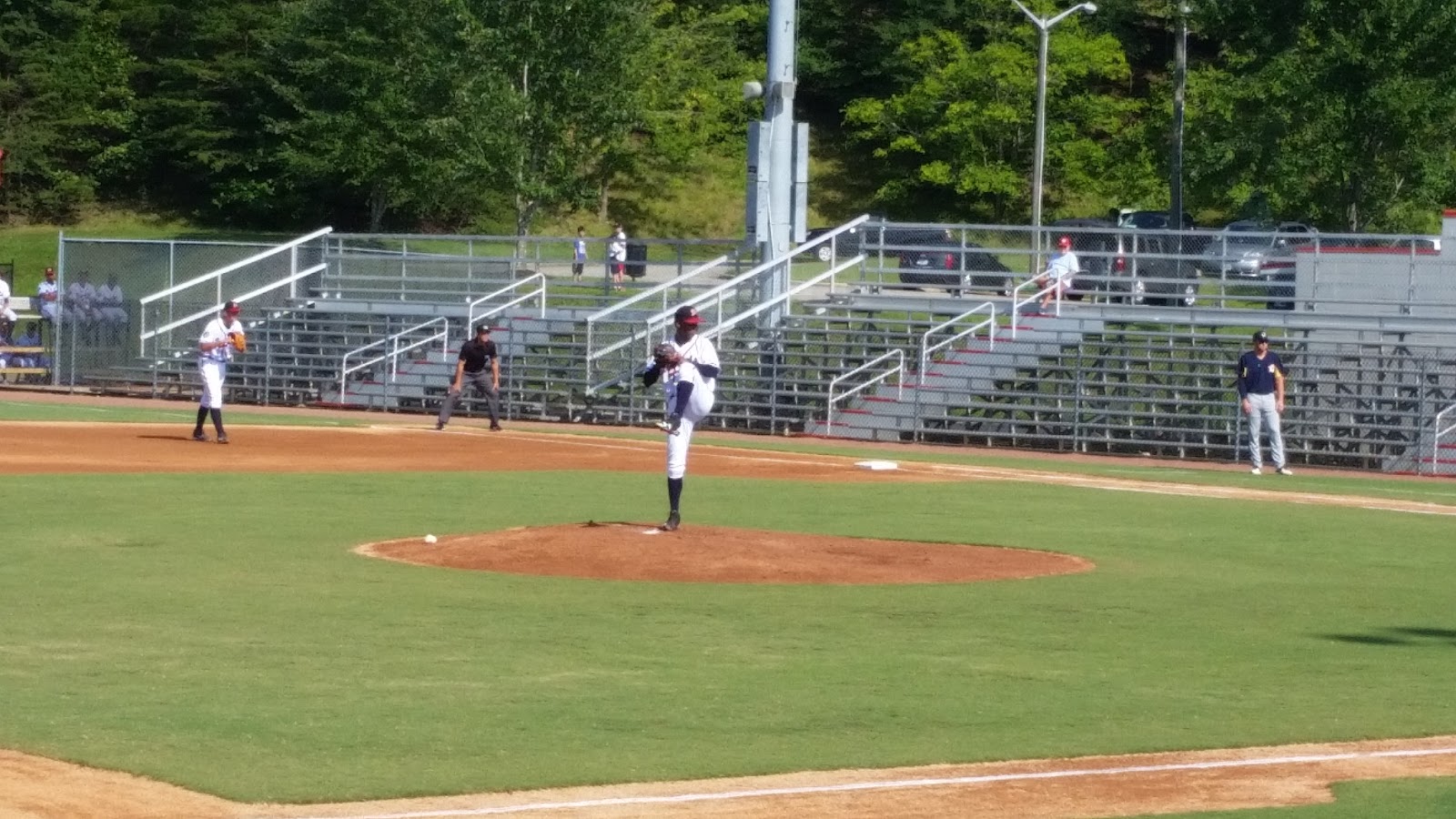
If you go a dollar or two extra, you can get a reserved seat. That puts you under the roof and gives you a chair with a back. Most of the seating is bleacher-style seating going up both the first-base and third-base lines. The sun sets behind third base. Netting extends from the ends of one dugout to the other so if you are hoping for a foul ball, you have to sit beyond the dugout - or just do as I did as a kid and stay in the parking lot. Eight-to-ten feet tall fencing extends from the dugout all the way to the bullpens, further limiting chances at foul balls. Sight lines can be bad in places a few places, but as you can tell by the pictures I took from a crappy cell phone camera, you're right on top of the action and can get a good seat on less-busy nights fairly easy.

The PA system is used frequently. Beyond just the walk-up music and names of players, they'll use sound effects and other clips of music to go along with what is happening during the game. You get the typical minor league ballpark staples like "Sweet Caroline," "YMCA," and "Cotton Eye Joe" between innings along with more current selections. The PA announcer will occasionally point out big things in the game such as "that diving catch was made by Justin Smith" or "and your Danville Braves take the lead!" They also let a kid do player introductions for a half-inning each game. Oh, and if you're into the racist hand thingy, Danville will implore fans to do the chop. The speaker down the third base line sounded like it had a short in it, which added to the rookie league feel, to be honest.

There are your usual between-inning games for fans - dizzy bat race, steal a base in 20 seconds, race the mascot. They also do a "Let's Make a Deal" where a fan gets a choice between receiving something for sure or taking their chance on the treasure box. Wednesday evening, Megan could have had a Kevin Maitan-autographed ball but chose the treasure box. She got a hot dog. Megan is dumb.

Speaking of concessions, they are pretty standard and overpriced, but to a lesser degree than you might see at other minor league parks. There are some BBQ sandwiches and Chic-Fil-A along with a Braves minor league staple, the bologna burger. The lines can get pretty bogged down - especially for random minor league games during the week. There's only one true concession area, though there is another one for ice-cold snacks and another drinks-only area that carries bottled-drinks and beer. There's a small gift area where you can purchase hats and so on and a bouncy house area that also has a place to throw a baseball at a batter/catcher cut-out, but be aware - it costs $5 per child. I had my kids with me last time and shelling out $10 for them to bounce for 20 minutes before the game was a bit much.

The crowd was weird. I don't know if many knew there was a double header, but the crowd was sparse at 5:00 when the first game began. The park started to fill up by the fourth inning for a good-sized crowd - in no small part because of the Dental Associates event. By the fourth inning of the second game, the crowd began to get smaller and smaller.

All told, it was a fun night for baseball even though the heat was nearly unbearable for much of the first game.