-->
Showing posts with label Jair. Show all posts

Saturday, September 9, 2017

Should the Braves Consider Moving Teheran?

Julio Teheran looked like the unquestioned ace of the Big Four pitching prospects the Braves once had churning in the minor leagues. Along with Mike Minor, Randall Delgado, and Arodys Vizcaino, Teheran was part of a group that would hopefully anchor the Braves rotation for much of the 2010's. Of course, here we are in 2017 and only Teheran remains as a starter, let alone in the Braves staff. And some might argue that we've reached the point where even that needs to change

Such commentary has pushed other Braves fans in a different direction. While more focused on a different pitcher, a frustrated Aaron Kirby remarked on Twitter this morning, "In fact, Julio and Folty have pretty similar stats this season. When are we moving Julio to the pen?" This refers to a common refrain from Braves fans - including ones at this blog - that Mike Foltynewicz profiles better as a reliever. But Kirby rightfully points out that both the flame-throwing right-hander and Teheran share many of the same issues. Why does one get talked about moving to the bullpen and the other doesn't? I would say for a variety of reasons, but the biggest is perception. People have long felt Folty's stuff was better suited for the bullpen. Nobody held the same regard for Teheran, who was considered a potential front-of-the-rotation arm.

Jeff Morris - Follow on Twitter
But five years into his career, is Teheran merely a decent enough rotation filler? Should the Braves consider possibly trading Teheran now rather than pay him at least $20M (including a 2020 buyout) through the 2019 season? While many will scoff at the idea out of practice, it's worth considering.

When Teheran signed a $32.4M extension in mid-February of 2014, he was coming off his first full-season in the majors. The deal effectively bought out the remaining five years of arbitration, a year of free agency, and potentially a second year with an $12M option for 2020. Along with the Andrelton Simmons' extension, both were very aggressive moves by the front office as they attempted to get ahead of the horse for what appeared likely to be very expensive arbitration years for the two young players. The plan was to pay them a bit more now but potentially save money later on. In turn, the players received financial security. Simmons would later be traded and while Teheran was often thrown around as a potential arm to be dealt in trade talks, he stuck around as the Braves went into a full rebuild.

Since signing the extension, he's been equally good and bad. In 2014 and 2016, he posted a matching WAR, according to Fangraphs, of 3.2 in both seasons. But then, his WAR fell to 1.1 in 2015 and it's unlikely to even reach that this season. In fact, since he signed the extension, his fWAR ranks just outside the Top 50 qualified starters in baseball at 7.9. That's lower than Tanner Roark, Mike Leake, and Bartolo Colon. It'd likely be lower if not for Teheran's durability. He's tossed the tenth most innings since the beginning of 2014. Nevertheless, the last four years haven't exactly lined up for Teheran like anyone had hoped.

Further, there is a reason to believe his 2016 bounce back season had a little too much luck in it. Lefties had a .247 BABIP against him that season, 35 points below his career average when facing left-handed hitters. His production against lefties has long been an issue that has limited Teheran, who has yet to develop a pitch to keep them honest. In turn, lefties bash him around to the tune of a 5.05 FIP over his career and it's only worsened as time has gone on (5.67 FIP since the beginning of 2015). Nearly 35% of batted balls since 2015 are classified as hard-hit, according to Baseball Info Solutions. To put it another way, a third of all balls left-handed batters put in play are scorched around the park. Some are caught, but too many of them find holes in the defense - or worse, become a souvenir for a fan in the outfield bleachers.

Teheran's problems against left-handers start with one key issue: his fastball loses much of its effectiveness against them. About a quarter of all swings on his four-seam fastball against right-handers are whiffs. That number falls about 10% against left-hand batters. Without a fastball to get ahead in the count, Teheran can't use his secondary pitches to induce weaker contact - or get more whiffs. Further, we don't see much of a drop in whiffs on Teheran's breaking pitches despite how many plate appearances in a game a right-hand hitter might have against Teheran. Against left-handers, his slider and curve see great declines in whiffs-per-swing after the first time through the order. That suggests that after left-hand batters get a read on his breaking pitches, they learn to lay off the ones they can't hit. The ones that they do...well, they don't always land.

Single Season Top fWAR for Braves SP since 2008 
Let's pull back for a second because it's definitely worth mentioning that Teheran doesn't turn 27 until the end of next January. Further, this is a pitcher with a pair of 3-win seasons during his career, something that's happened just nine times over the last decade for the Braves and almost certainly won't occur this year. Ignoring the reasons the Braves gave him an extension in the first place is a disservice to Teheran's time in the majors.

But two other pitchers show up on that list of 3-win guys since 2008 and they should scare Braves' fans - Jair Jurrjens and Tommy Hanson. Much like Teheran, they were, at different times in their career, expected to front line a Braves' rotation for the next half-decade. And while we can talk about injuries and personal demons, another issue that developed for both pitchers might also serve as a warning sign for Teheran.

Declining velocity doesn't always mean something bad, but it can be a problem for a pitcher moving forward. In his rookie season of 2008, Jair Jurrjens averaged 92.4 mph on his four-seamer and 92.7 mph on his sinker. By 2011, he had lost three mph on both and a year later, he would be non-tendered by the Braves. He's made three starts in the majors since. During Hanson's rookie year, he averaged 92.7 mph on his four-seamer and 92.4 mph on his sinker. During his one 3-win season, he added a tick more velocity on the four-seamer but lost some on his sinker. The added velocity on his four-seamer was gone the next year and in 2012, it fell to 90.7 mph. That was his final year with the Braves. With Teheran, his velocity dropped after his rookie season from 93 mph to 92.2 mph. It stayed roughly the same in 2015, but he's continued to bleed a little velocity off in the two years since. In five years, he's gone from an average 93 mph to 91.9 mph. He's just 26 years-old. Now, the loss in average velocity is not a massive alarming discrepancy, but at his age, losing velocity is something to keep an eye on.

To not be concerned about Teheran's production at this point is to ignore reality. What's worse is that Teheran's struggles might only get worse, depending on how high this peak in offensive production that we are seeing league-wide goes. In 2014, the league ISO was .135 and the wOBA was .310. It's climbed to .172 and .322 respectively this season, prompting many commentators to refer to this year as a sign the ball is juiced again. Teheran has always given up a healthy amount of homers, but with home runs leaving the yard at an increased rate, that makes a pitcher like Teheran especially vulnerable. It's worth mentioning that baseball runs in cycles and just a few years ago, people were going crazy about a "Golden Age of Pitchers."

Could the Braves need, as Kirby also said, a new pitching coach? Well, they went down that route last winter when they sacked Roger McDowell in favor of Chuck Hernandez. It's unlikely that the Braves will shed Hernandez after just one year, though Ken Rosenthal recently suggested some radical moves might be on the horizon by an increasingly frustrated front office.

Let's circle back to those questions I asked earlier: is Teheran merely a decent enough rotation filler? Should the Braves consider possibly trading Teheran now?

To the first question, I think there is a good chance of yes, Teheran is just a durable innings eater. According to Baseball-Reference, Teheran's most similar pitcher through 25 was Scott Sanderson. A veteran of 19 years in the majors, Sanderson got to the bigs at 21 years-old with the Expos and a lot was expected from the right-hander. Ultimately, he never received a Cy Young vote, was named to just one All-Star Game, and started two playoff games in which he got beat around a good deal. Nevertheless, he was a good rotation piece for the Expos and then the Cubs before settling into a more nomadic experience over the final seven years of his career. Essentially, he was the Ervin Santana of his time. Could that be Teheran's future?

Or could he be a starter that does figure it out finally in his later 20's more than he ever had before? Certainly, it's a possibility, but is it one the Braves should count on? Is it one that Teheran has shown much reason to expect over the last three years?

Maybe the best argument against trading Teheran is the one I have made before. Trading him this offseason might be the worst time to do so. His value has taken a big hit this season and moving him now could be considered selling low on a player who, again, has had two 3-win seasons in his young career. General managers can get over missing the right window to trade a pitcher - as Frank Wren did with Jair Jurrjens. What keeps them up at night is trading a pitcher who looks to be on the decline only to see them find it again in a new city while you took back a small return just to get rid of him.

Teheran's Splits vs. LH batters since 2013
The second-best argument against trading Teheran is the same one that one might argue when we discuss moving Foltynewicz to the bullpen. Why move these guys when the rotation isn't exactly pushing them out of the way right now? Inning eaters certainly have value especially in a young rotation prone to outings that require long relief stints. In addition, trading Teheran would have to be part of a series of moves aimed at shoring up the front-of-the-rotation. John Coppolella would have to rebuild the first three spots in the rotation this offseason without Teheran in the mix at an affordable rate.

To sum up, this has been an exercise from someone who's not sure what the answer is. I have decreasing confidence that Teheran will resemble the guy we once thought would headline a playoff rotation. At the same time, are the Braves in a position where they can actually trade Teheran right now? And even if they were, is now the right time to trade Teheran? Did the Braves already miss their window to maximize Teheran's market value and now are better off keeping him for some level of consistency as he eats innings every fifth day? All the while, they are merely hoping to see another unsustainably low BABIP against left-hand batters to increase Teheran's production.

There's no easy answer here. My belief is that the Braves will wait, see, and hope. I guess their fans are left with the same options.

Thursday, March 9, 2017

Thursday Throwback - Reed Johnson

Sometimes, moves just don't pan out like they ought to. That was the case of the 2012 midseason trade that sent Reed Johnson, along with Paul Maholm, to the Braves. The trade was born out of a move that didn't happen and ultimately, failed to deliver despite looking like a good deal on paper for Frank Wren. Even when Wren made the right move, it just didn't seem to work.

But long before that trade, Reed Johnson was born a few weeks before Christmas in 1976. A product of Riverside, California, Johnson was a star in both baseball and soccer in high school. His success there landed him a coveted scholarship opportunity with Cal-State Fullerton, where he was an Academic All-American and posted strong offensive numbers as a catalyst for the Titans' offense. Undrafted out of high school, Johnson played well enough during his college years to move into the 17th round of the draft, which is where the Blue Jays took him. The '99 draft wasn't very good for the Jays. They took Alex Rios with their first round pick and he did develop into a decent player, but only three other players made it to the majors, including Johnson, the second-best player taken that year by Toronto.

After a summer of adjusting to pro ball, Johnson became an overnight prospect in 2000. He spent the year at two different A-ball stops and slashed .298/.420/.479, flashing plus-plus plate discipline and enough power and speed to be a very intriguing prospect. In 2001, this time at Double-A, Johnson became a name to watch. Spending the year with the Tennessee Smokies, Johnson slashed .314/.384/.451. The walk total was a bit of a letdown, but Johnson filled out his baseball card with 29 doubles, four triples, 13 homers, and 42 steals. The Southern League All-Star looked like he was a great late-round find for the Blue Jays and a player that could help them very soon.

After missing most of 2002 with injury, Johnson worked his way into the picture for the big league club in 2003. After opening the year in the minors, Johnson would soon establish himself as a major league performer with a strong summer. In 114 games in the majors, Johnson hit .294 with 10 homers and a .353 on-base percentage. The Jays had opened the year with super sub Frank Catalanotto in right field, but an injury to Shannon Stewart opened left for Catalanotto and allowed Johnson to slide into right field. Bobby Kielty would later join the team, cutting into Johnson's playing time, but Johnson proved his worth by being the Blue Jays' most used leadoff hitter.

For the next two years, Johnson was the regular left fielder for the Jays and was unspectacular in his job before a breakout 2006 campaign saw Johnson hit .319/.390/.479 with 12 homers. He led the AL in getting hit by a pitch that season as well. However, his success was short-lived. During an injury-marred 2007 season, he hit just .236 over 79 games. Johnson struggled the next spring as well and with the Jays feeling a roster crush, Toronto surprisingly released Johnson as spring training was nearing its end. The five-year pro would not remain available for long as he landed with the Cubs. A bench bat and platoon player, Johnson was a perfect fit in Chicago. He OPS'd .778 his first season with the Cubbies before slashing .255/.330/.412 during an injury-shortened 2009 season.

Johnson took his talents out west and played for the Dodgers in 2010, which wasn't much of a trip from the city he was born (Riverside). He struggled with in Los Angeles, though, and lasted just one year before returning to the Cubs in 2011. Like he had never left, his success returned.

That brings us to the 2012 season. The Cubs were in the first year of their rebuild under Theo Epstein. The former Red Sox mastermind had just hired Jed Hoyer to be their General Manager. That season, the Cubs were breaking in young Anthony Rizzo at first base (who, interestingly enough, Hoyer had dealt to the Cubs as the Padres' GM) and Chicago was trying to add young talent to the mix to build what eventually would become a winner. Meanwhile, the Atlanta Braves were trying to get back to the playoffs after their 2011 collapse during then-manager Fredi Gonzalez's first year at the helm. The Cubs and Braves seemed like a perfect match and a week before the trading deadline, a deal seemed imminent. However, neither Johnson, nor lefthander Paul Maholm, were part of it.

Atlanta was desperate to add a starter to their team that they could count on. With Jair Jurrjens looking like a lost cause, the Braves had turned to Ben Sheets. 25 year-old Tommy Hanson was struggling and Brandon Beachy, also 25, had made just 13 starts before going down with injury. They still had Tim Hudson while Mike Minor was improving, as a team with playoff aspirations, Atlanta did not have the kind of rotation that would be able to compete against the big boys of the National League. Atlanta thought they had found their man in Ryan Dempster. The former closer had been excellent to begin 2012 with a 2.11 ERA through his first 15 starts. While Dempster wasn't an ace, he was the kind of bulldog starter that gave his manager and general manager a bit more confidence than hoping Sheets could make it through the summer or that Hanson could turn the corner.

Wren and Hoyer found the right mix of players that would make the deal happen. Atlanta would send young Randall Delgado to the Cubs, which would finally separate the four pitchers of the future (Minor, Delgado, Julio Teheran, and Arodys Vizcaino). Another prospect would head to Chicago as well and the Braves would get Dempster. One little problem, though. With over 14 years of experience, including eight full seasons with the Cubs, Dempster qualified as a 10-5 player and could nix any deal. Dempster was open to a trade, but preferred to head out west where he could join his good buddy Ted Lilly and the Dodgers. While Dempster weighed his options - and definitely held out hope for a move to the Dodgers - the Braves grew agitated. All the perimeters were agreed upon and the deal had been leaked out to the public. Wren set a deadline for Dempster, but the right-hander refused to make a decision as he held out hope Los Angeles would step up. Atlanta ultimately took themselves out of the process rather than watch Dempster play the part of the girl with a date to the Prom all lined up, but is still hoping to go with the high school quarterback rather than the dude that actually wants to be with her. Not that I know anything about that...

The Braves still wanted a pitcher, but could not find a Dempster-like arm on the trade market. Instead, they called Hoyer up and asked about Maholm. A long time Pirate, Maholm had joined the Cubs the previous offseason and he was also having a good season. Not a great one like Dempster, but would give the Braves a serviceable left-hand arm for their rotation. Meanwhile, the Braves did find their front-of-the-rotation arm by moving Kris Medlen into the rotation.  Coming along for the ride with Maholm and some bags of cash was Johnson. The Braves were stacked in the outfield with rookie Jason Heyward joining Michael Bourn and Martin Prado, but the prospect of adding a right-handed bat like Johnson to pair with Eric Hinske coming off the bench was a great fit. The Braves still broke up their four previously untouchable arms by sending Arodys Vizcaino to the Cubs in the deal along with reliever Jaye Chapman. Vizcaino was on the mend after having Tommy John surgery that spring.

Johnson got into 43 games down the stretch for the Braves and hit .270. He would get fairly regular time with Prado moving all over the field and helped to give the Braves their first real backup option to Bourn during the 2012 season. Both Prado and Bourn would be gone the next winter and would be replaced by Justin and Melvin "B.J" Upton Jr. Johnson, a free agent, liked Atlanta enough to return for a second year. He missed all of August with Achilles tendinitis, but missed even more time because Johnson was not a regular in the mix for the Braves even with the failures of the elder Upton. Instead, Johnson took a back seat to Jordan Schafer, who had returned after being claimed on waivers, and rookie Evan Gattis, who occasionally played left field to get his bat into the lineup more often. Johnson received five fewer plate appearances than Gerald Laird during the 2013 season and Johnson struggled to connect the bat to the ball with any authority.

During his year-and-a-half with the Braves, Johnson hit .256/.308/.332 with one homer, a pinch-hit two-run shot off former Braves farmhand Todd Redmond - then a member of Johnson's first team, the Jays. Johnson would struggle during a 2014 season spent as a reserve in Miami and continued his tour through the NL East with a stop in Washington next. A torn tendon in his left calf limited him to just 17 games with the Nats. He returned to DC the following year, but failed to make the roster coming out of camp last spring. I do not know if he's given up the dream of playing baseball again or not, but at 40 years-old, it seems unlikely that he'll continue his career.

His time with the Braves was short and ultimately uneventful. In the end, like many of Wren's deals, it just never worked like it should have. Of course, the Braves ended up re-acquiring Arodys Vizcaino from this deal so it cost precious little for Atlanta - even if it wasn't the deal they wanted.

Previous Throwbacks...
Mike Mordecai (1994-97)
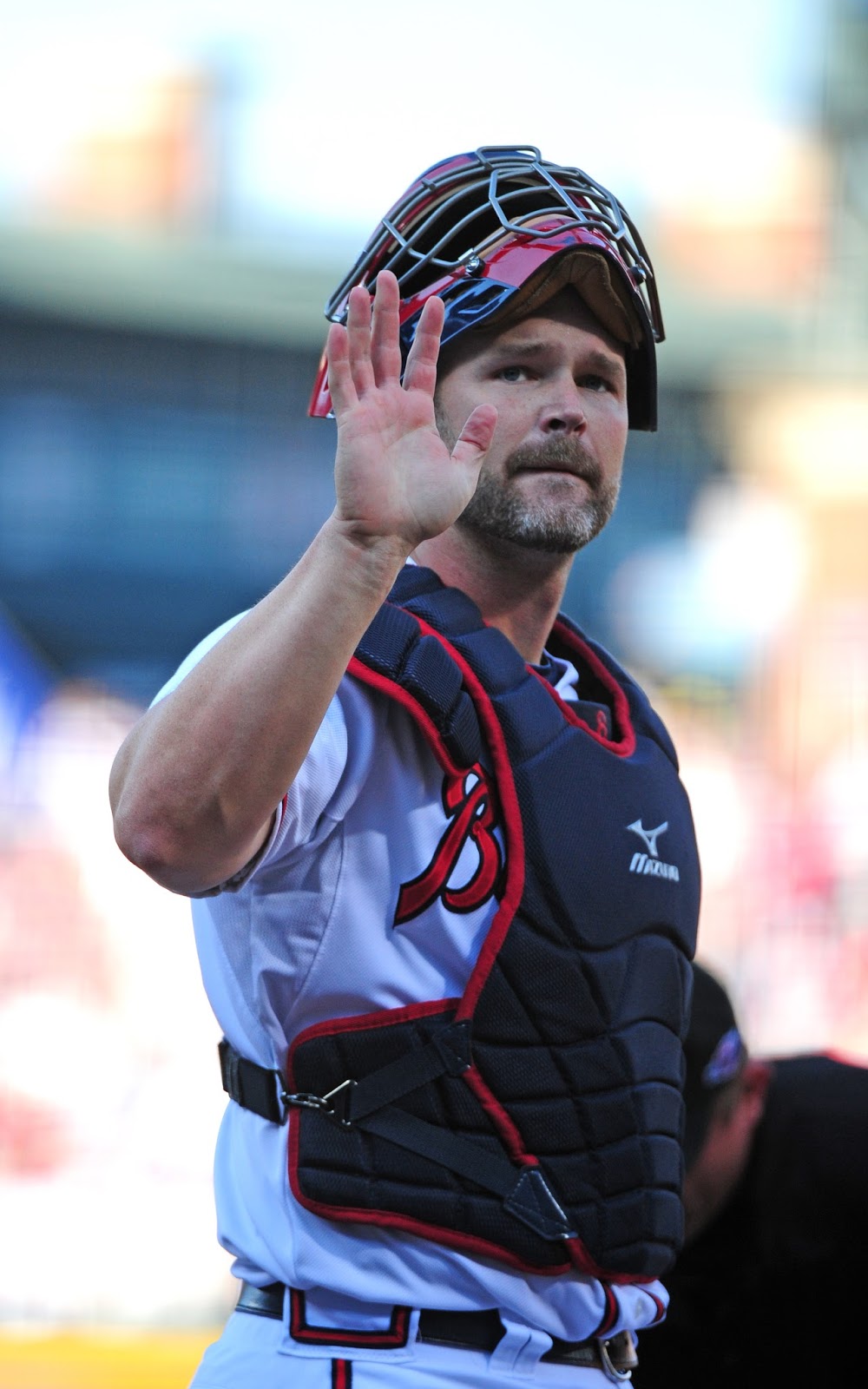
David Ross (2009-12)
Ryan Langerhans (2002-03, 2005-07)

...or view ALL of them.

Sunday, January 1, 2017

Best #61 in Braves Franchise History

(Series Note: Baseball-Reference was used for a collection of players so this series is as complete as their database is. No coaches/managers were included and a number had to have at least four options to be considered with two exceptions. I started from the highest available number because as I approach #1, I'll have much tougher decisions. For the complete series, click here.)

Best #61 in Franchise History

I began this series with the best intentions.

And then #61 came up and I struggled to find anyone to attach the label of "best" to. Throughout the history of the franchise, nine players have worn the old sixty-one and none did so for more than one year. Finding a true "choice" from this group proved quite difficult. Dave Schuler, who broke ground in 1985 by wearing the number the first time, nearly took this decision by default as I struggled to arrive at a better option. At least he was first, right? Sure, nearly half of the 50 batters he faced over nine games in '85 reached base, but he had the guts to wear what seems like a cursed number first.

Damian Moss was mini-Glavine in 2002, but he wore #61 in 2001. Phil Stockman and James Parr shared the number in 2008, but no one was searching the Chop Shop trying to find an authentic Stockman or Parr jersey. The number has been used by a player in each of the last five years - most recently by Tyrell Jenkins. Before him, it was Williams Perez and before that, Chasen Shreve. Back when Braves fans had hope for him, Christian Bethancourt arrived in the majors in 2013 and wore the number. None of these players excelled while wearing #61.

I searched and I searched and then I remembered - this is my list. I don't have to let results decide things for me. Who was the most memorable player to wear #61? Well, to me, that would be the one player I left out.

Getty Images
My choice for the Top #61 is...Livan Hernandez

Unlike pretty much every choice on this list, Hernandez adored the #61. He never played a game in the majors under a different number and that's despite playing for nine different franchises. The Braves were #8 on that list during his 17-year career.

Of course, for Braves fans, Hernandez would be known more for his rookie season in 1997 than his work in 2012 despite the latter being the time he actually spent with the Braves. One of the first Cuban defectors to set the baseball world on fire, Hernandez arrived in the majors to stay in mid-June of '97. He would face the Braves once during his 17-start rookie run in which he was the victor in his first nine decisions. But it was Game 5 of the NLCS that Livan Hernandez truly became a part of Braves' history.

Hernandez pitched in relief in Game 2 of the NLDS during Florida's 7-6 win over the Giants. He also pitched on October 10 during Game 3 of the NLCS and got the victory as the Marlins moved past the Braves 5-2. Hernandez entered in relief and surrendered a sacrifice fly to Javy Lopez that tied the game. A pair of run-scoring doubles by Darren Daulton and Charles Johnson off John Smoltz in the bottom of the sixth put the Marlins ahead and they would sail to the victory.

Hernandez tossed 22 pitches during Game 3. That's why it was a bit shocking that two days later, he got the start in Game 5. The Atlanta Braves offense in 1997 was elite. They finished the season third in the NL in runs scored, fourth in OBP, and second in home runs and slugging. That date, Atlanta had Greg Maddux on the mound facing some 22-year-old kid. In a series that was tied 2-2, this was about as good as the Braves could hope for if they wanted to take the series lead before heading back to Turner Field - then in its first year. The scene was set, but the Braves had not prepared for one final thing - the man behind the catcher. Umpire Eric Gregg.

In the first inning, Kenny Lofton led off things with a triple. The next batter walked, but Chipper Jones and Fred McGriff struck out swinging. With the count 2-2, Ryan Klesko joined the previous duo, except he struck out looking. As did Lofton opening the third. Another player who was just browsing was Michael Tucker in the fourth and seventh innings. Jeff Blauser led off the 8th by staring at strike three. Along the way, the Marlins had scored twice off Maddux, who had struck out nine over 7 innings, including a pair of guys looking in Moises Alou and Gary Sheffield. The Braves had plated just one run off Hernandez - a solo shot by Tucker in the second. That was one of just three hits. They also added two walks. Entering the ninth, down 2-1, Hernandez had 13 strikeouts. Number #14 was Keith Lockhart to open the frame as he went down swinging. After Chipper lined out, it was all up for McGriff. He worked the count full. Hernandez threw a breaking ball that sailed a foot outside. McGriff, who later said the strikezone that day was "a little big," naturally thought he had extended the game and given the Braves a chance to tie things up. Gregg rang him up.

It was the 15th strikeout of the game for Hernandez. During his long career, Hernandez struck out at least ten batters four times. This game was the gold standard for Hernandez followed by an 11-strikeout game and two 10-K games. Of the 143 pitches Hernandez threw that day, 88 were strikes. 37 of those strikes were called - a difference of 13% over the regular season for the number of called strikes to total strikes. Maddux did not benefit from an unusually high number of called strikes - just Hernandez. A deeper look, one that was done by Fangraphs' Jeff Sullivan in 2013, shows that the difference may have been in the left-handed strikezone. The Braves that day had six left-handed hitters (including the switch-hitting Chipper Jones) in their lineup. Of the Braves who took a called strike three, only Blauser wasn't a left-handed hitter.

Much like the Bill Buckner game in 1986, despite the Eric Gregg game being our lasting impression of the series, the Braves still had a chance to win the series. Two days later, Kevin Brown outpitched Glavine and the Marlins won 7-4.

Hernandez pitched the game of his life that day - with some help from Gregg. Two years later, he would be traded to the Giants and his nomadic journey would begin. After the Giants were the Expos and he lasted through the move to Washington. Next was Arizona, then the Twins, then the Rockies, and a 23-game stop in Flushing for the Mets in '09. He finished that season back with the Natspos and would play the next two years with Washington. From 1997 to 2011, he pitched in 474 games - all starts minus two relief appearances in the playoffs. But at 37, the jig was up. It was time to extend his career as a reliever and the Braves came calling.

The 2012 Braves had one starter above the age of 25 in Tim Hudson. They were relying heavily on the arms of Mike Minor, Tommy Hanson, Randall Delgado, and Jair Jurrjens. Brandon Beachy and Kris Medlen would later fill in, but adding Hernandez was a natural move for depth purposes. The signing would also allow the Braves to use Cristhian Martinez in a higher-leverage role. However, Fredi Gonzalez was never known for using his bullpen properly. The Braves manager began the season by using Hernandez in mop-up situations - the exact reason he was brought aboard. By May, however, Hernandez began to get higher-leverage calls. In a 2-0 game against the Phils with the Braves trailing, Hernandez was brought in to keep it a two-run ballgame. Instead, he gave up two runs. In Colorado two days later, he actually secured his first save after coming in during the eighth of a 12-9 game. After the Braves added a run in the ninth, Hernandez stayed in to get the save.

Rather than be utilized as a long reliever, Atlanta was using him in middle relief and he never looked all that comfortable in the role. Things came to a head against Hernandez's old mates, the Nationals. With the game tied 2-2 in the sixth, Hernandez came in after Beachy hit the first batter of the inning. By the time the sixth was over, it was 6-2 Nats. Bryce Harper would add a solo bomb off Hernandez in the 8th as Hernandez took the one for the team. Hernandez would be buried for two weeks until he got the call in the fifth inning against the Blue Jays with Atlanta clinging to a 4-1 lead and the bases loaded. Three singles and a double later and it was 6-4. Hernandez would give up two homers the next inning to put the Braves down 9-4. He would be cut soon after.

Hernandez finished the season with the Brewers and gave up a combined eleven runs in his final two outings of his career. It would be an unimpressive end to a career that seemed headed to gigantic things during the 1997 NLDS. But, I guess, Eric Gregg couldn't be his umpire every game.

Friday, October 7, 2016

Braves Can McDowell

By EricEnfermero (Own work) [CC BY-SA 4.0
(http://creativecommons.org/licenses/by-sa/4.0)], via Wikimedia Commons
After eleven seasons spanning three managers, Roger McDowell will no longer be the pitching coach of the Atlanta Braves. For a franchise that rarely sees turnover in the coaching staff, the last several months have been a change-of-pace. The in-season firing of Fredi Gonzalez, the very real chance that the interim manager Brian Snitker won't be in charge in 2017, and now McDowell's dismissal might point to one thing - John Coppolella is willing to change up the team a bit more than the last two general managers the Braves had.

McDowell replaced Leo Mazzone in 2006 after the latter left for Baltimore. Three years ago, McDowell nearly left the Braves following the 2013 season, but former general manager Frank Wren gave McDowell a boost in pay along with a long-term contract (for coaches) to keep him away from the Phillies. While with the Braves, McDowell pieced together bullpens with castoffs like Eric O'Flaherty, David Carpenter, and more recently - Jim Johnson, who cited his comfortability with McDowell as one of his reasons to forego free agency and reup with the Braves.

One criticism related to McDowell was a similar one lobbed at Mazzone - he didn't relate well with young starters and they rarely seemed to blossomed under his tutelage. Jair Jurrjens and Tommy Hanson both saw their careers slide into mediocrity after All-Star worthy beginnings. Others like Kyle Davies and Jo-Jo Reyes never developed. Another criticism of McDowell was found in the belief that his pitchers too often went under the knife, a stark change from the Mazzone years. When on the mound, righties Kris Medlen and Brandon Beachy - along with southpaw Mike Minor - could be excellent. However, they were frequently on an operating table rather than throwing strikes.

Both criticisms are a bit lacking in my mind. Young pitchers flame out all the time. I'm sure McDowell did struggle to reach certain prospects, but on the other hand, he got his fair share out of Julio Teheran, Alex Wood, Craig Kimbrel, Jonny Venters, and some of the aforementioned oft-injured pitchers. Furthermore, considering the rate of pitcher injuries - especially those that result in Tommy John surgery - is skyrocketing, can we really look at McDowell and blame him for that?

McDowell won't be without a job for too long. He's had too much success with the Braves, including a 2007 year where he pieced together a pitching staff that included Chuck James, Buddy Carlyle , Oscar Villarreal, Tyler Yates, Chad Paronto, and the previously mentioned Davies and Reyes and the Braves still finished third in the league in ERA. It was the first-of-seven years in which the Braves finished in the Top 5 in the National League in ERA, including a 3.18 ERA in 2013 to pace the league.

This dismissal means two things. One, the Braves do want a new voice to lead a very young pitching staff. Johnson is the only pitcher on the Braves roster who is definitely going to be on next year's team and is over the age of 30. Sixteen different pitchers took the ball for the Braves this year who were in their Age-25 year or younger. Pitchers like Sean Newcomb and Lucas Sims are a good spring camp away from entering the picture. Whether McDowell did have issues with reaching younger pitchers or not, the Braves definitely want the guy in charge of their young pitchers to have an exemplary record with young guns.

The other thing this firing immediately makes you think of - the Braves might be moving away from Brian Snitker as next year's manager and will be giving the next Braves manager a chance to build his own staff. That could be Bud Black, though I am not very excited by that idea. There is a good chance McDowell is just the tip of the ice berg and long-running coaches like Eddie Perez and Terry Pendleton will also be headed out.

I don't necessarily disagree with letting McDowell go. I think he was very good at his job and the fact that this 2016 team wasn't at the bottom of the league in ERA despite starting 16 different pitchers is impressive (four NL teams finished with an ERA worse than the Braves). Still, I am a firm believer in giving a manager the leeway to bring his guys in and build the coaching staff how he sees fit. Letting him go now simply allows McDowell even more time to secure employment for 2017 - which is actually a pretty good parting gift when you think about it.

Fare thee well, Second Spitter. May you land with an American League team and enjoy your time there.

Wednesday, June 8, 2016

Worst 5 Braves Drafts Since 2000 - #2

With the 2016 draft tomorrow, it's time to get to the end of this series. Just three more articles remain after this one.

Best/Worst Drafts since 2000
Worst: #5, 2009 | #4, 2004 | #3, 2013 | #2, 2011 | #1, 2001
Best: #5, 2010 | #4, 2015 | #3, 2007 | #2, 2002 | #1, 2000

2nd Worst Draft Since 2000 - The 2011 Draft 

Gilmartin | By Kaotate [GFDL or CC BY-SA 3.0],
via Wikimedia Commons
On one hand, Atlanta's haul in the 2011 draft produced eight major leaguers. On the other hand, the Frank Wren/Tony DeMacio-led approach of cheap, sign-able college players effectively reduced the chance that the Braves would bring an impact player into the system. The 2011 edition would possibly be their worst draft together.

Flash back to 2010. The Atlanta Braves would win 91 games in Bobby Cox's final year and were batting on the young duo of Tommy Hanson and Jair Jurrjens to lead their rotation while the also young core of Brian McCann, Martin Prado, Jason Heyward, and the just-arrived Freddie Freeman would give the Braves a big boost at the plate. The Braves also had high hopes for the foursome of Mike Minor, Arodys Vizcaino, Randall Delgado, and Julio Teheran. You could forgive Wren and DeMacio if they felt they had a dynasty on their hands.

Of course, they didn't and the 2011 draft certainly didn't help matters. Their first pick finally came with the 28th overall selection. As they had done two years before, they went with a left-hander out of a big southern college program. But Sean Gilmartin wasn't Minor - who certainly raised his share of eyebrows when the Braves drafted him. Minor's floor was noticeably higher than Gilmartin for one. Gilmartin was a borderline Top 50 player heading into the draft. He was a perfectly fine second rounder, but the Braves played it safe as they had done so often during the Wren years. Either there was an edict that they needed to compete and needed cheap depth players to fill in the gaps rather than hope for the best with an 18 year-old out of high school or the Braves were just flatout missing. Regardless, Atlanta made the choice to knowingly give up on the high reward and play the chances that they have grabbed a high enough floor guy to play in the majors.

They were successful. They also had very bad drafts as a result. 2011 stands out because the Braves not only drafted a college player in the first round once again, they did so in 18-of-the-first-19 rounds. They went with smart kids out of UConn (Nick Ahmed) and Gonzaga (Cody Martin) along with smaller school standouts like Kyle Kubitza and Tommy La Stella. The draft could have just easily been a winner. Instead of Joe Panik or Henry Owens, it was Gilmartin in the first round. Instead of Andrew Susac in the second, it was Ahmed. Instead of Carter Capps, it was Kubitza in the third. Rather than draft Greg Bird in the fifth, they took Nick DeSantiago. Could have had Ken Giles, but took Martin in the seventh.

Is this unfair? You betcha. But 2011 showed just how warped the Braves valued talent in the draft under Wren and DeMacio. I'm not a guy who buries Wren. I think he shoulders too much of the blame. But when it came to the draft, the Braves simply were missing and missing badly.

Here is a sign that something went wrong. The 2011 draft was just five years ago. Nobody from the draft remains the system. Some, like Gilmartin and Martin, were given away. As was J.R. Graham, who the Braves lost voluntarily in the Rule 5 draft. Kubitza and La Stella were traded for arms with higher upside. John Cornely and Gus Schlosser were sent packing. As was Ahmed, though at least he was a piece that helped the Braves acquire Justin Upton.

If a year stands out as a reason to not play it safe and draft for need, it's 2011. The Braves got exactly what they sought - good bets to make it to the majors. Eight of them did that - so far. But their roles in the majors reflect the conservative draft philosophy the Braves followed. Each player that has made it to the bigs has little chance of developing into much more than they were when they were drafted.

Friday, May 13, 2016

Worst 5 Braves Drafts Since 2000 - #5

With the 2016 draft less than a month away, I am going to take a look back at the Braves' drafts since 2000 with the Top 5 and Worst 5 in tandem order starting with the latter. If that is confusing, after the fifth worst draft today, the next article in this series will look at the fifth best draft. Clear enough? I hope so.

Best/Worst Drafts since 2000
Worst: #5, 2009 | #4, 2004 | #3, 2013 | #2, 2011 | #1, 2001
Best: #5, 2010 | #4, 2015 | #3, 2007 | #2, 2002 | #1, 2000

(Dis)Honorable Mentions go to the 2006 and 2008 drafts.

5th Worst Draft Since 2000...The 2009 Draft

By LWYang on Flickr (Original version)
UCinternational (Crop)
[CC BY 2.0], via Wikimedia Commons
For the first time in nearly two decades, the Braves had a Top 10 pick. It wasn't supposed to happen that way. The Braves had missed the playoffs in 2007, but had added Mark Teixeira and were hoping for a return to glory for a team with a young core of Brian McCann, Kelly Johnson, Yunel Escobar, and Jeff Francoeur. The problem was that John Schuerholz had neglected to build a starting rotation. He turned the team over to Frank Wren, who did acquire Jair Jurrjens, but that was not enough to piece together a winning ballclub in 2008. They would lose 90 games, guaranteeing the team a high-value pick.

With the young nucleus that now included Jurrjens and also had Jason Heyward, Tommy Hanson, and Freddie Freeman developing in the minors, a big splash with the seventh overall selection of the 2009 draft could have been a helpful springboard for the team into the future. They surrendered their 2nd round pick (56th overall) to sign Derek Lowe, which helped mute the overall value the Braves could expect from the 2009 draft. Still, with a marquee selection, the Braves could make the entire draft look good by grabbing a potential superstar.

Of course, had that happened, we wouldn't be talking about this draft as the fifth worst. The 2009 draft was an odd one for Atlanta. It was Roy Clark's last draft and Wren's second draft as general manager. The discord between the two led both to Clark's defection and an odd dynamic where neither were on the same page. Further, two years before, the draft-and-follow system had been abolished. The system, which had been big for finding value in late round picks like Hanson, allowed teams "control" over a player for nearly a full calendar year. It gave teams a long time to evaluate a player - usually after he went to junior college - before deciding whether or not to sign him. Other changes were coming with the compensation system, which seriously cut into how many picks a team was awarded. 2009 was the first draft after Type C free agents had been abolished.

That was the backdrop, but there was also an unusual focus the Braves took going into the 2009 draft. They knew they wanted pitching and they wanted it quick. The top college pitcher was Stephen Strasburg - a generational talent. That left other second-tier starters like Mike Leake, Aaron Crow, Alex White, and a lefty from Vanderbilt named Mike Minor. However, Atlanta's bread-and-butter for years was high-ceiling prep stars from the southeast and there were a pair available in Donavan Tate and Zack Wheeler. Other high school kids like pitchers Jacob Turner and Tyler Matzek were on the board.

The expectation entering the draft was that the Braves would focus on more young prep talent over the more polished college players in the draft. After all, since 2003, the Braves had taken one college player (Joey Devine) in the first round (10 total picks). But 2009 would buck the trend early and often as Atlanta played it conservative and picked Minor with the seventh overall pick. It was a shocking move, especially for a team with only two picks in the Top 100, to settle for a college star with a high floor, but limited ceiling. However, Minor came with this tagline - near major-league ready. That's what Atlanta wanted.

They would continue that trend with their second pick, third round-selection David Hale. A Princeton grad, Hale hadn't even played at a high level of college competition, but was a prime target because he was "near major-league ready." Atlanta wouldn't select their first high school kid until the tenth round, when they picked Aaron Northcraft with the 298th overall pick. In between Hale and Northcraft, they played it safe with Miami-Dade College's Mycal Jones (118th), Newberry College righty Thomas Berryhill (148th), and George Perimeter College outfielder Robby Hefflinger (208th). Atlanta surprised on-lookers again as Northcraft didn't begin a cascade of prep stars as Atlanta stuck with the college kids like Chris Masters (328th), Cory Harrilchak (418th), and even Riaan Spanjar-Fustenburg (478th). Of their first 21 picks, just two were coming out of high school. Their 21st pick was Ryan Weber, a righty out of St. Petersburg College. He would not only be the last player signed out of this draft to make it to the majors, he is the only player still with the system eight years later.

Why the obsession with college players? The Braves had a young core, a Hall of Fame third baseman, and were attempting to compete quickly rather than build a farm system. Adding college guys who could provide depth for the major league team was a way of achieving that. Further, college players typically cost less because, often, you don't have to convince them to sign rather than continue their amateur careers like you do with high school players. Atlanta saved money and felt they were adding talent that could cycle up to the major league team within a few years. Only three players did so and only Minor did it in a relatively short amount of time.

Let's focus again on the first round lefty. Suffice it to say, he had his ups and downs with the Braves. He did make it to the majors quickly and started his first game in the bigs just 14 months after being drafted. He would not establish himself for good until 2012. The next year, he began to look like a potential fixture of the Braves' organization for years with a 3.21 ERA over 32 starts. However, injuries and ineffective play would limit his 2014 before he was sidelined the entirety of 2015. He is just now beginning his rehab with the Royals' organization as he tries to get back on a major league for the first time since September 20, 2014.

Hale arrived in Atlanta in 2013 and was a regular bullpen asset in 2014, though his metrics painted a picture of a guy who was lucky to have a 3.30 ERA. The new Braves regime agreed and traded him to the Rockies for catching prospect Jose Briceno. Hale would spend most of 2015 hurt and has already been designated for assignment this season before being picked up by the Orioles, where he is pitching in AAA.

Minor did help propel the Braves to the 2014 NL East title and has the distinction of being the only Braves pitcher with a playoff win since the end of the 2011. That alone bumped this draft up to fifth worst because precious little major league talent was produced from Atlanta's safe picks. Let 2009's draft be an example on never drafting for need. Always focus on best player available. If Atlanta's spot comes up this June and they pick a high school pitcher, don't despair. They were selecting the best player available, not drafting for the need (supposedly, college-age hitters). When you sacrifice your chance at the best player available, you lose your shot at guys like A.J. Pollock (#17th overall in 2009).

At the time of the draft, Keith Law ranked the Braves' haul the fifth worst. To put their super conservative choices into context, not only did just three make it to the bigs, the Braves paid $4 million less in signing bonuses than what Strasburg got. Granted, Strasburg was again a generational talent and signed a major league deal with a $7.5 million signing bonus, but Atlanta spent under $4M to add their talent. The only plus was that they signed 20 of their first 22 picks. However, if you are going to invest in safe, college-age picks, you are doing so because their path to the majors is expected to be quick and a likely to happen. Atlanta failed at that. Their conservative drafts that followed continued this trend with two more drafts of the Wren years appearing in this countdown to come.

Like it is on the baseball field, if you don't play to win, you will lose. In 2009, the Braves should have learned that to build a productive minor league system out of the draft, you need both safe picks and high-ceiling picks. Unfortunately, too often over the next few years, that lesson was forgotten.

Thursday, April 14, 2016

Thursday Throwback - David Ross

Scott Cunningham/Getty Images
(For my take on Hector Olivera, click here.)

Backup catchers are sort of like backup quarterbacks. You might think spending money on one is a waste of resources until you need him to be there and produce. When that happens, you are happy that you had the foresight to get the best possible backup. For four years, David Ross fulfilled that role for the Atlanta Braves and they are still trying to replace him.

Born in March of 1977 in Bainbridge, Georgia, David Wade Ross later attended the aptly named Florida High School in Tallahassee. The Dodgers tried their luck with Ross in the 19th round of the '95 draft, but he passed and went to college - first at Auburn and then at Florida. It was at Auburn that he teamed up with center fielder and sometimes pitcher, Tim Hudson. Several years later, Hudson and Ross would again be teammates, but we'll get to that.

Ross had transferred to Florida for playing time and it led to him getting picked again by the Dodgers in '98, this time in the 7th round. Expected to be a power hitter behind the plate with advanced defensive skills, Ross began his minor league career in style with a .309/.412/.487 slash with Yakima in Short-Season A-ball after he was drafted. Two years later, a return trip to Florida with the Jacksonville Suns gave Ross his second .800 OPS season. He continued the good run with a .297/.384/.519 triple slash the following season with Las Vegas. His solid game got him to the majors in mid-summer of '02 and again in September. He would notably replace Paul Lo Duca in a 19-1 blistering the Dodgers gave the Diamondbacks. Long-time Cub Mark Grace took the ball to pitch the ninth and Ross put the cherry on the top with a first-pitch homerun. It was his first of what is currently 96 homeruns.

Ross missed much of 2003 before settling in as a backup in '04, though the results were terrible (.170/.253/.291). After failing to beat out Paul Bako for the backup job the next spring, Ross was sent to the Pirates. You might have forgotten he played for the Pirates - I know I did. He struggled with Pittsburgh. A late move to San Diego helped his season stats, but he still finished the year with a .671 OPS. Ross was nearing 30 and looked like a journeyman and not a particularly good one at that.

For the second consecutive spring, Ross was squeezed out of the opening day roster - this time by Rob Bowen - and the Padres dealt Ross to the Reds. It was in Cincinnati that Ross found a little stability. In his first year, he took advantage of the Great American Ball Park's generous dimensions to hit a career-best 21 homeruns with a .932 OPS. His follow-up campaign would see the power sustained (17 homeruns), but he simply could not get on base enough (.271 OBP). He would get a third year with the Reds and the results were a mixed bag. He improved his on-base ability, but his power nearly disappeared. The Reds moved on, releasing Ross that August. He briefly caught on with the Red Sox and would even play a game in the postseason.

That offseason, Atlanta was looking for stability behind Brian McCann. They had gone through Corky Miller, Clint Sammons, and Brayan Pena for two seasons. Pena was the only one to provide any element of offense, but the Braves didn't seem convinced he was a capable enough receiver. McCann had played 145 games, which is still his career-high, and by the end of the year, he continued to produce though he lacked the power he had showed so impressively earlier in the season. Ross would help the Braves in a number of ways. The Braves had gifted Todd Pratt to McCann in the latter's first full season of '06, but the still young-McCann could benefit from a guy who had seen much the game had to offer in Ross. Plus, Ross was seen as a leader for a staff that began the year with 23 year-old Jair Jurrjens and later added 22 year-old Tommy Hanson. While little was expected from his bat, the prevailing assumption was that Ross would be able to contribute a few taters and not be a complete zero at the plate like Miller and Sammons.

Year 1 went about as good as the Braves could have hoped. Ross triple slashed .273/.380/.508 with 7 HR. His pairing with McCann was brilliant and the drop-off was nearly non-existent. His leadership was also present for both McCann and the pitchers he worked with. In the second year of a two-year contract, he continued to excel for the Braves, slashing .289/.392/.479 with 13 doubles, the second-best total for any season of his career. He would go on to appear twice that postseason as a defensive replacement. One of his biggest knocks of his first two seasons came in the fifth inning of the August 31, 2010 game against the visiting Mets. The Braves had began the inning down 2-1, but a two-run double by Jason Heyward and a run-scoring single by Alex Gonzalez had put the Braves on top. A batter after Gonzalez, Ross chased Jon Niese with a Grand Slam to deep left.

After bringing back Ross on a second two-year deal, the Braves catching situation remained the best in baseball in 2011. Ross never matched his production from the first two seasons, but he slashed .263/.333/.428 in 171 PA - a stellar effort from a backup. He picked up his second two-homer game as a Brave on April 26 and on July 2, he smacked his second Grand Slam as a Brave, providing the edge against Jake Arrieta and the Orioles 5-4. On July 27, he tied a 1-0 game with an RBI single against Paul Maholm and the Pirates in the sixth and four innings later, hit a walk-off single to win the game. A year later, he remained sturdy with a .256/.321/.449 slash. While the season would go down as the year Ross started over a hurting and struggling McCann in the ill-fated Wild Card Game, I think 2012 should be all about August 8 in Philadelphia. It was on that night, as the Braves cruised to a ho-hum 12-6 win, that Ross reached first base with two outs on an error. On the second pitch to next hitter, Paul Janish, Ross stole second. In his eleventh year in the majors, Ross has finally stole his first base.

But sure, let's focus on that Wild Card Game. McCann's shoulder was shot and he needed offseason surgery to rectify the situation. The two catchers shared a good deal of time in September rather than there being a clear distinction between the two. It was McCann's worst season - well, until he became a Yankee. Over his final 19 games, McCann had hit just .209 with a .260 OBP and .328 slugging. So, it was not too surprising that Ross played ahead of McCann - yet it still seemed like it was. Ross stepped in and gave the Braves a boost, though. He singled twice and homered over four at-bats. And Fredi Gonzalez's decision probably would have been lauded had the umpires not changed what the meaning of the infield fly rule was. I'm half-kidding, of course.

The Braves had gotten away with paying Ross just $1.625M for the final two years of his Braves' run. Over his four years with Atlanta, he had slashed .269/.353/.463. He deserved a pay raise and the Braves couldn't match what he was worth on the open market. That was not a problem for the Boston Red Sox, who inked Ross to a $3.1M average salary. His season got off to a miserable as he hit the DL in mid-June with concussion issues. When he returned, he was able to regain his place as Jon Lester's personal catcher, which became important in keeping him in the mix for the playoffs. He began to steal time beyond Lester's starts from Jarrod Saltalamacchia and in Game 5 of the World Series, he picked up a go-ahead RBI double off Adam Wainwright that helped the Red Sox win and inch closer to a World Series title. Two days later, with Ross behind the plate, the Red Sox beat the Cards 6-1, giving Ross his first World Series ring.

After another year with Boston that included some miserable results, Ross again hit free agency and joined the Cubs. His first year there was miserable at the plate, though his value in the clubhouse and behind the plate still impressed many. He even pitched two games - and did really well (2 ING, 6 batters up, 6 batters down). He returns for a farewell tour this year that has attracted a great deal of attention, which is a testament to Ross the person moreso than Ross the player.

For four years, the Braves had the best catching situation in baseball with an All-Star and a capable backup. The years since have shown how rare that is to put together. With his career nearly up, one has to wonder what's next after 2016. With how well-liked he is and how his leadership is lauded, hard not to see a coaching future for Ross. Maybe that could be a pathway back to Atlanta. Just spitballing.
Rossy gets some air as Chipper Jones sends a ball through the air against the Phillies on 9/2/12.
Scott Cunningham/Getty Images
Recent Thursday Throwbacks...
Ryan Langerhans (2002-2003, 2005-07)
Special - Rafael Furcal's Near-Signing (2008)
Marquis Grissom (1995-96)
...or view ALL of them.