For the past month and change, I have been looking at the minor league affiliates for the 1995 Atlanta Braves. For me, it has been both a look back at those prospects that never panned out and also, a nice glimpse at what that World Series-winning team had in the pipeline with players like Andruw Jones and Kevin Millwood still in the minors. I hope you, the reader, had a little fun looking back. As this is my Saturday column, I need a replacement. I will stick with the minor leaguers of the past, but instead of looking at a year's minor league system, I have a list of players for the "What Could Have Been" team. Next Saturday, I'll reveal at least one player for that team.
But this week is about the Richmond Braves. For an organization whose minor league teams finished a combined 89 games under .500 at the minor league level, the R-Braves were a bright spot for the parent club. Only the 71-70 Macon Braves and 75-66 R-Braves finished above .500. The Braves had a long, long relationship with the capital of Virginia that began in 1966 and continue until 2008 when the Braves, following a exhausting battle for a new stadium, finally moved their AAA team to Gwinnett. The Richmond Braves won five titles, including their fourth in 1994. The '95 squad still had plenty of talent, but not as much as the Norfolk Tides, who had all three of the next generation of Mets pitchers go through Norfolk that year in Jason Isringhausen, Bill Pulsipher, and Paul Wilson.
Managing Richmond that year was Grady Little, who was in his 16th year of managing despite being just 45. He joined the Braves system in 1986 and worked his way up from rookie ball to AAA in 1993. His third year as R-Braves manager would be his last and he left the Braves system for MLB positions as a coach with the Padres, Red Sox, and Indians. He got his first big league managing job in 2000 with the Indians and led Cleveland to a pair of 90-win seasons before heading to Boston where he picked up 93 and 95 wins, but would notably be let go after failing to remove Pedro Martinez against the Yankees in the ALCS. After a pair of seasons with the Cubs as a consultant/instructor/scout, Little got his next job when the Dodgers hired him. Again, he won games, but two years was all he got. In six seasons as a major league manager, Little has a 539-433 record.
Behind the plate was long-time minor leaguer Eddie Perez. Originally signed in 1997, Perez was a catcher/first baseman throughout his career in the minors, but once he made it to Richmond under Little in 1994, he rarely needed his first-base glove. As expected, Perez's minor league numbers are underwhelming. His career-best OPS was .725 in 1991 mostly at Durham. He never hit more than nine homers. But his defense was very good and he made his MLB debut in 1995, including hitting his first homer off former nasty right-hander Mike Jackson. When Greg Maddux's personal catcher, Charlie O'Brien, left after 1995 for Toronto and a second career designing catcher's helmets, Perez took over his role. He actually had a great hitting season in 1998, slashing .336/.404/.537. The following season, after Javy Lopez was limited by injuries, Perez set many new highs due to just playing a lot, but he only OBP .299. He would catch fire in the NLCS against the Mets, though, going 10 for 20 with 2 2B and 2 HR, winning the series MVP. After injuries killed his next two seasons, the Braves said good bye to their six year backup and he played in Cleveland for a year before posting possibly his best season with the Brewers in 2003, hitting .271/.304/.420 over 375 PA with a career high 11 homers. After the season, he returned to Atlanta in 2004 and struggled in his typical backup role. He played 15 games with the Braves in 2005 before an injury just about killed his season. After rosters expanded, he appeared as a pinch hitter in a 12-3 win against the Rockies, grounding back to the mound. It would be his last major league at-bat. Perez came back for a 13 game run with Mississippi as a player-coach in 2006 before joining the big league club as the bullpen coach for the 2007 season. He has held that spot since.
Most often at first base was Tyler Houston. A former top prospect who was Bryce Harper before that diva, Houston had reached Richmond at the end of 1993 and stagnated. He hit just .255/.298/.404 in 1995 and split time between catcher, first, third, left and right field. It was a disappointing turn of events for the guy who had been selected second overall in 1989 after the Orioles picked Ben McDonald. As far as bWAR goes, Houston's career MLB bWAR of 1.5 ranks 11th of players selected in the 1989 first round. Nevertheless, the Braves liked his versatility and power left-hand bat (sometimes) and Houston spent the first three months of 1996 with the Braves before they shipped him off to the Cubs. From there, he spent the next seven years rarely staying for long in one spot. He did hit .279/.326/.475 with 37 homers in 252 games with the Brewers from 2000 to midseason of 2002. After struggling with the Phils in 2003, Houston returned to Nevada and coaches little league and varsity baseball.
At second was a pair of players who received about equal time. Jose Munoz was originally a Dodgers product who topped out at AAA for three seasons with the Dodgers before becoming a minor league free agent. After a year with the Red Sox system, Munoz spent one year in Richmond, hitting .290 with 7 steals in 17 attempts. Ouch. Like Houston, he played other positions, including short, third, left and right. He spent 1996 in the White Sox system and spent 17 games in the majors for his only action in the "show." After getting cut after the season, Munoz tried his luck in Mexico before eventually retiring after nobody else came calling. Limited by injuries, Tony Graffanino also got 50 games at second with the R-Braves in 1995 where he struggled badly, OPSing .544. It was a stark change from the solid hitting Graffanino had displayed since being selected in the tenth round of 1990. After getting healthy, Graffanino slashed .283/.350/.436 in 1996 with the R-Braves and got to the majors for 22 games. After two years coming off the bench for the big league club, Graffanino was a victim to the numbers. With new Brave Bret Boone coming aboard in 1999, his double play partner Walt Weiss, not to mention Keith Lockhart and Ozzie Guillen on the bench, there was little room for Graffy. Remember, the Braves also added Brian Hunter for first-base depth following Andres Galarraga's bout with cancer. Graffy wasn't jobless for long and joined the Rays system. He would go on to play in 750 games in the majors after the Braves cut him.
Ed Giovanola had seemed to climb the ladder with Graffanino and the double play combo was back together in Richmond. Giovanola avoided the injury big and slashed .321/.417/.427 with the R-Braves and even got a 13 game run with the big league club where he went a miserable 1 for 14. After two years of getting frequent flier miles between Atlanta and Richmond, Giovanola was waived after 1997 and he landed in San Diego, where he received his most playing time. He hit .230 with a .652 OPS over 166 PA in 1998. He would spend about half of 1999 with the Padres as well, posting an awful .518 OPS. His big moment came on August 25th against the Phils when he entered with 2 outs in the 7th and the Pads down 15-1. Oh, forgot to mention that he entered to pitch. He gave up a hit and got a flyball to end the six-run bloodbath of the 7th before working around two walks to throw a scoreless 8th. He even got an at-bat in the ninth and singled. His career was over after 1999.
Over at third base most of the time was MLB veteran Mike Sharperson. With 550 games in the majors, including a trip to the 1992 All-Star Game, Sharperson had been cut ahead of the 1994 season by the Dodgers and was in his second straight season mostly at the minor league level. The 33 year-old spent most of the season with Richmond, hitting .319 with 16 doubles. He also got into seven games with the big league club, going 1 for 7 with 2 RBIs. He went to San Diego the following season and by May 26th, he was on his way back to the majors and had just been recalled to join the Padres in Montrael. Sadly, he was involved in a car accident that claimed his life. He was just 34.
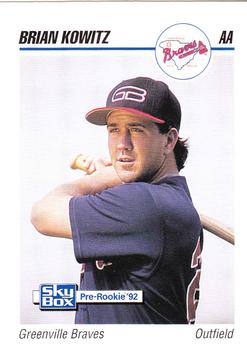
A variety of players got the call in left field. Nobody played more than 34 games and we'll skip past these hodgepodge of names and go to Brian Kowitz, the normal center fielder. Selected in the 9th round out of Clemson in 1990, there was a good deal of hope with Kowitz, who had speed and was projected to have developing pop. He originally made it to Richmond in 1993 and posted an .801 OPS with the International League Champs in 1994. His numbers fell the following season, though like many starting position players for the R-Braves, Kowitz did get a shot to play in Atlanta and he hit .167 over 28 PA. The Braves soured on him and he spent 1996 with the Blue Jays and Tigers organizations, but he hit even worse. His career was effectively over at that point, though Kowitz played 13 games for Aberdeen in the Atlantic League in 2000. He's now an instructor with former major leaguers Larry Bigbie and Val Majewski at former Cardinals Matt Morris's The Baseball Warehouse.
Getting the bulk of time in right field was Bobby Moore. He had made it to the majors with the Royals for a cup of coffee in 1991, where he went 5 for 14. After that season, the Braves sent infielder Rico Rossy to the Royals to acquire Moore, who had good speed and not much else. He spent 1992 with the R-Braves and OPS'd .604. After spending most of 1993 in the Mexican League, Moore landed back in the Royals organization in 1994 before ending the season BACK IN Richmond. After a 60 games with the R-Braves in '94, Moore played 108 games with the R-Braves in 1995 with a .673 OPS. After one more season with Richmond, his career was over after 1996 after never getting back to the majors after his short run in 1991. He joined the Braves as a coach and has spent ten of the last 12 years with Rome as their hitting coach with two years in Lynchburg in the same capacity.
In 1995, the Richmond Braves had five pitchers get at least eleven starts and some of them played a big role for major league teams. The best prospect of the group was Jason Schmidt, who entered the season as the 42nd best prospect. His numbers in 1995 pushed him to 11th after he had a 2.25 ERA in 116 innings for the R-Braves to go with a 1.25 WHIP. He also appeared in nine games in the majors with two starts. Blocked by a veteran pitching staff, Schmidt was ticketed for more minor league work, but did start 11 games with the Braves in 1996 before late August when the Braves packaged him with a pair of prospects for Denny Neagle. Schmidt would show glimpses of a breakout campaign, but unfortunately for the Pirates, it never came until they sent him to the Giants. While logging over 1000 innings in San Fran, Schmidt posted a 3.36 ERA with nine shutouts and a Cy Young runner-up season in 2003. Injuries ultimately limited him to 43.1 ING after 2006 and after 2009, he basically called it quits.
Lefthander Terrell Wade was a top prospect as well. Why he didn't go by his given first name, Hawatha, is rather perplexing. Wade was actually an amateur free agent in 1991 out of Rembert High School in South Carolina. This is why scouts earn the big bucks when they find an undrafted free agent who makes it to the majors. He had an explosive strikeout arm that K'd 208 in 158.1 ING during 1993. In Richmond during 1995, Wade was a disappointing hurler, posting a 4.56 ERA, 1.41 WHIP, and 7.9 K/9. He did finish the year with the Braves for three games and became a regular fixture out of the bullpen in 1996 when he had a 2.97 ERA despite a worrisome 1.49 WHIP. He even appeared in three games in the postseason that year. After a rough 1997 landed him back in the minors, Wade was selected by the expansion Devil Rays after the season. He started two games in 1998 with the Rays to finish up his major league career. After 2000, he was stuck in independent ball, even returning to Macon for their new independent team in 2003. He got roughed up in three games with Nashua during 2006 as part of his final professional action.
Righty Matt Murray had started the season with Greenville, but started 19 games down the stretch with Richmond with a 2.78 ERA and 1.15 WHIP. He made it to the majors for four games with the Braves, including a start, before the Braves sent him to Boston to complete a deal that landed Mike Stanton with the Red Sox. With the BoSox, Murray got hammered in 3.1 ING. He would spent the next four seasons trying to get back to the majors, including a return to Richmond in 1996, but wasn't successful. Right-hander Chris Seelbach had been picked in the 4th round of 1991 by the Braves and after nine games with Greenville, Seelbach made it back to Richmond for a 14 game run in 1995. Later that season, he was the player to be named later in the Alejandro Pena trade with the Marlins. After two seasons in AAA for the Marlins, Seelbach spent one year with the Mariners before returning to the Braves organization in 1999. He would appear in seven games with the big league club in 2000-01 with little success. After 2001, he headed to Japan to finish his career with an uneven two seasons with Nappon Ham. After a 3.60 ERA in 2002, it ballooned to 5.61 in 2003.
If Damon Hollins was the "Mayor" of Richmond, Brad Woodall was the city manager. Woodall arrived in 1993 for 57.2 ING. From there, he was stuck in Richmond ala Todd Redmond. He even threw three shutouts during 1994 with a 2.42 ERA and 1.12 WHIP. But, behind the Big Three and more, Woodall was buried in the International League. The UNC product did appear in 18 games with the big league club between 1994-96 and posted a miserable 6.50 ERA. After 1997, Woodall finally left the organization and went to Milwaukee in 1998 where he got his biggest taste of the big leagues. He started 20 out of 31 games for the Brewers with a 4.96 ERA and 1.39 WHIP in 138 innings. He also homered off future Brave John Thomson. Woodall failed to make the Brewers in 1999 and got waived where the Cubs acquired him. After he wasn't productive, Woodall headed back to the minors. After a year off possibly because of injury, he came back to pitch for Long Island in the Atlantic League and while he was solid, he never got back to the majors. Since retiring, Woodall spent a couple of years in the Rays system as a coach before becoming a pitching coach with UW-Madison. He also opened the Woodall Baseball Academy and penned A Parent's Guide to Pitching.
Saving games for the R-Braves was 30 year-old Rod Nichols, who nailed down 25 saves to go with a ridiculous 9.5 K/BB rate. 57 strikeouts to SIX walks...including one intentional. That's serious control coming out of the pen. Nichols had already logged 95 games in the majors, all but four with the Indians, between 1988 and 1993. After finishing 1995 with five ugly outings with the big league Braves, Nichols returned to Richmond in 1996 and saved 20 more games with a 1.99 ERA, but did not appear in the majors. After a season in Japan, Nichols retired and eventually transitioned into coaching in the Phillies system. Since 2013, he has been the bullpen coach for the Phillies.
Richmond only had a +14 run differential in 1995 as a product of the league's worst offense (3.96 R/G, .690 OPS). That's how a team with the second best pitching in the league finishes just nine games over .500. Silver lining was that pitching staff was the youngest in the league and threw 14 shutouts. Overall, it was a good season, though the R-Braves definitely would have preferred a bit more offense to give their pitching staff more of a chance to get the old dubya.
Showing posts with label 1995. Show all posts
Saturday, June 21, 2014
Saturday, June 14, 2014
1995 Reflections: Greenville Braves
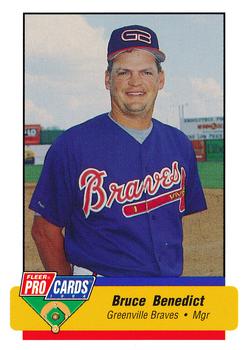
In the manager position for the G-Braves was Bruce Benedict, the long time Brave who was showered in the 80's at Atlanta-Fulton County Stadium with a chorus of "BRUUUUUUUUUUCE!" After retiring, Benedict became a coach and manager in the Braves system for three years, including 1994-95 with Greenville. He would spend one year managing Norfolk for the Mets organization in 1996, but transitioned into scouting. After time with in that position with the Mets and Cardinals, he currently serves as a White Sox scout in the Atlanta area while operating his own baseball academy.
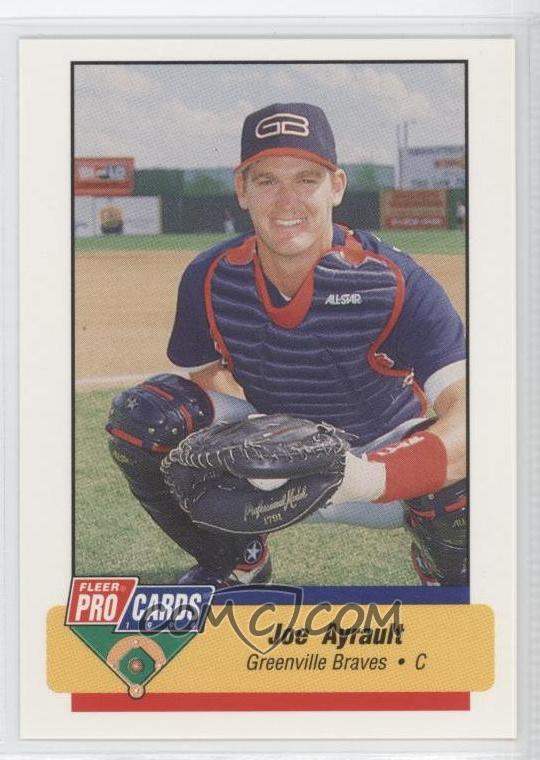
His primary catcher in Greenville in both years was Joe Ayrault, a right-handed hitter catcher in the Benedict mold of defense-first, offense-optional. Ayrault briefly made it to the majors with the Braves in 1996 for a seven game run as a defensive replacement in late innings. He went 1 for 5 with a HBP with a single off future Brave, Chris Hammond. His claim to fame was being the "third catcher" in the postseason roster as Bobby Cox never liked going into the postseason with just two catchers. Ayrault would give up his major league dream in 1997 and, amazingly, became a hitting coach. In 2007, he eventually became a manager for the final three editions of the Sarasota Reds. He moved on to the Brewers organization in 2010, managing Helena for two years and Brevard County for the last three.
A variety of options played at first base. Greg Sparks, a 31 year-old playing his final games for an MLB organization, posted a .660 OPS in 65 games before the G-Braves moved on to other options. After a run in Mexico and the independent Texas-Louisiana League, Sparks was finished with over 1300 games played in professional ball and no trip to the Show. Raymond Nunez, who began the year with Durham, smacked nine homers in 81 games to provide a more useful bat at first than Sparks. He spent one more year in the Braves organization before trying his luck in the Cubs system. After two years with them, he played five years in Mexico, hitting 47 homers, but never coming north. Most recently, he managed in the Marlins Dominican Summer League between 2010-12.
The little engine that could, Marty Malloy, handled second base duties for most of the season, hitting .278 with a career-best ten taters. He would play four more seasons in the Braves organization, mostly at Richmond, and got an eleven game run in September of 1998. In his first game in the bigs, he started at second and batted second. After striking out in his first at-bat, he hit a solo homerun off Rick Reed in the third, his only homer of his major league career. Malloy spent 2000-2001 with the Tigers and Reds minor league systems before making the Marlins roster in 2002. He only hit .120 and was released, picking back up with Reds to finish the year in their minor league system. By the end of 2003, his playing career was over with 1201 games played in the minors.
A young infielder who was already in his third organization, Pablo Martinez got the lionshare of games at shortstop and the weak-hitting Dominican actually had a pretty good season in 1995 with the stick compared to his career. He hit .255/.313/.353 with a career high of 22 doubles. He would spend two more seasons with the Braves organization, including a four-game callup in 1996 where he picked up his only major league hit, a single in the 16th inning against the Dodgers. The Braves eventually won it 5-3 in 18 innings. Martinez would land in the Milwaukee organization to start 1998 and after a ten game run in independent ball, he came back to the Braves through midseason 2000. However, he never got back to the bigs after 1996. After a year with Somerset in the Atlantic League, Martinez's career was over after 2001.
At third base was the #75th best prospect in baseball, according to Baseball America, former 1992 eleveth rounder Bob Smith. He had projection-able power and good speed with plenty of youth. The 21 year-old slashed .261/.331/.430 for the G-Braves with 14 homeruns. He would follow that up with a pair of underwhelming seasons at Richmond before becoming the 12th selection of the 1997 expansion draft by the Tampa Bay Devil Rays. He spent all of 1998 with the expansion Rays, hitting 11 homers and batting .276. A feisty third baseman who once got suspended after a fight with Jorge Posada, the D-Rays had hope that Smith would man third base for several years. Subsequent seasons were not nearly as good and in 2002, the Rays cut him after a .466 OPS in the first month of the season. He tried his luck in four different organizations, but only padded his AAA stats. By 2006, he was out of baseball.
While two outfield slots were occupied for almost all of the season, left field in Greenville was a mix of four players with Troy Hughes, a veteran of nine minor league seasons, getting the majority of starts. Hughes originally got to Greenville in 1993 and posted a .796 OPS. He failed in Richmond the following season, receiving a demotion, and was back in Greenville to open 1995. He posted a .707 OPS before the Braves sent Hughes to the Yankees for Luis Polina, who would help the Braves to their '95 Series victory. Meanwhile, Hughes languished in AA for the Yanks, Cubs, and A's organizations, ultimately seeing his career end after 1997. Juan Williams blasted 15 homers for Greenville in 1995 while playing left and DH. After 62 games and a 1.010 OPS, Williams received a well-earned promotion to AAA but he never got to the majors from there, even after playing for Boston and the Cubs. His career ended after an 18-game run with Allentown in 1999. I wrote about Pedro Swann last week, but he also got 15 games for the G-Braves in 1995. Finally, there was Mike Warner, who was a major disappointment after posting back-to-back .900+ OPS seasons as Warner posted a .705 OPS in 1995. Warner would play in the Dodgers and A's organizations after the Braves let him go after 1998, but spent most of the remainder of his career playing independent baseball. He was done by 2003.
In center field was the #99th prospect in baseball, Damon Hollins. A right-hand hitting, left-hand throwing outfielder from Vallejo, CA, Hollins was only in his fourth professional season and second full season, but the 21 year-old did hit .247 with 18 HR. He would gain fame for two different stints in Richmond between 1996-98 and 2001-2004, earning the nickname "The Mayor." He briefly made an appearance with the big league club in 1998 before being dealt to the Dodgers in September. He got back to Atlanta in 2004, going 8-for-22. After the season, he left the Braves for the Rays and received his most extensive playing time in the majors in 2005-06, playing in 241 of his career 256 MLB games and bashing all 28 of his homeruns while serving as a fourth outfielder in Tampa. They non-tendered him after the 2006 season and he headed to Japan, where he hit 12 homers for Yomiuri. He tried to get back to the majors with the Royals and Phillies, but after failing to make the latter in 2009, his career was done. He hit 71 homers for the Richmond Braves.
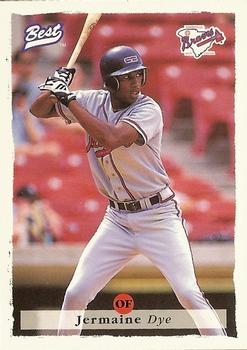
Another California native, Jermaine Dye, manned right field for the Greenville Braves in 1995. The #88 prospect in the game increased his value with the G-Braves by slashing .285/.329/.481 with 15 HR as a 21 year-old. Dye would head to Richmond in 1996, but didn't stay long. An injury to David Justice brought Dye up in mid May and he finished sixth in the Rookie of the Year balloting while slashing .281/.304/.459. After the season, the Braves made the unpopular decision to ship Dye out to the Royals in the Keith Lockhart/Michael Tucker trade. It took Dye three seasons, but he broke out with the Royals in 1999, bashing 27 homers and posting an .880 OPS. From there, he became a very good regular player for the A's and White Sox after his time in KC was done. He didn't get a deal he liked after 2009 and just before the 2011 season began, Dye decided to hang them up with a career .826 OPS in his 14-year career.
The G-Braves staff was led by a bunch of no-names, though 23 year-old lefty Darrell May started 15 games. Despite a 3.55 ERA and a 1.11 WHIP, May had a 2-8 record when the Braves promoted May to Richmond to finish the season. May, a former 14th rounder by the A's, was actually a 46th rounder by the Braves before he signed and expectations were low, but like Trey Hodges would do a few years later, his minor league numbers were good because he was smart and had good control. May finished 1995 in Atlanta with a pair of meh-outings. After failing to make the Braves roster in 1996, he was waived and picked up by the Pirates. He would pitch for both the Pirates and Angels in 1996 and allowed 12 ER and 6 HR in 11.1 ING. After another year with the Angels with little positive results, May headed to Japan to refine his game. He spent two seasons with Hanshin and two more with Yomiuri, including a great 2000 campaign where he finished with a 2.95 ERA and three shutouts in 24 starts. May came back across the Pacific and landed in Kansas City for three years. A pretty solid 3.77 ERA and 1.19 WHIP over 210 innings in 2003 was sandwiched between 5.00+ ERA's in 2002 and 2004, including a league-leading 19 loses in 2004. The following season, May tried to hook on with the Padres and Yankees, but pitched poorly. He got one last shot with the Reds' AAA team in 2006, but was released on June 1st and his career ended and he became a high school baseball coach in Texas.
Former 3rd rounder Carl Schutz, a left-hander out of Southeastern Louisiana, followed up a 20 save season with Durham in 1994 with 26 in Greenville in 1995. However, he had control problems and it derailed his career from taking off. He did appear in three games with the '96 Braves, striking out five in 3.1 ING while surrendering a run. He spent the last year-and-half of his career in the Cubs system.
As a team, the '95 G-Braves scored the second most runs per game in the Southern League while tying for the league-lead in homers, but their success was muted by a pitching staff that struck out the fewest batters while allowing, by a significant margin, the most homers in the league. They gave up the second most runs in the league and finished with five more victories than the league's worst team.
Saturday, June 7, 2014
1995 Reflections: Durham Bulls
Welcome to the fourth week of a look back at the "Other" 1995 seasons for teams affiliated to the Braves. In many cases, I search for information about the particular team through Google, whose their automatic fill-in options don't catch my eye. In the case of the 1995 Durham Bulls, there was something that grabbed my attention. If you have Chrome, go ahead and start typing "1995 Durham Bulls." I'll wait.
Did you see the word "brawl" follow the phrase? The 1995 Bulls are known for the brawl that occurred on May 22, 1995. I'll get to that in a little bit, but let's talk about the Bulls a little more. Popularized by the Kevin Costner flick, Bull Durham, the Bulls began an association with the Braves in 1980 and continued until 1997. At that point, the Bulls changed to a Rays squad and moved up to AAA. 1995 was also the first year for the Bulls in their new ballpark, a 7,000-seat stadium that has been expanded to 10,000 seats now.
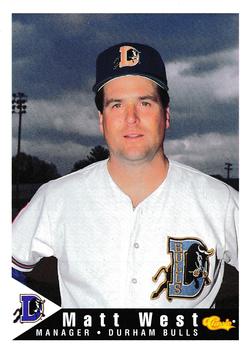
Still, for 17 years, the city of Durham, NC saw some of the greatest Braves prospects play. The squad in 1995, however, wasn't one of those teams filled with tremendous young stars. They were led on the field by Matt West, a veteran of eight minor league seasons, including seven with the Braves. He retired after 1988 and became a coach in the Braves organization, before being promoted in 1994 to the manager of the Bulls. In two seasons with the Bulls, he led Durham to a 129-146 record before going into sales and marketing, eventually starting his own company named Intangibles, LLC.
Three players picked up significant time behind the plate, including the underwhelming Dave Toth. In 11 minor league seasons, Toth finished with a .682 OPS, including a .664 OPS with Durham in 85 games. He received cameos in 1995 and 1997 with the Richmond Braves and would play three seasons with the White Sox and their AAA squads, but never played in a major league game.
At first base, West could pencil in Randall Simon daily. On a bad offense, the native of Curacao slashed .264/.326/.440 with 18 HR and a team-leading 185 TB. Probably his oddest statistic was that of his 36 walks, 14 were intentional. That was the most by a player in the Braves minor league system and double what Andruw Jones had. Ron Wright blasted 32 homers for Macon and was walked intentionally once. Simon would go on to make it to the Braves for cup of coffee runs in 1997 and 1998 before spending most of 1999 with the Braves, hitting .317 with 5 HR in 237 PA. After the season, he became involved in a controversy when John Rocker supposedly referred to Simon as a "fat monkey" in Rocker's infamous interview to Sports Illustrated. Possibly seeking to avoid a season-long issue, the Braves cut Simon after spring training. Simon would make it back to the majors in 2001 and he produced well for a pair of bad Tigers clubs, slashing .302/.327/.454 over 211 games. Still, the Tigers traded him to the Pirates after the season. In 2003, Simon would again find himself embroiled in controversy when during a Sausage Race in Milwaukee, Simon hit one of the racing Sausages with a bat. He didn't cause the female student doing the race any serious injury beyond a skinned knee, but Simon was suspended and fined, both by MLB and the Milwaukee police. He later made nice, giving an autographed bat to the female, who also received a complimentary trip to Curacao from the overly nice Curacao Tourism Board. Simon would play for the Cubs, Rays, and Phillies over the remainder of his MLB career, but struggled. He also spent 16 games in Japan, sucking it up. After three seasons in the independent leagues, Simon hung 'em up after 2010.
A pair of light-hitting middle infielders got the majority of playing time up the middle. Manny Jimenez hit .245 in his third different year with Durham and his .602 OPS was his best total with the Bulls. He would spend two more years with Greenville before his career ended after the 1997 season. Similar case for Danny Magee. A former sixth rounder from Louisiana, Magee would repeat Durham after slashing .256/.315/.350 with the Bulls in 1995. He was actually very productive in 1996, slamming 12 HR to go with 17 steals, but was cut after just seven games with Greenville in 1997 and his career was over.
Johnny Knott was part of a group that manned the hot corner. Of the lot, he had the best season for Durham. The 5'11" right-hand hitting third basemen from St. Louis, Knott hit .267/.401/.422 with 11 HR and 11 steals. This was following up a productive 1994 season with Macon that saw Knott OPS .867 with 17 HR and 38 steals. Nevertheless, he was released before the 1996 season. With no blogs to question the decision, it went largely unnoticed and wasn't given a ridiculous amount of expert disagreement. The Braves must have knew something because Knott failed to catch on with a big league organization and spent 1996-2000 hitting 59 homers and OPSing .933 in independent baseball before finishing up his career before his 30th birthday.
In left field, Gator McBride played in his third season of professional ball and struggled to make enough solid contact. After hitting .338 in 81 games with Macon the previous season, McBride struggled to a .236 season with a .734 OPS. He would never make it to AAA and was cut after 1998. He spent that year with a month-plus in Sarasota for the Red Sox and the rest of the season with Chillicothe in the independent Frontier League. That would be his final season. Manning the other corner slot was Scott Pagano, who was picked up from the independent league Ohio Valley Redcoats after OPSing 1.025 in 1994. Pagano, who the Tigers cut after two seasons after making him a 16th round pick in 1992, would spend one year with the Braves and OPS'd .658 with the Bulls. He did steal 41 bases, second most in the Carolina League. He would get time in the Mets and Phillies organization, never making it past AA, and finished his career with a run in the Mexican League.
1993 second rounder Andre King was the everyday option in center field. King hit just .252/.327/.382, failing yet again to turn his speed into a true weapon. In late August, the Braves sent King to the White Sox for Mike Devereaux, who would go on to claim the NLCS MVP award against the Reds. King wouldn't spend long in their system and headed to the Reds organization for 1996. He gave up baseball after 1997 with a career slash line of .237/.322/.347 and just 13 games above A-ball. That fall, he walked-on at Miami and played wide receiver for the Hurricanes for four years before becoming a 7th rounder for the Browns in 2001. After four seasons and 30 receptions, King's football career, like his baseball career, was over. Also with the Durham Bulls and playing the corner outfield position was Wonder Monds. That's what baseball-reference calls him. His full name is Wonderful Terrific Monds III, a name that was originally given to his grandfather after the latter's birth followed a number of girls and was considered to be "wonderful, just terrific." A 50th rounder out of Tennessee State in 1993, Monds OPS'd .717 with 28 steals for Durham and would play with the Braves organization until 1997. After years with the Rockies and Reds organization, Monds ended his career without appearing in AAA.
Six different pitchers received at least 14 starts with the Durham Bulls. Micah Bowie was the best of the group, though the lefty still walked 61 in 130.1 ING. Though his minor league numbers were largely average, Bowie picked the right time to have his best season, posting a 2.96 ERA with Richmond in 1999. It got him both to the majors briefly in Atlanta before being packaged in a deal to the Cubs that brought over Jose Hernandez and Terry Mulholland for the stretch run. Bowie's 11 starts in Chicago were awful. Like, let's talk about this for a second awful. In 47 innings, he gave up 54 runs (all but two were earned), 8 homers, and walked 30. A 2.19 WHIP is hard to accomplish in 47 innings because rarely can you pitch that bad and pitch that often. Bowie would become a journeyman from there, playing in four different organizations and making it to the majors with three of them, though never for very long. His 30 game, 57.1 ING run with the Nationals in 2007 was the exception. After 2008, Bowie's career was finished.
John LeRoy posted a 5.44 ERA in 125.2 ING with the Bulls in 1995, but he was only 20. He would repeat the level and nearly shaved off two runs off his ERA. He spent the next season in AA, but struggled. Still, he appeared in a game against the Mets that September. The Braves had already won a hundred and opened their final series of the year at Shea Stadium. Playing the game like a spring training game where many regulars received two plate appearances and a trip to the bench, the Braves fell behind 5-1 early and by the seventh, they had fought back to a 6-4 deficit. With Tony Graffanio on first, Rafael Belliard stepped in against Brian Bohanon and for the first time in ten years, Belliard hit a homer that tied up the game. LeRoy got the call in the ninth and around a walk, he K'd the side. In the tenth, the Mets loaded the bases off LeRoy, but failed to score. An RBI single by Danny Bautista put the Braves ahead and they would win 7-6, giving LeRoy his first major league win in his first major league game. He would never pitch in the majors again. He would play until 2001, including a four-game run with the new Rays-affiliated Bulls in 1998.
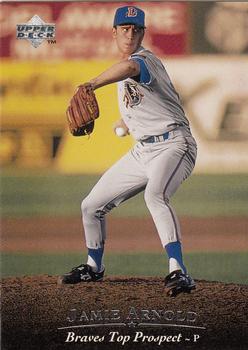
Young righty Jamie Arnold was repeating Durham and posted a 3.94 ERA in 14 games before a ten game run in Greenville that was awful. Arnold would eventually get to the bigs with the Dodgers in 1999 for 36 games and pitched for both Chicago and the Dodgers in 2000. In 50 games in the major leagues, Arnold posted a 5.73 ERA. After heading back to the minors, Arnold would pitch for two more years before hanging up his spikes.
Matt Byrd led the way in the bullpen with 27 saves, which led the system. It would be his best year of a short career. After struggling in 79 games with Greenville over the next two seasons, Byrd was released and finished up his career with ten games in the Colorado system.
However, the most notable thing that occurred during the 1995 season for the Durham Bulls happened on May 22nd. Playing the Winston-Salem Warthogs, a Reds affiliate, after twice getting nailed by the Warthog pitcher following homers, Knott charged the mound and brawl that caused a 32-minute delay was ON! I found a better description than I can provide here, but former Brave Paul Bako was also involved and one player went to the hospital. Every player on both teams were suspended and fined with the exception of two pitchers, one for each team, that were in the stands charting pitches.
Overall, the Bulls finished 13 games under .500 with the third most anemic offense and second worst pitching staff. They lacked marquee prospects and were outclassed by the rest of the Carolina League. It's a bad sign when the most notable thing about a team's year is the brawl they got into, even if it was a historic one.
Did you see the word "brawl" follow the phrase? The 1995 Bulls are known for the brawl that occurred on May 22, 1995. I'll get to that in a little bit, but let's talk about the Bulls a little more. Popularized by the Kevin Costner flick, Bull Durham, the Bulls began an association with the Braves in 1980 and continued until 1997. At that point, the Bulls changed to a Rays squad and moved up to AAA. 1995 was also the first year for the Bulls in their new ballpark, a 7,000-seat stadium that has been expanded to 10,000 seats now.
Still, for 17 years, the city of Durham, NC saw some of the greatest Braves prospects play. The squad in 1995, however, wasn't one of those teams filled with tremendous young stars. They were led on the field by Matt West, a veteran of eight minor league seasons, including seven with the Braves. He retired after 1988 and became a coach in the Braves organization, before being promoted in 1994 to the manager of the Bulls. In two seasons with the Bulls, he led Durham to a 129-146 record before going into sales and marketing, eventually starting his own company named Intangibles, LLC.
Three players picked up significant time behind the plate, including the underwhelming Dave Toth. In 11 minor league seasons, Toth finished with a .682 OPS, including a .664 OPS with Durham in 85 games. He received cameos in 1995 and 1997 with the Richmond Braves and would play three seasons with the White Sox and their AAA squads, but never played in a major league game.
At first base, West could pencil in Randall Simon daily. On a bad offense, the native of Curacao slashed .264/.326/.440 with 18 HR and a team-leading 185 TB. Probably his oddest statistic was that of his 36 walks, 14 were intentional. That was the most by a player in the Braves minor league system and double what Andruw Jones had. Ron Wright blasted 32 homers for Macon and was walked intentionally once. Simon would go on to make it to the Braves for cup of coffee runs in 1997 and 1998 before spending most of 1999 with the Braves, hitting .317 with 5 HR in 237 PA. After the season, he became involved in a controversy when John Rocker supposedly referred to Simon as a "fat monkey" in Rocker's infamous interview to Sports Illustrated. Possibly seeking to avoid a season-long issue, the Braves cut Simon after spring training. Simon would make it back to the majors in 2001 and he produced well for a pair of bad Tigers clubs, slashing .302/.327/.454 over 211 games. Still, the Tigers traded him to the Pirates after the season. In 2003, Simon would again find himself embroiled in controversy when during a Sausage Race in Milwaukee, Simon hit one of the racing Sausages with a bat. He didn't cause the female student doing the race any serious injury beyond a skinned knee, but Simon was suspended and fined, both by MLB and the Milwaukee police. He later made nice, giving an autographed bat to the female, who also received a complimentary trip to Curacao from the overly nice Curacao Tourism Board. Simon would play for the Cubs, Rays, and Phillies over the remainder of his MLB career, but struggled. He also spent 16 games in Japan, sucking it up. After three seasons in the independent leagues, Simon hung 'em up after 2010.
A pair of light-hitting middle infielders got the majority of playing time up the middle. Manny Jimenez hit .245 in his third different year with Durham and his .602 OPS was his best total with the Bulls. He would spend two more years with Greenville before his career ended after the 1997 season. Similar case for Danny Magee. A former sixth rounder from Louisiana, Magee would repeat Durham after slashing .256/.315/.350 with the Bulls in 1995. He was actually very productive in 1996, slamming 12 HR to go with 17 steals, but was cut after just seven games with Greenville in 1997 and his career was over.
Johnny Knott was part of a group that manned the hot corner. Of the lot, he had the best season for Durham. The 5'11" right-hand hitting third basemen from St. Louis, Knott hit .267/.401/.422 with 11 HR and 11 steals. This was following up a productive 1994 season with Macon that saw Knott OPS .867 with 17 HR and 38 steals. Nevertheless, he was released before the 1996 season. With no blogs to question the decision, it went largely unnoticed and wasn't given a ridiculous amount of expert disagreement. The Braves must have knew something because Knott failed to catch on with a big league organization and spent 1996-2000 hitting 59 homers and OPSing .933 in independent baseball before finishing up his career before his 30th birthday.
In left field, Gator McBride played in his third season of professional ball and struggled to make enough solid contact. After hitting .338 in 81 games with Macon the previous season, McBride struggled to a .236 season with a .734 OPS. He would never make it to AAA and was cut after 1998. He spent that year with a month-plus in Sarasota for the Red Sox and the rest of the season with Chillicothe in the independent Frontier League. That would be his final season. Manning the other corner slot was Scott Pagano, who was picked up from the independent league Ohio Valley Redcoats after OPSing 1.025 in 1994. Pagano, who the Tigers cut after two seasons after making him a 16th round pick in 1992, would spend one year with the Braves and OPS'd .658 with the Bulls. He did steal 41 bases, second most in the Carolina League. He would get time in the Mets and Phillies organization, never making it past AA, and finished his career with a run in the Mexican League.
1993 second rounder Andre King was the everyday option in center field. King hit just .252/.327/.382, failing yet again to turn his speed into a true weapon. In late August, the Braves sent King to the White Sox for Mike Devereaux, who would go on to claim the NLCS MVP award against the Reds. King wouldn't spend long in their system and headed to the Reds organization for 1996. He gave up baseball after 1997 with a career slash line of .237/.322/.347 and just 13 games above A-ball. That fall, he walked-on at Miami and played wide receiver for the Hurricanes for four years before becoming a 7th rounder for the Browns in 2001. After four seasons and 30 receptions, King's football career, like his baseball career, was over. Also with the Durham Bulls and playing the corner outfield position was Wonder Monds. That's what baseball-reference calls him. His full name is Wonderful Terrific Monds III, a name that was originally given to his grandfather after the latter's birth followed a number of girls and was considered to be "wonderful, just terrific." A 50th rounder out of Tennessee State in 1993, Monds OPS'd .717 with 28 steals for Durham and would play with the Braves organization until 1997. After years with the Rockies and Reds organization, Monds ended his career without appearing in AAA.
Six different pitchers received at least 14 starts with the Durham Bulls. Micah Bowie was the best of the group, though the lefty still walked 61 in 130.1 ING. Though his minor league numbers were largely average, Bowie picked the right time to have his best season, posting a 2.96 ERA with Richmond in 1999. It got him both to the majors briefly in Atlanta before being packaged in a deal to the Cubs that brought over Jose Hernandez and Terry Mulholland for the stretch run. Bowie's 11 starts in Chicago were awful. Like, let's talk about this for a second awful. In 47 innings, he gave up 54 runs (all but two were earned), 8 homers, and walked 30. A 2.19 WHIP is hard to accomplish in 47 innings because rarely can you pitch that bad and pitch that often. Bowie would become a journeyman from there, playing in four different organizations and making it to the majors with three of them, though never for very long. His 30 game, 57.1 ING run with the Nationals in 2007 was the exception. After 2008, Bowie's career was finished.
John LeRoy posted a 5.44 ERA in 125.2 ING with the Bulls in 1995, but he was only 20. He would repeat the level and nearly shaved off two runs off his ERA. He spent the next season in AA, but struggled. Still, he appeared in a game against the Mets that September. The Braves had already won a hundred and opened their final series of the year at Shea Stadium. Playing the game like a spring training game where many regulars received two plate appearances and a trip to the bench, the Braves fell behind 5-1 early and by the seventh, they had fought back to a 6-4 deficit. With Tony Graffanio on first, Rafael Belliard stepped in against Brian Bohanon and for the first time in ten years, Belliard hit a homer that tied up the game. LeRoy got the call in the ninth and around a walk, he K'd the side. In the tenth, the Mets loaded the bases off LeRoy, but failed to score. An RBI single by Danny Bautista put the Braves ahead and they would win 7-6, giving LeRoy his first major league win in his first major league game. He would never pitch in the majors again. He would play until 2001, including a four-game run with the new Rays-affiliated Bulls in 1998.
Young righty Jamie Arnold was repeating Durham and posted a 3.94 ERA in 14 games before a ten game run in Greenville that was awful. Arnold would eventually get to the bigs with the Dodgers in 1999 for 36 games and pitched for both Chicago and the Dodgers in 2000. In 50 games in the major leagues, Arnold posted a 5.73 ERA. After heading back to the minors, Arnold would pitch for two more years before hanging up his spikes.
Matt Byrd led the way in the bullpen with 27 saves, which led the system. It would be his best year of a short career. After struggling in 79 games with Greenville over the next two seasons, Byrd was released and finished up his career with ten games in the Colorado system.
However, the most notable thing that occurred during the 1995 season for the Durham Bulls happened on May 22nd. Playing the Winston-Salem Warthogs, a Reds affiliate, after twice getting nailed by the Warthog pitcher following homers, Knott charged the mound and brawl that caused a 32-minute delay was ON! I found a better description than I can provide here, but former Brave Paul Bako was also involved and one player went to the hospital. Every player on both teams were suspended and fined with the exception of two pitchers, one for each team, that were in the stands charting pitches.
Overall, the Bulls finished 13 games under .500 with the third most anemic offense and second worst pitching staff. They lacked marquee prospects and were outclassed by the rest of the Carolina League. It's a bad sign when the most notable thing about a team's year is the brawl they got into, even if it was a historic one.
Saturday, May 31, 2014
1995 Reflections: Macon Braves
Welcome to the third part of a look back at the "Other" 1995 teams for the Braves franchise, the minor league clubs that would continue to produce players that would contribute to the Streak. Two weeks ago, we looked at the Danville Braves and last week, we touched base with the Emeralds in Eugene. Up this week is the Macon Braves. Atlanta began a relationship with Macon in 1991 after the town of Macon had been without organized baseball since the Pirates left four years earlier. The Braves would stay in Macon until 2002 when they moved their A ball squad to a new park in Rome, Georgia.
The 1995 squad was managed by Nelson Norman, a former middle infielder who played in 198 games in the majors, mostly when he was a 21 year-old rookie for the Rangers back in 1979. His playing days came to a close after 1989 and five years later, he got his first crack at managing with the Expos in the Gulf Coast League. The following season, Atlanta brought him in for one year with Macon. After leaving the Braves organization, Norman would coach in the Red Sox and Cardinals organization, eventually serving as a manager for the Dominican Summer League Cardinals for 2010 and 2011. Most recently, he has been the Director of Baseball Operations in the Dominican Republic for the Orioles.
Macon was led by several future major leaguers. Behind the plate, Pascual Matos was in his second season with Macon. Matos never hit very well (though he smacked 18 homers for Durham in 1997), but was a plus defender. In 1995, he hit just .185, but handled the pitching staff well. He would stick in the Braves organization until the end of 2000 and appeared in six games with the Braves in 1999, going 1 for 8 with 2 RBI. He would never make it back to the majors. After leaving the Braves' organization, Matos spent time with the Yankees, Rockies, and White Sox organization and played in the Canadian Baseball League, the Atlantic League, and the Golden Baseball League before a turn in the Italian Baseball League in 2008. He called a career after that and the well traveled backstop probably headed home.
At first base was Ron Wright, a big power hitter from Washington. Wright, who was a 7th rounder in 1994, bashed 32 homers for Macon and OPS'd .849. He would continue to destroy baseballs, hitting 36 homers in 1996 while playing in three different cities and being part of the trade that sent Jason Schmidt to the Pirates for Denny Neagle. He was the #46th prospect in baseball according to Baseball America, but struggled to stay healthy after 1996, failing to play in at least 100 games until 2001. By that time, Wright had been waived by the Pirates and picked up by the Reds, who let him go and he landed in Tampa Bay. Wright headed to the northwest for the 2002 season and played for the Mariners organization, ultimately getting a start at DH on April 14th of that year against former Rangers starter, Kenny Rogers, whose control in 1999 is the basis of this blog's name. Wright went 0 for 3 with a strikeout and grounded into a double play before being lifted for a pinch hitter. He headed back to the minors and after a 2003 season saw him play in the Indians and Tigers organization, Wright tried his luck in independent ball for a season. After no one else called, he retired after the 2004 season, a bust of a prospect. Fortunately for the Pirates, that Schmidt kid worked out for them.
Second base was manned by Mike Eaglin, who spent seven seasons in the Braves organization. He was repeating a year at Macon after injuries limited him to just 26 games in 1994 and Eaglin OPS'd just .673. After peaking at AA with the Braves, Eaglin played briefly for the White Sox organization in 1999, but was out of professional ball after that.
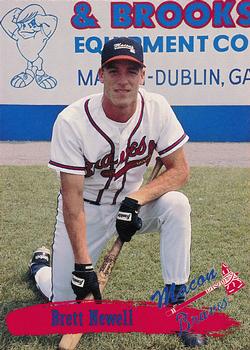
While the Macon Braves had a number of everyday regulars, shortstop was a position in flux during the 1995 season. Brett Newell, a 23rd rounder in 1994, got the most starts and hit just .256/.328/.295. He also spent a month with Durham. After struggling in 1996, Newell reinvented himself as a reliever and struck out 46 with the Eugene Emeralds in 34.1 ING during the 1997 season. He was either cut or picked up in the minor league Rule 5 draft the following season and played for the Royals organization, but was significantly less productive and after 1998, he was done with baseball. Jose Delgado also got time for the Macon Braves at short. Delgado, a former second rounder for the Pirates, OPS'd just .635 in 45 games. He would hit .293 the following season for Macon, but his success was short-lived and after 1998, he was cut and tried his luck in independent ball for three years before calling it quits. Previously discussed Australians Glenn Williams and Ben Utting also got at least 20 games at short for Macon.
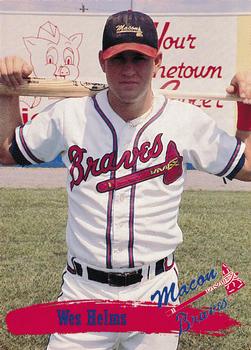
Big Wes Helms manned the hot corner for Macon. A tenth rounder out of North Carolina in 1994, Helms hit .275/.347/.401 for Macon in 1995 with 11 long flies. He would hit 17 the following season and reached the Baseball America Top 100 list as a result. Helms had a disappointing season in 1997 and only OPS'd .768 with Richmond in 1998 with 103 K's to 35 walks, but did make it to the bigs for Atlanta for a seven game cup of coffee that included a homer off one-time Brave Justin Speier. After an injury-shortened 1999, Helms had a fine season for Richmond in 2000, slashing .288/.325/.475 with 20 homers, a new personal best. He played six games in the majors, but got his first serious run in the majors during 2001 and 2002. He backed up the corners, getting spot starts against lefthanders, and bashed 16 homers over 185 games. However, outside of his power, Helms didn't hit all that well and the Braves shipped Helms and John Foster off to the Brewers for Ray King following the 2002 season. He hit a career-best 23 HR in 536 PA with the Brewers in 2003, his only year as a true starter in the bigs, but would eventually settle into a backup role at first and third who was often called upon to pinch hit. In fact, with the Marlins in 2006, he played in a career-high 140 games, but only managed 278 PA. He hit .311 as a pinch-hitter that season in 52 games. Over his career, Helms hit a respectable .259 as a pinch hitter with 7 pinch-hit homers. After the Marlins cut the .191-hitting Helms during mid-August 2011, the Braves inked him to a contract where he played in nine forgetful games with the Gwinnett Braves. He retired after the season
In the outfield, a pair of no-names (Brett Brewer and Gus Kennedy) flanked future superstar Andruw Jones. Brewer was a 1993 14th rounder out of Arizona who was playing in his third and final season in the Braves organization (and in professional ball). He on-based .340 and stole 15 bases, but hit just .241. Kennedy had a big year, though, slashing .253/.386/.506 with 24 homers and 20 steals. After he struggled in 1996, the Braves cut bait and he would spend the next three years trying his hand with the Cubs, Padres, and Angels organizations, but never made it to AA. After a 45 game run to finish 1999 in independent ball, his career came to a close.
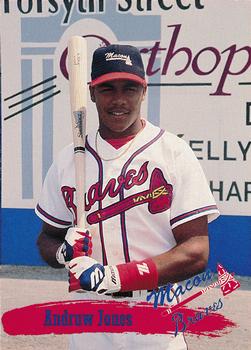
Meanwhile, Jones was already ranked by Baseball America as the #21st best prospect in baseball. He would spend all of 1995 with Macon and led all Braves minor leaguers with 56 steals while slashing .277/.372/.512. He added 41 doubles and 25 homers while driving in a cool 100. Jones would head to Durham the following season, but didn't stick with them all season like he did Macon. The best prospect in baseball rifled up the ladder, even joining the big league club for the playoff push and famously homered in his first two at-bats in the World Series. After a year spent learning on the job, Jones became the everyday CF in 1998 and manned that position for the Braves until 2006, hitting 368 homers and winning a Gold Glove every season, though toward the end, it was more awarding him based on reputation. His post-Atlanta career has been rocky. He crashed and burned in one season with the Dodgers, and while he was productive in limited opportunities for the Rangers, White Sox, and Yankees, he was no longer an everyday player. Over the last two seasons, he has played with Rakuten in Japan, hitting 39 homers in 191 games while largely playing DH and first base.
Macon was led on the mound by Derrin Ebert and Damian Moss as an impressive 1-2, though their only complete game shutout came from Anthony Briggs. Ebert, an 18th rounder the previous year out of California, posted a 3.31 ERA and 1.27 WHIP, but never came close to those numbers again. He broke camp with the Braves in 1999 for a five game run and picked up a save in his debut against the Phillies, though it was a three-inning save as the Braves routed the Phils 11-3. He finished the season with a 5.63 ERA in 8 innings with the Braves, who ultimately released him following the 2000 season. He would go to play with seven teams in five years, including the Brewers twice, though his 2004 season was wiped out because of injury. However, he never made it back to the bigs. Moss, on the other hand, posted a 3.56 ERA and 1.37 WHIP with the Macon Braves and the Australian native would make it to the majors in 2001, where he became a part of the rotation under Tom Glavine's wing in 2002 when he started 29 games for the Braves and posted a 3.42 ERA while finishing fifth in the Rookie of the Year voting. However, he walked 89 and after the season, the Braves made him expendable, trading him to the Giants in return for Russ Ortiz. By the 2003 deadline, the Giants had seen enough and sent him packing to the Orioles, who released him. He pitched eight innings for the 2004 Rays, but headed to the minors, where his career would languish. Stops in Cincinnati, Seattle, Colorado, and even back in Atlanta did little to get him back to the majors. He even pitched for the Macon Music in 2007, the independent ballclub that replaced the Braves. After 2010, Moss called it quits and currently runs a baseball/softball clinic in Georgia. Briggs threw his only complete game shutout in 1995 and would stick with the Braves organization until 1998. After a year with Colorado, his hope of getting to the majors was finished.
Those three were joined by other future major leaguers for a pitching staff that was surprisingly pretty bad. John Rocker started 16 games with Macon to go with his 12 starts in Eugene. Micah Bowie started five games in Macon before heading to Durham where he started 23.
However, Kevin Millwood spent the entire year with Macon. In 29 games with Macon, Millwood started 12. It may be forgotten, but Millwood was not a big prospect. The imposing Tar Heel was repeating Macon after appearing in 12 games with them the previous season and in 1995, he posted a 4.63 ERA and 1.39 WHIP. He did K 89 in 103 innings. Millwood started to find it from there, settling into a starter role in 1996 and climbing the ladder from AA to the bigs in 1997. By 1998, he was entrenched in Atlanta and was stellar for the Braves in 1999, his only All-Star season. His numbers were good, though never elite, and he was expected to anchor the rotation in 2003. That was before Greg Maddux famously accepted arbitration before the season, forcing the Braves to cut salary and send Millwood packing, and getting only Johnny Estrada in return from the division rival Phillies. He would throw a no-hitter the following season, but after two years in Philadelphia, he headed to Cleveland in 2005. After his only ERA title with the Indians, Millwood signed a long-term deal with the Rangers, but didn't pitch well in Arlington. He finished up his career with single season campaigns with the Orioles, Rockies, and Mariners. On June 8th of 2012, he started a combined no-hitter with six scoreless against the Dodgers before exiting with injury. Five pitchers would pitch the remaining three innings to complete the no-hitter.
Ken Raines, who paced the Danville Braves with 6 saves, led the Macon Braves with 8. Eric Olszewski struck out 103 in 81.1 ING and saved five games, but struggled with control and injuries and was in independent ball by 1999 and out of baseball after 2000.
Macon would finish 71-70 on the season, despite the league's best offense (5.24 R/G, almost a run higher than the league average). This was mostly due to a pitching staff that was substandard. Macon walked 58 more batters than the next team and surrendered the second most homers to Hickory while uncorking the most wild pitches in the league. They had a few good pitchers mixed in, but too many were minor league filler and would be out of baseball by 2000. Still, for fans of Macon in 1995, the idea of watching Andruw patrol center field nightly had to be a treat.
The 1995 squad was managed by Nelson Norman, a former middle infielder who played in 198 games in the majors, mostly when he was a 21 year-old rookie for the Rangers back in 1979. His playing days came to a close after 1989 and five years later, he got his first crack at managing with the Expos in the Gulf Coast League. The following season, Atlanta brought him in for one year with Macon. After leaving the Braves organization, Norman would coach in the Red Sox and Cardinals organization, eventually serving as a manager for the Dominican Summer League Cardinals for 2010 and 2011. Most recently, he has been the Director of Baseball Operations in the Dominican Republic for the Orioles.
Macon was led by several future major leaguers. Behind the plate, Pascual Matos was in his second season with Macon. Matos never hit very well (though he smacked 18 homers for Durham in 1997), but was a plus defender. In 1995, he hit just .185, but handled the pitching staff well. He would stick in the Braves organization until the end of 2000 and appeared in six games with the Braves in 1999, going 1 for 8 with 2 RBI. He would never make it back to the majors. After leaving the Braves' organization, Matos spent time with the Yankees, Rockies, and White Sox organization and played in the Canadian Baseball League, the Atlantic League, and the Golden Baseball League before a turn in the Italian Baseball League in 2008. He called a career after that and the well traveled backstop probably headed home.
| Images courtesy of tradingcarddb.com |
Second base was manned by Mike Eaglin, who spent seven seasons in the Braves organization. He was repeating a year at Macon after injuries limited him to just 26 games in 1994 and Eaglin OPS'd just .673. After peaking at AA with the Braves, Eaglin played briefly for the White Sox organization in 1999, but was out of professional ball after that.
While the Macon Braves had a number of everyday regulars, shortstop was a position in flux during the 1995 season. Brett Newell, a 23rd rounder in 1994, got the most starts and hit just .256/.328/.295. He also spent a month with Durham. After struggling in 1996, Newell reinvented himself as a reliever and struck out 46 with the Eugene Emeralds in 34.1 ING during the 1997 season. He was either cut or picked up in the minor league Rule 5 draft the following season and played for the Royals organization, but was significantly less productive and after 1998, he was done with baseball. Jose Delgado also got time for the Macon Braves at short. Delgado, a former second rounder for the Pirates, OPS'd just .635 in 45 games. He would hit .293 the following season for Macon, but his success was short-lived and after 1998, he was cut and tried his luck in independent ball for three years before calling it quits. Previously discussed Australians Glenn Williams and Ben Utting also got at least 20 games at short for Macon.
Big Wes Helms manned the hot corner for Macon. A tenth rounder out of North Carolina in 1994, Helms hit .275/.347/.401 for Macon in 1995 with 11 long flies. He would hit 17 the following season and reached the Baseball America Top 100 list as a result. Helms had a disappointing season in 1997 and only OPS'd .768 with Richmond in 1998 with 103 K's to 35 walks, but did make it to the bigs for Atlanta for a seven game cup of coffee that included a homer off one-time Brave Justin Speier. After an injury-shortened 1999, Helms had a fine season for Richmond in 2000, slashing .288/.325/.475 with 20 homers, a new personal best. He played six games in the majors, but got his first serious run in the majors during 2001 and 2002. He backed up the corners, getting spot starts against lefthanders, and bashed 16 homers over 185 games. However, outside of his power, Helms didn't hit all that well and the Braves shipped Helms and John Foster off to the Brewers for Ray King following the 2002 season. He hit a career-best 23 HR in 536 PA with the Brewers in 2003, his only year as a true starter in the bigs, but would eventually settle into a backup role at first and third who was often called upon to pinch hit. In fact, with the Marlins in 2006, he played in a career-high 140 games, but only managed 278 PA. He hit .311 as a pinch-hitter that season in 52 games. Over his career, Helms hit a respectable .259 as a pinch hitter with 7 pinch-hit homers. After the Marlins cut the .191-hitting Helms during mid-August 2011, the Braves inked him to a contract where he played in nine forgetful games with the Gwinnett Braves. He retired after the season
In the outfield, a pair of no-names (Brett Brewer and Gus Kennedy) flanked future superstar Andruw Jones. Brewer was a 1993 14th rounder out of Arizona who was playing in his third and final season in the Braves organization (and in professional ball). He on-based .340 and stole 15 bases, but hit just .241. Kennedy had a big year, though, slashing .253/.386/.506 with 24 homers and 20 steals. After he struggled in 1996, the Braves cut bait and he would spend the next three years trying his hand with the Cubs, Padres, and Angels organizations, but never made it to AA. After a 45 game run to finish 1999 in independent ball, his career came to a close.
Meanwhile, Jones was already ranked by Baseball America as the #21st best prospect in baseball. He would spend all of 1995 with Macon and led all Braves minor leaguers with 56 steals while slashing .277/.372/.512. He added 41 doubles and 25 homers while driving in a cool 100. Jones would head to Durham the following season, but didn't stick with them all season like he did Macon. The best prospect in baseball rifled up the ladder, even joining the big league club for the playoff push and famously homered in his first two at-bats in the World Series. After a year spent learning on the job, Jones became the everyday CF in 1998 and manned that position for the Braves until 2006, hitting 368 homers and winning a Gold Glove every season, though toward the end, it was more awarding him based on reputation. His post-Atlanta career has been rocky. He crashed and burned in one season with the Dodgers, and while he was productive in limited opportunities for the Rangers, White Sox, and Yankees, he was no longer an everyday player. Over the last two seasons, he has played with Rakuten in Japan, hitting 39 homers in 191 games while largely playing DH and first base.
| So, Moss decided...I want to look like a hitter? |
Those three were joined by other future major leaguers for a pitching staff that was surprisingly pretty bad. John Rocker started 16 games with Macon to go with his 12 starts in Eugene. Micah Bowie started five games in Macon before heading to Durham where he started 23.
However, Kevin Millwood spent the entire year with Macon. In 29 games with Macon, Millwood started 12. It may be forgotten, but Millwood was not a big prospect. The imposing Tar Heel was repeating Macon after appearing in 12 games with them the previous season and in 1995, he posted a 4.63 ERA and 1.39 WHIP. He did K 89 in 103 innings. Millwood started to find it from there, settling into a starter role in 1996 and climbing the ladder from AA to the bigs in 1997. By 1998, he was entrenched in Atlanta and was stellar for the Braves in 1999, his only All-Star season. His numbers were good, though never elite, and he was expected to anchor the rotation in 2003. That was before Greg Maddux famously accepted arbitration before the season, forcing the Braves to cut salary and send Millwood packing, and getting only Johnny Estrada in return from the division rival Phillies. He would throw a no-hitter the following season, but after two years in Philadelphia, he headed to Cleveland in 2005. After his only ERA title with the Indians, Millwood signed a long-term deal with the Rangers, but didn't pitch well in Arlington. He finished up his career with single season campaigns with the Orioles, Rockies, and Mariners. On June 8th of 2012, he started a combined no-hitter with six scoreless against the Dodgers before exiting with injury. Five pitchers would pitch the remaining three innings to complete the no-hitter.
Ken Raines, who paced the Danville Braves with 6 saves, led the Macon Braves with 8. Eric Olszewski struck out 103 in 81.1 ING and saved five games, but struggled with control and injuries and was in independent ball by 1999 and out of baseball after 2000.
Macon would finish 71-70 on the season, despite the league's best offense (5.24 R/G, almost a run higher than the league average). This was mostly due to a pitching staff that was substandard. Macon walked 58 more batters than the next team and surrendered the second most homers to Hickory while uncorking the most wild pitches in the league. They had a few good pitchers mixed in, but too many were minor league filler and would be out of baseball by 2000. Still, for fans of Macon in 1995, the idea of watching Andruw patrol center field nightly had to be a treat.
Saturday, May 24, 2014
1995 Reflections: Eugene Emeralds
Last Saturday, I started to look at the "Other" Braves teams of 1995, the season that brought a World Championship to Atlanta. I am moving up the ladder after opening with the Danville Braves and will head to the other coast to look at the Eugene Emeralds.
Wait, we had a team in Oregon? It didn't last long. The Braves experimented with the idea of a short-season A-ball team, largely built of college draftees. In 1995, the experiment began in Eugene and lasted four years before the Braves moved their short-season squad to Jamestown, New York, but after three years, they simply dropped the extra squad, pushing up Danville as the highest short-season team before the jump to full season ball in the South Atlantic League. The Eugene squad actually replaced the Idaho Falls Braves team that existed from 1986 to 1994. The Eugene Emeralds continue to play, most recently as an affiliate of the Padres.
But back to 1995. Paul Runge took over the reigns for the first season in the Northwest League. Runge had managed Idaho Falls in 1993, Danville in 1994, and would head to Macon in 1996. He has managed 1459 games in the minors, all with the Braves, and currently serves as a minor league coordinator in the Astros organization.
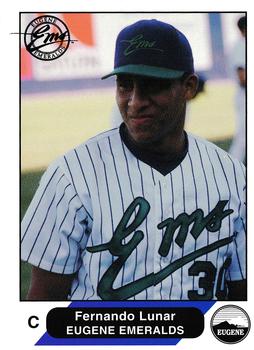
The Emeralds were led behind the plate by Mike Mahoney and Fernando Lunar. Mahoney was the better hitter, but the difference between the two was not great and both had sub .700 OPS. Mahoney would eventually get cut after the 1999 season, when he hit just .228 with Richmond. He caught on with the Cubs and made his major league debut with the Cubbies in 2000. He would stick around for the Cubs, making it back to the bigs for a 16 game run in 2002 and also played for the Cardinals in 2005, where he hit his only major league homer against Mark Prior. Lunar made it to the majors with the Braves in 2000, but was traded at the deadline to the Orioles as part of the package that brought B.J. Surhoff to the Braves. He played in 75 games with the Orioles, mostly in 2001, but appeared in his final game with the O's on April 11th, 2002. He would bang around the minors for awhile, even playing in six games for Mississippi in 2007 to close off his career. He did have a brief moment in the sun during his time with the Braves. On June 24th, 2000, Lunar was called for a "catcher's balk" while receiving a pitch from Greg Maddux where he set up behind the plate with a foot outside the catcher's box. In 363 games with the Braves, Maddux was called for just four balks.
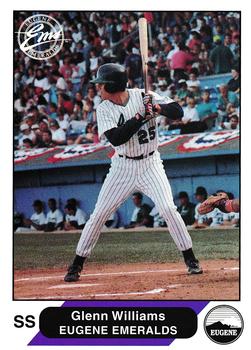
Wilt Person and Randy Hodges were the primary performers at first and second, but neither would be in the system by 1997. At third base, Brian Rust was a recent draftee from Lewis and Clark College out of Portland so he had to enjoy playing near to home. He would struggle, though he did hit 10 homers for Eugene the following season. Rust would catch on with the O's organization in 1999 and played three years for them, reaching AAA, but he never got a callup, finishing his career with a .785 OPS after 2001. At shortstop, Rob Sasser was a tenth rounder in 1993 by the Braves out of Oakland, CA. He was a slow riser, but after a brief run in Danville that I spoke of last week, Sasser headed to Eugene and was a solid everyday player for the Emeralds, slashing .269/.344/.444 with 9 HR and 14 steals. He struggled defensively as most minor league shortstops do. After a 1996 year with Macon that saw him hit .262 with 38 steals, the Angels selected him in the minor league Rule 5 draft. He wasn't there long before being used in a deal that sent Ken Hill to the Angels and Braves nemesis Jim Leyritz to the Rangers. In 1998, Sasser appeared in a 10-2 rout by the White Sox over the Rangers, hitting a popup in foul territory to former major leaguer Chad Kreuter. Sasser would play baseball until 2006, but never got back to the majors. Glenn Williams, the Australian prospect, slashed just .224/.291/.373 while playing mostly DH, though he did play a little short. Williams was ranked #76 by Baseball America before the season, but would continue a unspectacular career where he OPS'd .700 in 1260 minor league games before hanging it up after 2007. He did have a nice cup of coffee in 2005 with the Twins, though, hitting .425 in 40 AB.
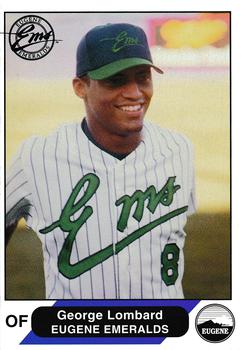
From left-to-right, the outfield was made up of George Lombard, Joe Trippy, and a platoon of Reymundo DeLeon and Roosevelt Brown. In the case of Lombard, the Braves had a five-tool prospect. A second rounder out of Lovett School in Atlanta, Lombard hit .252/.323/.351 with Eugene with 35 steals. When you add his 16 steals from Macon, Lombard finished the year with a personal best 51 steals. Lombard would climb the ladder, reaching the Baseball America Top 100 before 1997 with a high of the #26th best prospect in the game prior to 1999. However, he stagnated in AAA and injuries limited him to 32 games from the beginning of 2001 to mid-June of 2002. At that point, the Braves traded him to the Tigers. He would bounce around from there, playing for the Devil Rays, Red Sox, Nationals, Dodgers, Marlins, and Indians. He was a bust and played in just 144 games in the majors, half of which came for the Tigers after his trade in 2002. That version of the Tigers lost 106 games. Since returing after 2009, Lombard managed for two seasons in the Gulf Coast League for the Red Sox before being promoted to an outfield and baserunner coordinator in the Red Sox farm system.
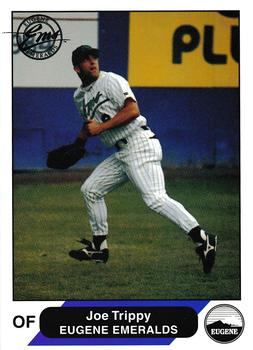
Trippy was a northwest native and undrafted free agent with range and speed. He hit .309 and stole 29 bases for Eugene. He added 48 steals in 1996 and 34 in 1997 for Durham, but couldn't hit at AA and eventually tried his hand in independent ball before ending his playing career after 2001. His season with Eugene was the only year of DeLeon's playing career. He struck out 48 times in 127 at-bats and slashed .189/.268/.260. Roosevelt Brown, a native of Mississippi, was a 20th rounder back in 1993. He slashed a brilliant .309/.366/.558 with Eugene and was hitting .278 with 19 HR with the Macon Braves in 1996 before the Braves sent him to Marlins for Terry Pendleton. After 1997, the Cubs selected him in the minor league Rule 5. He hit well with them and made it to the majors in 1999 and would go on to appear in 228 games over four years with the Cubs, hitting .251/.311/.407. The Cubs cut him after 2002 and he went to Japan, hitting .291 with 43 HR in two years with Orix. He tried to make the Braves squad in 2005, but was a spring training cut as Ryan Langerhans beat him out for the last OF spot. After a season in the White Sox system, he retired and has been a hitting coach in the Braves system.
The top starters for the Emeralds included a famous name. John Rocker, a 1993 18th rounder, started 12 games for Eugene, though he didn't pitch very well (5.16 ERA, 1.37 WHIP). Of course, he would go on to become a great reliever whose mouth got him into trouble, along with some injury issues. Charlie Cruz, a 13th rounder out of Florida State, was Eugene's best starter, striking out 90 in 81.1 ING to go with a 2.55 ERA and 1.28 WHIP. Cruz finished second in K's. Billy Blythe was historically awful in 1995. In 14 games, including 10 starts, Blythe gave up 55 runs, 41 earned, in 37.2 ING (9.80 ERA). He walked a league-leading 49 and struck out 24. He was equally wild the following season, walking 107 in 122.2 ING for Macon with 19 wild pitches. After injuries and ineffective play, Blythe was finally cut in 1999 after never making it beyond Macon.
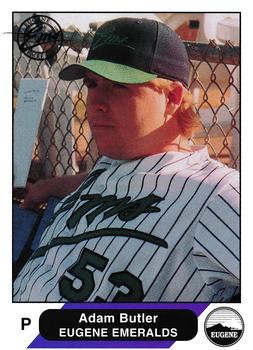
Future Brave Adam Butler was signed out of independent ball and led Eugene with 8 saves, which was three fewer than the league-lead, shared by Russ Ortiz (yep). He struck out a Kimbrel-like 50 in 25.1 ING. In 1996, the lefthander saved 30 at three different levels while nailing down 22 saves with Greenville in 1997. Butler broke camp in 1998 with the Braves, though after four games, he was demoted with a 33.75 ERA. In his final April game, he gave up a homer to future Brave, Rico Brogna. He would get a pair of callups and lowered his ERA to 10.80, but never got back to the bigs after 1998. He spent just more year in the Braves system and went back to independent ball. After 2001, he hung up the spikes. Another lefty, Antone Brooks, was stellar with the Emeralds, allowing just one earned run in 17 innings with 26 K's. He went to Macon the following season and again was very good with 101 K's in 80.1 ING to go with 10 saves. Unfortunately, injuries derailed a once promising career and after 2001, his time was done.
The Emeralds would finish 37-39, 11.5 games out of first.
Wait, we had a team in Oregon? It didn't last long. The Braves experimented with the idea of a short-season A-ball team, largely built of college draftees. In 1995, the experiment began in Eugene and lasted four years before the Braves moved their short-season squad to Jamestown, New York, but after three years, they simply dropped the extra squad, pushing up Danville as the highest short-season team before the jump to full season ball in the South Atlantic League. The Eugene squad actually replaced the Idaho Falls Braves team that existed from 1986 to 1994. The Eugene Emeralds continue to play, most recently as an affiliate of the Padres.
| Good advice. Cards used in this column credit to http://www.tradingcarddb.com/ |
The Emeralds were led behind the plate by Mike Mahoney and Fernando Lunar. Mahoney was the better hitter, but the difference between the two was not great and both had sub .700 OPS. Mahoney would eventually get cut after the 1999 season, when he hit just .228 with Richmond. He caught on with the Cubs and made his major league debut with the Cubbies in 2000. He would stick around for the Cubs, making it back to the bigs for a 16 game run in 2002 and also played for the Cardinals in 2005, where he hit his only major league homer against Mark Prior. Lunar made it to the majors with the Braves in 2000, but was traded at the deadline to the Orioles as part of the package that brought B.J. Surhoff to the Braves. He played in 75 games with the Orioles, mostly in 2001, but appeared in his final game with the O's on April 11th, 2002. He would bang around the minors for awhile, even playing in six games for Mississippi in 2007 to close off his career. He did have a brief moment in the sun during his time with the Braves. On June 24th, 2000, Lunar was called for a "catcher's balk" while receiving a pitch from Greg Maddux where he set up behind the plate with a foot outside the catcher's box. In 363 games with the Braves, Maddux was called for just four balks.
Wilt Person and Randy Hodges were the primary performers at first and second, but neither would be in the system by 1997. At third base, Brian Rust was a recent draftee from Lewis and Clark College out of Portland so he had to enjoy playing near to home. He would struggle, though he did hit 10 homers for Eugene the following season. Rust would catch on with the O's organization in 1999 and played three years for them, reaching AAA, but he never got a callup, finishing his career with a .785 OPS after 2001. At shortstop, Rob Sasser was a tenth rounder in 1993 by the Braves out of Oakland, CA. He was a slow riser, but after a brief run in Danville that I spoke of last week, Sasser headed to Eugene and was a solid everyday player for the Emeralds, slashing .269/.344/.444 with 9 HR and 14 steals. He struggled defensively as most minor league shortstops do. After a 1996 year with Macon that saw him hit .262 with 38 steals, the Angels selected him in the minor league Rule 5 draft. He wasn't there long before being used in a deal that sent Ken Hill to the Angels and Braves nemesis Jim Leyritz to the Rangers. In 1998, Sasser appeared in a 10-2 rout by the White Sox over the Rangers, hitting a popup in foul territory to former major leaguer Chad Kreuter. Sasser would play baseball until 2006, but never got back to the majors. Glenn Williams, the Australian prospect, slashed just .224/.291/.373 while playing mostly DH, though he did play a little short. Williams was ranked #76 by Baseball America before the season, but would continue a unspectacular career where he OPS'd .700 in 1260 minor league games before hanging it up after 2007. He did have a nice cup of coffee in 2005 with the Twins, though, hitting .425 in 40 AB.
From left-to-right, the outfield was made up of George Lombard, Joe Trippy, and a platoon of Reymundo DeLeon and Roosevelt Brown. In the case of Lombard, the Braves had a five-tool prospect. A second rounder out of Lovett School in Atlanta, Lombard hit .252/.323/.351 with Eugene with 35 steals. When you add his 16 steals from Macon, Lombard finished the year with a personal best 51 steals. Lombard would climb the ladder, reaching the Baseball America Top 100 before 1997 with a high of the #26th best prospect in the game prior to 1999. However, he stagnated in AAA and injuries limited him to 32 games from the beginning of 2001 to mid-June of 2002. At that point, the Braves traded him to the Tigers. He would bounce around from there, playing for the Devil Rays, Red Sox, Nationals, Dodgers, Marlins, and Indians. He was a bust and played in just 144 games in the majors, half of which came for the Tigers after his trade in 2002. That version of the Tigers lost 106 games. Since returing after 2009, Lombard managed for two seasons in the Gulf Coast League for the Red Sox before being promoted to an outfield and baserunner coordinator in the Red Sox farm system.
Trippy was a northwest native and undrafted free agent with range and speed. He hit .309 and stole 29 bases for Eugene. He added 48 steals in 1996 and 34 in 1997 for Durham, but couldn't hit at AA and eventually tried his hand in independent ball before ending his playing career after 2001. His season with Eugene was the only year of DeLeon's playing career. He struck out 48 times in 127 at-bats and slashed .189/.268/.260. Roosevelt Brown, a native of Mississippi, was a 20th rounder back in 1993. He slashed a brilliant .309/.366/.558 with Eugene and was hitting .278 with 19 HR with the Macon Braves in 1996 before the Braves sent him to Marlins for Terry Pendleton. After 1997, the Cubs selected him in the minor league Rule 5. He hit well with them and made it to the majors in 1999 and would go on to appear in 228 games over four years with the Cubs, hitting .251/.311/.407. The Cubs cut him after 2002 and he went to Japan, hitting .291 with 43 HR in two years with Orix. He tried to make the Braves squad in 2005, but was a spring training cut as Ryan Langerhans beat him out for the last OF spot. After a season in the White Sox system, he retired and has been a hitting coach in the Braves system.
The top starters for the Emeralds included a famous name. John Rocker, a 1993 18th rounder, started 12 games for Eugene, though he didn't pitch very well (5.16 ERA, 1.37 WHIP). Of course, he would go on to become a great reliever whose mouth got him into trouble, along with some injury issues. Charlie Cruz, a 13th rounder out of Florida State, was Eugene's best starter, striking out 90 in 81.1 ING to go with a 2.55 ERA and 1.28 WHIP. Cruz finished second in K's. Billy Blythe was historically awful in 1995. In 14 games, including 10 starts, Blythe gave up 55 runs, 41 earned, in 37.2 ING (9.80 ERA). He walked a league-leading 49 and struck out 24. He was equally wild the following season, walking 107 in 122.2 ING for Macon with 19 wild pitches. After injuries and ineffective play, Blythe was finally cut in 1999 after never making it beyond Macon.
Future Brave Adam Butler was signed out of independent ball and led Eugene with 8 saves, which was three fewer than the league-lead, shared by Russ Ortiz (yep). He struck out a Kimbrel-like 50 in 25.1 ING. In 1996, the lefthander saved 30 at three different levels while nailing down 22 saves with Greenville in 1997. Butler broke camp in 1998 with the Braves, though after four games, he was demoted with a 33.75 ERA. In his final April game, he gave up a homer to future Brave, Rico Brogna. He would get a pair of callups and lowered his ERA to 10.80, but never got back to the bigs after 1998. He spent just more year in the Braves system and went back to independent ball. After 2001, he hung up the spikes. Another lefty, Antone Brooks, was stellar with the Emeralds, allowing just one earned run in 17 innings with 26 K's. He went to Macon the following season and again was very good with 101 K's in 80.1 ING to go with 10 saves. Unfortunately, injuries derailed a once promising career and after 2001, his time was done.
The Emeralds would finish 37-39, 11.5 games out of first.
Subscribe to:
Posts (Atom)